The Best Air Mattresses for Camping, and the Cold They Do Not Fix
An air bed is the most comfortable thing you can lie on at a campsite and the worst thing you can lie on when it gets cold. Both of those are true at once.
An air mattress is a large volume of air with nothing to stop it moving. Your body heats the air against your back, that air circulates to the cold underside, gives its heat to the ground, and comes back. The bed is effectively a convection loop pumping your warmth into the earth all night. No air bed publishes an R-value, because there is essentially none to publish.
That is why people report being cold on an air bed at temperatures they would sleep through on a foam pad. It is not the bag failing; it is the bed actively moving heat away. The effect gets worse as the bed gets taller, because a bigger chamber convects more freely.
The fix is not a warmer sleeping bag. It is a layer of insulation between you and the air: a closed-cell foam pad, a self-inflating pad, or even a folded wool blanket on top of the bed. The mechanism is the same one in why you get cold in a sleeping bag.
Compared on published numbers
Mattress
Size
Height
Capacity
Pump
Weight
Coleman SupportRest Double-High Queen
78 x 60 in
18 in
600 lb
built in, 3 to 4 min
not published
SoundAsleep Dream Series Queen
80 x 60 in
19 in
500 lb
internal one-click, under 4 min
20 lb
Figures as published by each manufacturer.
When an air bed is the right answer
For two people car camping at a drive-up site in summer, an air bed is genuinely the most comfortable option available and it is not close. It is thicker than any pad, it is wide enough for two, and it costs a fraction of two premium self-inflating mats.
It is also the right answer for guests, for anyone with back trouble who needs a specific firmness, and for tent camping with a toddler, where 18 inches of soft surface is a feature rather than a hazard.
It is the wrong answer for cold weather, for backpacking, and for anywhere you cannot inflate it. The three-way comparison is in air mattress vs sleeping pad vs cot.
Air beds deflate overnight even when they are not leaking
Cold air contracts. A bed inflated firm at 70 F in the evening will feel soft at 45 F by 2am purely because the air inside lost volume, with no puncture involved at all. Inflate slightly firmer than feels right at bedtime, expect to top it up on cold nights, and do not assume a soft bed in the morning means a leak. Genuine leaks usually show at the seams or around the valve, and the finding-and-patching routine transfers from how to repair a sleeping pad.
Pumps, and the mistake that strands people
Built-in electric pumps are the fastest and need mains power. At a campground without hookups that means a power station or a car inverter, and a dead bed otherwise.
Rechargeable pumps avoid the power problem and add a battery to remember to charge. The ones worth owning, and the airflow figure that decides how long you stand there, are in best air pumps for camping.
12V car pumps work anywhere you can park, and mean running an extension from the vehicle.
Foot and hand pumps are slow, tiring and completely reliable. Worth carrying as a backup whatever your main pump is.
Check which type you are buying before the trip rather than at the site. An internal electric pump with no power is the single most common way a family ends up sleeping on a tent floor.
Sizing it to the tent
A queen bed is 78 to 80 by 60 in, which is 32.5 to 33 square feet. A four-person tent publishes 56 to 63 square feet, so one queen takes more than half of it. A six-person tent at 85 to 100 square feet takes two, which is why Coleman publishes a fits-two-queens figure for the Skydome 6.
Leave at least six inches between the bed and the tent wall. Bedding pressed against an inner wall wicks condensation straight into it, which is how people wake with a wet sleeping bag on a dry night — see best 6-person tents for the floor areas.
What to buy with it
A closed-cell foam pad or a wool blanket to go on top, because that is the insulation the bed does not have. A vinyl patch kit for the puncture that eventually happens. And a manual backup pump.
Which to buy: the Coleman SupportRest if you want the highest capacity rating and the simplest setup, and the SoundAsleep Dream Series if your complaint about air beds is that they sag in the middle. Add the insulating layer either way.
The picks in full
1. Best overall
Coleman SupportRest Double-High Queen Airbed
Coleman
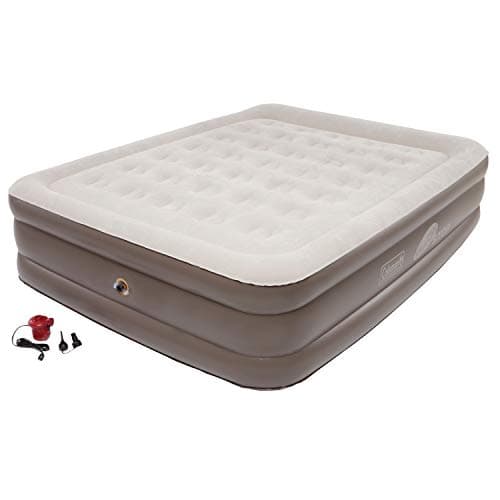
18 in of double-high bed at 78 by 60 in, rated to 600 lb, inflating in about three to four minutes.
Coleman publishes a 78 by 60 by 18 in size, a 600 lb capacity, a built-in pump and an inflation time of about three to four minutes.
Six hundred pounds is the specification worth noting. Air bed capacity ratings are a proxy for seam construction and material thickness, and a bed rated well above the load it carries is one that does not stretch into a hammock over a season.
The drawback
78 by 60 in is 32.5 square feet of tent floor, which fills most of a four-person tent, and Coleman does not publish a weight for it.
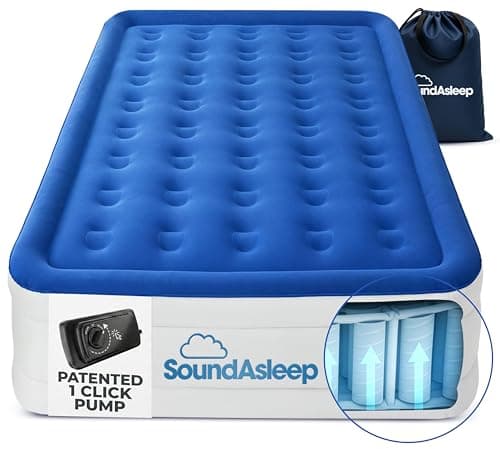
40 internal air coils under a 19 in queen rated to 500 lb, with a one-click pump reaching full inflation in under four minutes.
SoundAsleep publishes an inflated size of 80 by 60 by 19 in, a weight of 20 lb, a 500 lb capacity, an internal one-click pump reaching full inflation in under four minutes, 40 internal air coils, and a flocked top with a SureGrip bottom.
The coil count is what separates a bed that stays flat from one that bulges in the middle. Internal baffles tie the top and bottom sheets together; more of them means the surface stays closer to level under a body rather than ballooning.
The drawback
20 lb and an internal electric pump, which means it needs mains power or a power station at the site. A campground without hookups makes this a problem.
Because the air inside circulates. Your body warms the air against your back, it moves to the cold underside, gives its heat to the ground and returns. Air beds publish no R-value because they have essentially none. Put a foam or self-inflating pad on top.
QWhy does my air mattress go flat overnight?
Usually contraction rather than a leak. Cold air takes up less volume, so a bed inflated firm at 70 F feels soft at 45 F with no puncture at all. Inflate slightly firmer at bedtime and expect to top it up on cold nights.
QWill an air mattress fit in my tent?
A queen is 78 to 80 by 60 in, about 33 square feet. A four-person tent publishes 56 to 63 square feet, so one queen takes more than half. Leave six inches to the tent wall, or bedding wicks condensation off the inner.
QWhat kind of pump should a camping air mattress have?
Built-in electric pumps are fastest and need mains power, which a campground without hookups does not have. Rechargeable and 12V car pumps avoid that. Carry a manual foot or hand pump as a backup whatever the main pump is.
How we picked
Everyone else in this category will tell you they tested twenty of these. We have not tested any of them, and we would rather say so than pretend. There is no gear closet here and no test lab.
What we did instead: pulled the published specifications from each manufacturer's own spec sheet or manual, named the standard behind every rating so you can check what it actually promises, did the arithmetic that turns a spec into a decision, and pulled today's real retail price rather than quoting one from memory. Every pick states a drawback, because a list where nothing is wrong with anything is an advert.
The limits of that method, stated plainly: published specs do not capture zipper quality, seam durability, or how a tent behaves at 2am in a storm. Where that matters, we say so on the pick. The full method is here.