The Best Air Pumps for Camping, Where Airflow and Pressure Do Different Jobs
Every pump is sold on how small it is. The two numbers that decide whether your bed is inflated before you lose patience are on the spec sheet, and neither one is on the front of the box.
Airflow in liters per minute is how fast a pump moves air. Pressure in kPa is how hard it can push at the end. A sleeping pad is a small volume that needs to end up firm; a queen air bed is an enormous volume that needs very little pressure. Buy for the one you actually own, because a pump that is excellent at one is mediocre at the other.
Almost every listing in this category leads with battery capacity and a photograph of something tiny. Neither tells you how long you will be standing in a field holding it. The two figures that do are published by the brands that publish anything at all, and the gap between 180 and 500 L/min is the difference between a pad and a bed.
What to look for
Specification
What to want
Why
Airflow (L/min)
400+ for a queen air bed; 150+ is plenty for a pad
volume is what makes a big inflatable slow
Pressure (kPa)
4 kPa or more
pressure is what makes the last ten percent firm rather than squishy
Pump runtime
longer than the job, with margin
a pump that dies mid-bed leaves you finishing it by mouth
Nozzle fit
a nozzle that matches the valve you own
the single commonest reason a pump turns out to be useless
Deflation
yes, ideally at the same pressure
packing down is half the work and most of the valve damage
Charge port
USB-C
one cable for the pump, the headlamp and the phone
What decides whether a pump suits your gear, rather than how small it looks.
Nozzle fit deserves the emphasis. Camping valves are not standardized: a flat Boston valve on an air bed, a twist-lock on an inflatable pad, a multi-function valve on a Sea to Summit mat and a dump valve on a pool float are four different shapes. Count the nozzles a pump ships with and check one of them is yours before anything else on this page matters.
Compared on published numbers
Pump
Airflow
Pressure
Weight
Runtime
Light
FLEXTAIL Tiny Pump 2X
180 L/min
4 kPa
3.5 oz
max 30 min
230 lm, 24 h
FLEXTAIL Max Pump 3
500 L/min
5 kPa
4.3 oz
max 60 min
3 levels, up to 11 h
Sea to Summit Air Stream
not published
not published
1.7 oz
unlimited
none
Figures as published by each manufacturer.
The blank cells are not an oversight. A pump sack has no meaningful airflow rating because the rate is however fast you can roll it, and it has no pressure rating because the pressure is your arms. What it has instead is a runtime that never ends, which is why it is on this page at all.
Your air bed may already have a pump
Both air mattresses this site recommends inflate themselves — the Coleman SupportRest and the SoundAsleep Dream Series both have an internal pump, and the SoundAsleep publishes full inflation in under four minutes. If that is your bed, you do not need anything on this page to go camping. You might still want one: internal pumps are the component that fails first, they need mains power on most models, and none of them will inflate a pad, a kayak or a pool float. The comparison that decides which bed you should own in the first place is air mattress vs sleeping pad vs cot.
Runtime is the specification that bites
Battery capacity is quoted in watt-hours or milliamp-hours and tells you almost nothing useful, because the draw depends on the motor. What you want is the figure FLEXTAIL actually publishes: maximum pump runtime. Thirty minutes on the Tiny Pump 2X and sixty on the Max Pump 3 are the numbers that decide whether a pump finishes the weekend.
Thirty minutes sounds like plenty, and for pads it is — a pad takes well under a minute. The problem is arithmetic across a trip: two pads, twice a day, four days, plus the deflation runs, and you are using the same charge for the lantern mode as well. A pump that charges over USB-C is a pump you can top up from the power bank you already carry, which is the real fix and costs nothing extra.
Pads, beds and the pressure difference
An inflatable sleeping pad holds a few liters and needs to be firm enough to keep your hip off the ground, so pressure matters and volume does not. A queen air bed holds a very large number of liters at low pressure, so volume matters and pressure does not. This is why one pump cannot be optimal for both, and why the pad-versus-pad distinctions in inflatable vs self-inflating sleeping pads change what you should buy here: a self-inflating mat only needs topping off, which a pump sack does perfectly and an electric pump does with a tap.
One honest caution on firmness. A pad inflated rock-hard is less comfortable and conducts more heat, not less, because you are compressing the air and the insulating structure together. Fill it until it holds your weight without bottoming out, then let a little back out. The thermal side of that is in sleeping pad R-value explained.
Which to buy
Buy the FLEXTAIL Tiny Pump 2X if you sleep on pads, or if you want one small thing that inflates everything you own and doubles as a lantern. It is the default recommendation here and the one most people should stop reading at.
Buy the FLEXTAIL Max Pump 3 if the inflatable is big — a queen air bed, a raft, a family-size pool toy. Five hundred liters a minute and an hour of runtime are the two reasons, and on a pad they are both wasted.
Buy the Sea to Summit Air Stream Pump Sack if you are carrying your kit, if you own Sea to Summit mats, or if you would rather not have one more battery in the tent. It is also the only one of the three that cannot let you down on night four, which on a long trip is worth more than airflow. If you are assembling the rest of the sleep system around it, start at best sleeping pads for car camping and add the pump last.
The picks in full
1. Best overall
FLEXTAIL Tiny Pump 2X
FLEXTAIL
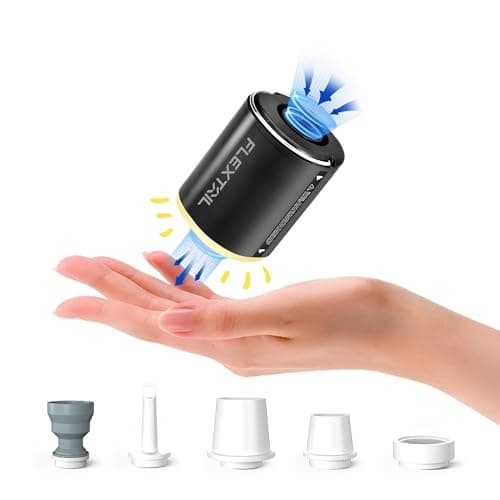
180 L/min at 4 kPa from a 3.5 oz body that also runs as a 230 lumen lantern for 24 hours.
FLEXTAIL publishes 180 L/min of airflow, 4 kPa (0.58 PSI) of pressure, a 3.5 oz (100 g) weight, a 1.8 by 1.7 by 2.3 in body, a 5.92 Wh battery charged over USB-C, a maximum pump runtime of 30 minutes, five nozzles, an IP44 rating, and a lantern mode at 230, 120 or 30 lumens giving 24 hours of light.
The reason this wins is that it is the only item here you will carry without thinking about it. Three and a half ounces is less than a full water bottle cap of inconvenience, and because it also replaces a small lantern, the honest weight cost of adding it to your kit is close to zero. For anyone whose bed is a sleeping pad rather than an air bed, this is simply the answer.
It deflates as well as inflates, which matters more than people expect. Getting the last of the air out of a pad by kneeling on it is how valves get stressed and how pads end up needing a repair at the valve.
The drawback
Max 30 minutes of pump runtime per charge, and 4 kPa is 0.58 PSI. That is enough for a pad and adequate for an air bed, but it is not the tool for filling a queen in a hurry.
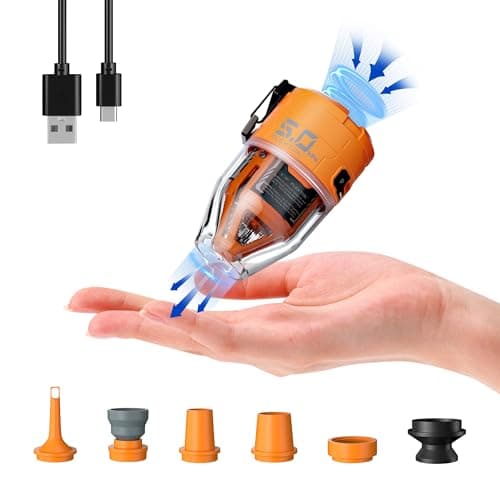
500 L/min at 5 kPa in both directions, with 60 minutes of runtime and six nozzles, at 4.3 oz.
FLEXTAIL publishes 500 L/min of airflow, 5 kPa of pressure for both inflation and deflation, a 4.3 oz (122 g) weight, a 3.3 by 1.9 by 1.9 in body, a 7.215 Wh battery, a maximum pump runtime of 60 minutes, six nozzles, and a light with three brightness levels running up to 11 hours on low.
Five hundred against 180 L/min is the entire argument. Airflow is what empties the clock on a large inflatable, and a queen air mattress is a genuinely large volume of air. Doubling the runtime at the same time is the other half of it: a pump that stops halfway through the bed is worse than no pump, because now you are finishing it by mouth.
Buy this one if the thing you inflate is big. If it is a pad, you are paying extra for airflow you cannot use and a shorter light.
The drawback
Noticeably more expensive than the Tiny Pump 2X for the same job on a pad, and its light runs up to 11 hours against the Tiny Pump's 24. On a sleeping pad, 500 L/min is easy to overshoot.
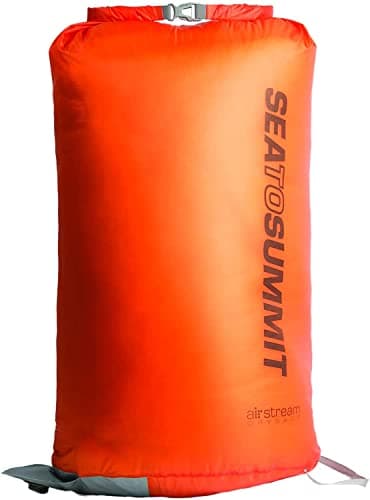
A 1.7 oz 20 L dry bag that inflates an Air Sprung Cell mat in two or three compressions and has no battery to flatten.
Sea to Summit publishes a 20 L volume, a 1.7 oz (48 g) weight, 15D Ultra-Sil siliconized nylon with a polyurethane inner coating, a 1,200 mm hydrostatic head, a flat size of 27 by 1 by 17 in and an in-use size of 25 by 8 by 10 in, and inflation in two or three compressions for its Air Sprung Cell mats, with a top-off function for self-inflating mats.
It is a dry bag that becomes a pump, which is the reason to own one: it is not an extra item, it is an item you were already carrying doing a second job. Storage by day, inflation at night, and nothing that can be dead when you need it on night four.
The sideways benefit is dryness. A pad inflated by lung power collects the moisture in your breath, and the longer that goes on the worse it gets, which is covered properly in backpacking sleeping pads. A pump sack fills the pad with ambient air instead, for 48 grams and no electronics.
The drawback
The multi-function valve fit is for Sea to Summit mats, so other brands need an adapter, and no realistic number of compressions fills a queen air bed. It also costs more than the Tiny Pump 2X.
Published specs
Volume
20 L
Weight
1.7 oz (48 g)
Fabric
15D Ultra-Sil siliconized nylon, PU inner coating
Hydrostatic head
1,200 mm
Flat
27 x 1 x 17 in (69 x 3 x 43 cm)
In use
25 x 8 x 10 in (63 x 20 x 26 cm)
Inflation
two or three compressions for an Air Sprung Cell mat
QDo I need an air pump if my air mattress has a built-in pump?
Not to go camping. A built-in pump is the simplest answer and the SoundAsleep Dream Series publishes full inflation in under four minutes. A separate pump earns its place when the internal one fails, when you need to inflate something that is not the bed, such as a sleeping pad or a pool float, or when there is no mains power at the site.
QWhat size air pump do I need for a queen air mattress?
Buy on airflow rather than battery size. A queen air bed is a large volume at low pressure, so aim for several hundred liters per minute: FLEXTAIL publishes 500 L/min for the Max Pump 3 against 180 L/min for the Tiny Pump 2X, and that gap is most of the difference in how long you stand there holding it.
QCan I use an electric air pump on a sleeping pad?
Yes, and it is better for the pad than mouth inflation because it keeps the moisture in your breath out of the inside. Go gently on the last few seconds: a pad wants to be firm enough not to bottom out, not rock hard, and a 500 L/min pump will overshoot that in a moment.
QIs a pump sack better than a rechargeable pump?
It is better at never running out and at weighing nothing, which makes it the backpacking answer. It is worse at large volumes, since no realistic number of compressions fills a queen air bed, and the Sea to Summit multi-function fit means other brands of mat need an adapter.
How we picked
Everyone else in this category will tell you they tested twenty of these. We have not tested any of them, and we would rather say so than pretend. There is no gear closet here and no test lab.
What we did instead: pulled the published specifications from each manufacturer's own spec sheet or manual, named the standard behind every rating so you can check what it actually promises, did the arithmetic that turns a spec into a decision, and pulled today's real retail price rather than quoting one from memory. Every pick states a drawback, because a list where nothing is wrong with anything is an advert.
The limits of that method, stated plainly: published specs do not capture zipper quality, seam durability, or how a tent behaves at 2am in a storm. Where that matters, we say so on the pick. The full method is here.