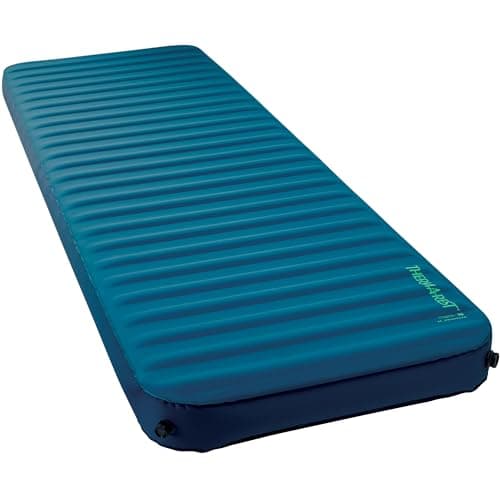
Therm-a-Rest MondoKing 3D
Therm-a-Rest
R 7.0 at 4.25 in thick. The car-camping mattress, at 4 lb 6 oz.
$289.95 · Check price on Amazon
#ad how this is funded · price as of October 23, 2026
The three pad types fail in three different ways. Pick the failure you can live with, because that is really what you are choosing between.
Trail & Tarp earns a commission from qualifying purchases made through links on this page, at no extra cost to you. Full disclosure.
The short answer
Self-inflating pads are the comfortable, warm, heavy choice for car camping. Pure air pads are the light, packable choice for carrying, and they puncture. Closed-cell foam is the indestructible choice that is thin and bulky. Weight, comfort, durability — pick two.
All three do the same job, which is not cushioning: it is stopping the ground conducting your body heat away all night. That is what R-value measures, and it matters more than the bag rating — see R-value explained.
| Therm-a-Rest MondoKing 3D | Klymit Static V Base | Therm-a-Rest Z Lite Sol | |
|---|---|---|---|
| Type | self-inflating | inflatable, uninsulated | closed-cell foam |
| R-value | 7.0 | 1.3 (ASTM) | 2.0 |
| Thickness | 4.25 in | 2.5 in | 0.75 in |
| Size | 77 x 25 in (large) | 72 x 23 in | 72 x 20 in |
| Weight | 4 lb 6 oz (large) | 18.7 oz / 530 g | 14 oz |
| Packs to | not published | 8 x 3 in | folds, does not compress |
Read the R-value column against the weight column and the whole category makes sense. The MondoKing gives you 7.0 for 4 lb 6 oz. The Z Lite Sol gives you 2.0 for 14 oz. The Static V Base gives you 1.3 for 18.7 oz — less warmth than the foam for more weight, which tells you it is bought for comfort and packability rather than insulation.
Open a valve and the compressed foam inside expands, pulling air in. A few breaths tops it off. The foam is what makes these warm: it is insulation in its own right, so the pad works even before you add air, and it does not rely on trapped air alone.
That is also why they are heavy and why they never pack as small as an air pad. A MondoKing at 4.25 in thick and 4 lb 6 oz is a mattress, and it is the right answer in a car where nobody carries anything. The comfort gap over a 2.5 in air pad is not subtle, especially for side sleepers — best sleeping pads for side sleepers.
No foam, just baffled chambers you inflate. They pack to the size of a water bottle — Klymit publishes 8 by 3 in — and the good insulated ones reach high R-values with reflective films rather than bulk.
The trade is that a hole ends the night. Not the trip, if you carry a patch kit and know how to find the leak, but the night. They are also noisy, and they feel unstable if the pressure is too high — most people over-inflate air pads badly.
The Static V Base is the uninsulated end of this type: R 1.3 makes it a summer pad, which Klymit is upfront about. Repair technique is in how to repair a sleeping pad.
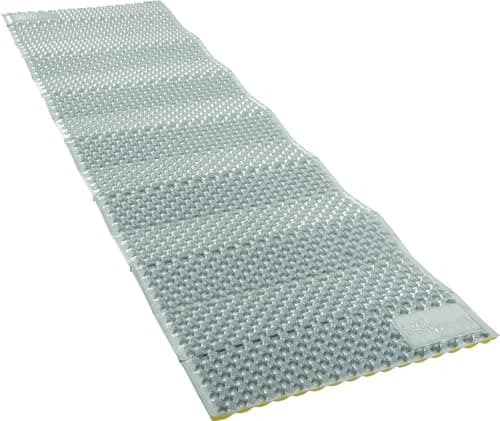
A folded sheet of dense foam. It cannot puncture, cannot deflate, needs no inflation and costs the least. At R 2.0 and 14 oz the Z Lite Sol beats the Static V Base on warmth and weight both.
What it cannot do is be comfortable. Three-quarters of an inch of foam over a root is three-quarters of an inch of foam over a root. And it does not compress, so it rides strapped to the outside of a pack.
Stack a foam pad under an air pad and you get both
R-values are additive. A Z Lite Sol at R 2.0 under a Static V Base at R 1.3 gives you about R 3.3 — a genuine three-season setup from two cheap pads. It also means a puncture downgrades your night rather than ending it, because the foam is still there. This is what a lot of experienced campers actually carry, and it is cheaper than one high-R pad.
Over-inflating. A pad pumped hard is a drum: your hips and shoulders sit on top of the pressure rather than sinking into it, and you wake up sore having blamed the pad's thickness.
Inflate until firm, then let a little out until your hip just fails to touch the ground when you lie on your side. That single adjustment does more for comfort than moving up a pad category, and it is easier to judge with a pump than with your lungs — see best air pumps for camping.
| If this is you | Buy |
|---|---|
| Car camping, comfort first | self-inflating, the thicker the better |
| Backpacking, three-season | an insulated air pad |
| Backpacking on a budget, summer only | closed-cell foam |
| Cold ground, any activity | highest R-value you can carry, or stack two |
| You hate fiddling with gear | closed-cell foam; unroll and done |
| Side sleeper | self-inflating or a thick air pad, never foam alone |
For a household buying once, a thick self-inflating pad is the purchase people regret least, and the foam pad is the cheap second item that makes cold nights and punctures survivable. The roundups are in best sleeping pads for car camping and best backpacking sleeping pads.
Therm-a-Rest
R 7.0 at 4.25 in thick. The car-camping mattress, at 4 lb 6 oz.
#ad how this is funded · price as of October 23, 2026
Klymit
18.7 oz packing to 8 x 3 in, R 1.3. Packable and summer-only.
Therm-a-Rest
R 2.0 at 14 oz and cannot puncture. Also the best thing to stack under an air pad.
#ad how this is funded · price as of October 23, 2026
A self-inflating pad contains open-cell foam that expands and pulls air in when you open the valve, and that foam insulates on its own. A pure air pad is baffled chambers you inflate, with no foam, so it packs far smaller and weighs less but punctures and relies on trapped air for warmth.
Generally yes, because the foam inside is insulation in addition to the trapped air. Therm-a-Rest publishes R 7.0 for the MondoKing 3D against Klymit's R 1.3 for the uninsulated Static V Base, though insulated air pads with reflective films can reach high R-values too.
Yes, and R-values add. A closed-cell foam pad at R 2.0 under an air pad at R 1.3 gives roughly R 3.3, which is a real three-season setup from two inexpensive pads. It also means a puncture costs you comfort rather than the whole night.
Almost always over-inflation. A hard pad makes your hips and shoulders ride on top of the pressure instead of sinking in. Inflate until firm, then release air until your hip just stops touching the ground when you lie on your side.
Every figure on this page comes from a published source. We have not tested this gear, so the numbers are the manufacturer's or the standard body's, not ours. How we research.