A cot is colder than the ground, not warmer. Being suspended means moving air passes underneath you all night and carries heat away by convection, and the thin fabric of the bed does nothing to stop it. The fix is a sleeping pad on top of the cot, with a real R-value. Without one, a cot is a summer-only piece of furniture.
This surprises people because a cot solves the two most obvious ground problems — lumps and standing water — so it feels like an upgrade in every direction. It is not. On the ground, the ground itself is a poor conductor and your body warms a small patch of it over the night. On a cot, air moves continuously under the fabric and never warms up, which is the same reason an airbed is cold.
Cot
Sleeping surface
Height
Capacity
Weight
Coleman ComfortSmart Deluxe
80 x 30 in
15 in
300 lb
About 24.7 lb
Coleman Trailhead II
75 x 25 in
17 in
300 lb
Not published
TETON Outfitter XXL
80 x 35.5 in
19.5 in
600 lb
26 lb
All figures as published by the manufacturers.
Measure your tent before you buy a cot
This is the mistake that gets made most often, and it is unrecoverable once the box is open. A cot is rigid: unlike a sleeping pad it cannot be shuffled into a slightly-too-small space, and unlike an airbed it cannot be underinflated to fit. The TETON is 86 in long in use, which exceeds the wall-to-wall length of several popular six-person tents.
Sloped walls are the second trap. A dome tent's usable floor at cot height — 15 to 19.5 in off the ground — is significantly smaller than its floor area, because the walls lean in. A cabin tent with near-vertical walls such as the Eureka Copper Canyon takes cots far better than a dome with the same published square footage.
Where the cold really comes from
Do not solve a cold cot with a warmer sleeping bag. A bag is rated on the assumption that it is used on an insulating surface, and the insulation underneath you is crushed flat by your body weight regardless of how good the bag is. Put a pad with a stated R-value on the cot: an R-value around 2 covers summer, 3 to 4 covers spring and autumn. The measurement method is ASTM F3340-18, and it is explained in sleeping pad R-value explained.
Who a cot is genuinely right for
People who struggle to get up off the floor. This is the strongest case and the one that keeps people camping into later life. Fifteen to nineteen inches is roughly chair height, and standing up from a cot is a normal movement rather than a project.
Rough, rocky or wet pitches. A cot ignores what is underneath it, which is why they are standard on gravel pads and hard-packed sites where a pad finds every stone.
Anyone who wants the space underneath. A cot converts the floor beneath it into storage. In a tent shared by four people that is a meaningful amount of order.
Not backpackers, and usually not couples. These weigh 25 lb and pack to the size of a golf bag. And two single cots is two single beds — if sleeping next to each other matters, a double airbed or two wide pads is the better answer.
What to expect the first night
Cots creak. Steel frames on uneven ground move slightly with every turn, and the fabric stretches over the first few nights before it settles. Setting all four feet on solid, level ground helps more than anything else, and a scrap of foam or an offcut of carpet under each foot both quiets it and stops the feet sinking into soft ground — or punching through the tent floor, which is the other thing nobody warns you about.
Then add the pad, a proper pillow, and a bag rated for the temperature rather than the season, and a cot becomes the closest thing to a real bed that fits in a car. The category comparison, if you are still deciding, is air mattress vs sleeping pad vs cot.
The picks in full
1. Best all-round camping cot
Coleman ComfortSmart Deluxe Cot
Coleman
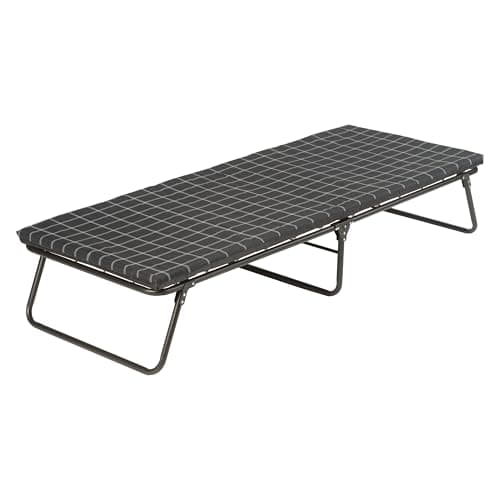
80 x 30 in at 15 in high with a 300 lb capacity, and a foam mattress included rather than sold separately.
Coleman publishes 80 x 30 x 15 in, a 300 lb capacity, a weight of about 24.7 lb, a fit for people up to 6 ft 6 in, and an included foam mattress.
The 6 ft 6 in figure is the reason it leads. Most cots are built to a 75 in frame, which leaves anyone over about six foot with their heels hanging off the end — a genuinely uncomfortable way to spend a night and the single most common complaint about cots. An 80 in sleeping surface removes it.
The included pad also saves the classic mistake of buying a cot, sleeping on bare fabric over a steel frame, and concluding that cots are uncomfortable. It is thin, and you will still want a sleeping pad on top in anything but summer, but it means the cot works out of the box.
The drawback
24.7 lb and it does not fold small. The included foam is thin comfort padding, not insulation, which is a distinction that matters below about 60 F.
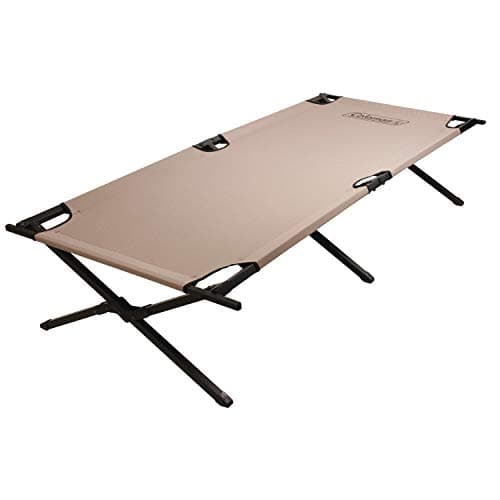
75 x 25 in at 17 in high on a steel cross-bar frame, rated to 300 lb and folded flat for a car trunk.
Coleman publishes 75 x 25 x 17 in, a 300 lb capacity, a fit for people up to 6 ft 2 in, steel cross-bar construction, and a fold that fits most car trunks.
The narrow footprint is the point rather than a compromise. Two 30 in cots do not fit side by side in most four-person tents; two 25 in cots do, with room to walk. If your tent is the constraint — and in a correctly sized tent it usually is — the narrow cot is the one that actually works.
17 in of height is also more than the ComfortSmart, which sounds trivial and is not: the gap under a cot is usable storage for boots and bags, and it is the difference between a tidy tent and one where everything lives on the floor.
The drawback
25 in wide is genuinely narrow, and the 6 ft 2 in height limit rules out a lot of adults. No pad included.
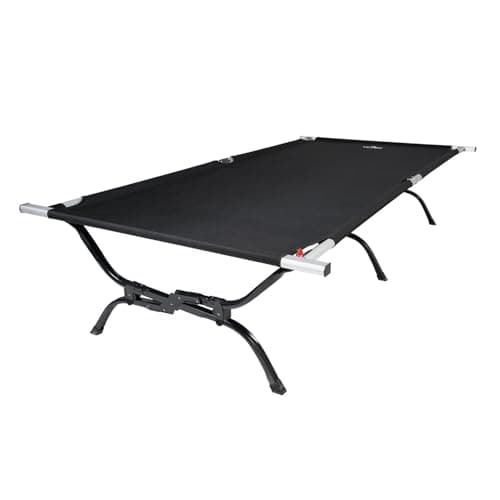
An 80 x 35.5 in sleeping surface on an aluminum frame rated to 600 lb, at 19.5 in high.
TETON publishes in-use dimensions of 86 x 45 x 19.5 in, an 80 x 35.5 in sleeping surface, a 600 lb capacity, a 26 lb weight, a folded size of 42 x 12 x 7 in, an aluminum frame with 600D polyester canvas, a patented steel S-leg design and a pivot arm to lever the final end bar into place.
Double the capacity of the two Colemans, and five and a half inches wider. Capacity ratings on cots are not a comfort promise but they are a good proxy for frame stiffness, and a 600 lb frame flexes less under anyone, which is what stops the mid-night sag that makes cheap cots feel like hammocks.
The pivot arm addresses the one universally hated part of owning a cot. Tensioning the last bar on a taut camp bed normally requires either brute force or trapped fingers, and a lever that does it for you is a real quality-of-life feature. Check your tent's floor dimensions before buying: 86 in in use is longer than some tent walls.
The drawback
26 lb and 86 in long in use, which will not fit in every six-person tent. Folded, it is still 42 in long.
QAre camping cots warmer than sleeping on the ground?
No, colder. Air moves freely under a suspended cot all night and carries heat away, while the ground at least warms slightly beneath you. Put a sleeping pad with a real R-value on top of the cot to fix it.
QWhat size camping cot do I need?
Match it to your height and your tent. Coleman publishes a 6 ft 6 in fit for the ComfortSmart Deluxe and 6 ft 2 in for the Trailhead II. Also check your tent's floor at cot height, because sloped dome walls reduce the usable space well below the published floor area.
QDo you need a mattress on a camping cot?
For comfort in summer, a thin pad or the included foam is enough. For warmth in any cooler weather you need a pad with a stated R-value, because bare cot fabric provides essentially no insulation against the air moving underneath.
QWill a camping cot damage my tent floor?
It can. Cot feet concentrate weight on small points and can punch through or abrade a tent floor, especially on hard ground. Put a scrap of foam or carpet under each foot, which also quiets the creaking and stops the feet sinking into soft ground.
How we picked
Everyone else in this category will tell you they tested twenty of these. We have not tested any of them, and we would rather say so than pretend. There is no gear closet here and no test lab.
What we did instead: pulled the published specifications from each manufacturer's own spec sheet or manual, named the standard behind every rating so you can check what it actually promises, did the arithmetic that turns a spec into a decision, and pulled today's real retail price rather than quoting one from memory. Every pick states a drawback, because a list where nothing is wrong with anything is an advert.
The limits of that method, stated plainly: published specs do not capture zipper quality, seam durability, or how a tent behaves at 2am in a storm. Where that matters, we say so on the pick. The full method is here.