Match the sleeping surface to your height plus about four inches, and buy a weight capacity with real headroom above your body weight — a cot at its stated limit flexes, sags in the middle and creaks all night even though it has not failed. Standard cots are 75 by 25 in and rated to 300 lb; the oversized ones run 80 to 84 in long, 33 to 35.5 in wide, and 400 to 600 lb.
Capacity is where people under-buy. A stated 300 lb limit is a structural rating, not a comfort one. At 280 lb on a 300 lb cot the frame is within its specification and the fabric still hammocks, which puts your hips lower than your shoulders and your spine in a curve. The practical rule is to leave at least 100 lb of margin, and more if two people ever sit on the edge of it.
Length is where people mis-measure. Cot listings quote two different figures: the frame length and the sleeping surface. TETON publishes an 86 in overall length and an 80 in sleeping surface, a six-inch difference entirely taken up by the frame ends. Read the sleeping surface.
Compared on published figures
Cot
Sleeping surface
Capacity
Height
Weight
Folded
TETON Outfitter XXL
80 x 35.5 in
600 lb
19.5 in
26 lb
42 x 12 x 7 in
Kamp-Rite Oversize Kwik-Cot
84 x 33 in
400 lb
21 in
23 lb
41 x 7 x 7 in
Coleman ComfortSmart Deluxe
80 x 30 in
300 lb
15 in
about 24.7 lb
not published
Coleman Trailhead II
75 x 25 in
300 lb
17 in
not published
folds flat
Figures as published by each manufacturer.
A cot is a comfort device, not a warmth device
Getting off the ground removes conduction, which is the biggest heat loss route when you are lying on it. It replaces that with convection: air now moves freely under you on all sides, and the fabric bed itself has essentially no R-value. On a warm night that is a feature. On a 45 F night it is why people describe cots as cold.
The fix is a pad on top, and it does not need to be an expensive one, because the cot has already solved the hard-ground problem. A closed-cell foam pad at R 2.0 is enough for summer; a self-inflating pad for shoulder season. The same argument at length is in air mattress vs sleeping pad vs cot.
Measure the tent before you measure yourself
An oversized cot in use is 86 by 45 in, which is 27 square feet of tent floor. A 4-person tent typically publishes 56 to 64 square feet, so one cot takes nearly half of it and two will not fit alongside each other in most of them. Also check headroom: a 21 in cot inside a tent with a 54 in peak leaves 33 inches to sit up in. Sizing the tent around the cot is covered in what size tent do I need.
What fails, and what that tells you
Cots fail in three places, and knowing which tells you what to inspect on a used one or expect on a cheap one. The fabric tears at the corner grommets where tension is highest. The end bars bend if the frame is thin-wall steel. And the leg feet punch through the tent floor, which is not a cot failure but is the most common actual damage.
A set of cot foot pads or squares of carpet under the legs solves the last one for a few dollars and is the most worthwhile accessory in the category. If you are inspecting a secondhand cot, put your full weight on one end and watch the corner grommets rather than the middle.
Which to buy
Over 300 lb, buy the TETON Outfitter XXL — the capacity margin is the whole point and 35.5 in is the widest surface here. Over 6 ft 4 in but under 400 lb, the Kamp-Rite Oversize Kwik-Cot is longer and sits higher. Under 300 lb and up to 6 ft 6 in, the Coleman ComfortSmart Deluxe arrives with the pad problem already solved.
If none of these fit the tent, the honest answer may be a thick pad on the floor instead. The standard-size options are in best camping cots, and the pads that work under concentrated weight are in best sleeping pads for car camping.
The picks in full
1. Best overall
TETON Sports Outfitter XXL Cot
TETON Sports
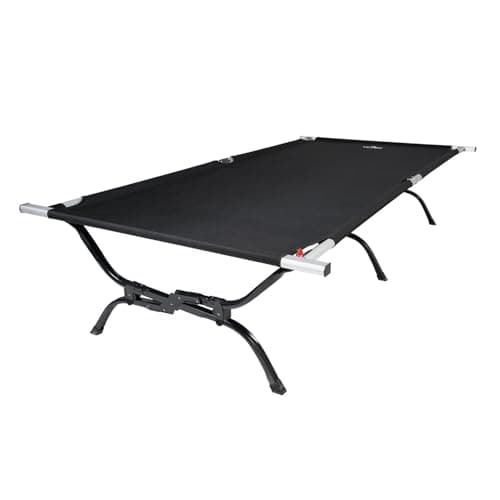
An 80 by 35.5 in sleeping surface rated to 600 lb, standing 19.5 in off the ground.
TETON publishes a 600 lb capacity, an 86 by 45 by 19.5 in size in use, an 80 by 35.5 in sleeping surface, a 26 lb weight and a 42 by 12 by 7 in folded size.
Thirty-five and a half inches of width is what separates this from an ordinary cot. Standard cots run 25 to 30 in, which is narrower than a twin bed, and a larger camper spends the night aware of both edges. At 35.5 in there is room to turn over.
The drawback
26 lb and an 86 by 45 in footprint in use. That is a large object inside a tent, and it needs a 10-foot floor to sit alongside anything else.
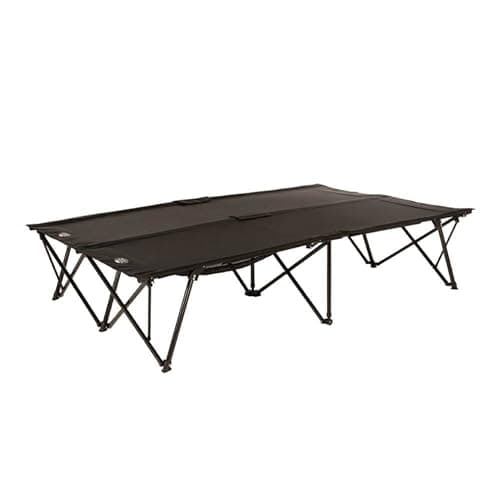
An 84 by 33 in sleeping surface at 21 in high, with a padded head area and side storage pockets.
Kamp-Rite publishes an 84 by 33 in sleeping surface, a 21 in height, a 400 lb capacity, a 23 lb weight, a 41 by 7 by 7 in folded size, a steel frame, 600 denier fabric with a padded head area, side storage pockets and a carry case.
Eighty-four inches is seven feet of cot, which handles a 6 ft 6 in camper with clearance at both ends. The 21 in height is the tallest here, and that is a real ergonomic advantage: sitting on the edge of a 21-inch cot to put boots on is a normal chair height.
The drawback
400 lb capacity, which is 200 lb below the TETON, and 23 lb of steel that folds to a 41-inch bundle rather than anything compact.
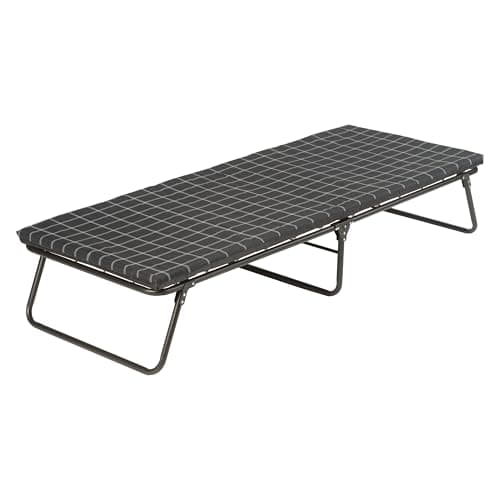
80 by 30 in at 15 in high with a foam mattress in the box, rated to 300 lb and fitting to 6 ft 6 in.
Coleman publishes an 80 by 30 by 15 in size, a 300 lb capacity, about 24.7 lb of weight, a fits-to height of 6 ft 6 in and an included foam mattress.
The included mattress is the reason it is here. A bare cot has almost no insulation value, so most cots need a pad bought separately; this one arrives ready. If you are under 300 lb and over six feet, it is the least fuss in the group.
The drawback
300 lb capacity rules it out for a lot of the people reading this page, and 30 in of width is standard rather than generous.
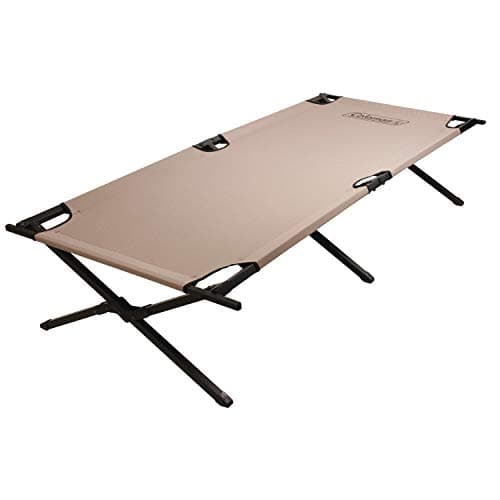
75 by 25 in at 17 in high, rated to 300 lb, on a steel cross-bar frame that folds flat.
Coleman publishes a 300 lb capacity, a 75 by 25 by 17 in size, a fits-to height of 6 ft 2 in and a steel cross-bar frame that folds flat for a car trunk.
It is in this comparison as the baseline. Every dimension here is what a standard cot gives you, and the gap between 75 by 25 in and 84 by 33 in is exactly what “big and tall” means in this category.
The drawback
75 inches fits to 6 ft 2 in and no further, and 25 in is the narrowest surface here. This is the cot a big or tall camper buys for a guest, not for themselves.
Leave at least 100 lb of margin above your body weight. A stated limit is a structural rating, not a comfort one: at 280 lb on a 300 lb cot the fabric hammocks and puts your hips below your shoulders even though the frame is within specification.
QHow long a cot does a tall camper need?
Your height plus about four inches of sleeping surface, and read the sleeping surface rather than the frame length. TETON publishes an 86 in overall length against an 80 in sleeping surface; the six-inch difference is frame.
QAre camping cots cold to sleep on?
Yes, without a pad. A cot removes conduction to the ground and replaces it with air moving freely underneath you, and the fabric bed has essentially no R-value. A closed-cell foam pad at R 2.0 fixes it for summer.
QWill an oversized cot fit in my tent?
Check both the floor and the height. An oversized cot occupies about 27 square feet in use, nearly half of a 4-person tent's floor. A 21 in cot under a 54 in peak also leaves only 33 inches of sitting-up room.
How we picked
Everyone else in this category will tell you they tested twenty of these. We have not tested any of them, and we would rather say so than pretend. There is no gear closet here and no test lab.
What we did instead: pulled the published specifications from each manufacturer's own spec sheet or manual, named the standard behind every rating so you can check what it actually promises, did the arithmetic that turns a spec into a decision, and pulled today's real retail price rather than quoting one from memory. Every pick states a drawback, because a list where nothing is wrong with anything is an advert.
The limits of that method, stated plainly: published specs do not capture zipper quality, seam durability, or how a tent behaves at 2am in a storm. Where that matters, we say so on the pick. The full method is here.