Trail & Tarp earns a commission from qualifying purchases made through links on this page, at no extra cost to you. Full disclosure.
Start with the ground, before anything else
The short answer
Pitch on the flattest ground you can find, and if there is any slope at all, sleep with your head uphill. Then clear the site properly — on hands and knees, by feel, not by eye. A three-degree slope you cannot see standing up will slide you off a pad all night, and a single pine cone under a hip will wake you every time you roll over.
Sleeping head-downhill raises blood pressure in the head and is genuinely unpleasant; sleeping across a slope means you spend the night bracing. If the only flat-looking spot is a hollow, take the slope instead and orient for it, because a hollow is where the water goes and a wet night beats a tilted one only in theory.
Clearing the pitch takes ninety seconds and is the highest-return ninety seconds of the evening. Sweep by hand across the whole footprint, not just where you think you will lie. Sticks, cones, stones and roots all read as invisible through a tent floor and unmistakable through a hip at 3am. It also protects the floor fabric, which is half the argument in do you need a tent footprint.
The pillow is not a luxury item
Almost everybody who says they cannot sleep in a tent is sleeping on a rolled-up fleece. A bundle of clothes has no consistent height, migrates during the night, and puts your neck at whatever angle it happens to settle at. It is the cheapest genuinely bad decision in the whole kit.
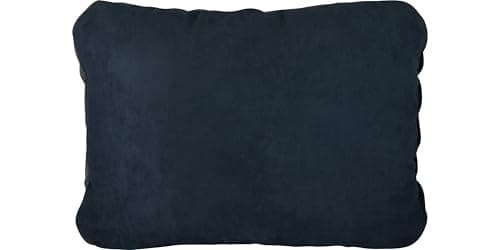
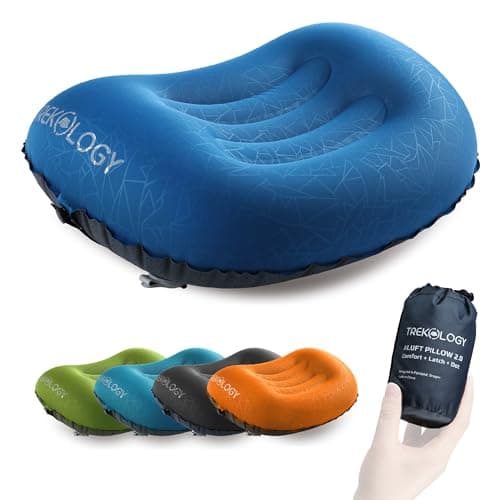
Two shapes solve it differently. A compressible foam pillow such as the Therm-a-Rest Compressible Pillow Cinch publishes 18 by 13 by 6 in at 10 oz with a cinch cord that sets the loft; it feels like a pillow because it is one, and it is bulky. An inflatable such as the Sea to Summit Aeros Premium publishes 2.8 oz and a 3.3 by 2.8 in packed size, which is a rounding error in a pack but never quite feels like bedding. The full comparison is in the camping pillow roundup.
Whichever you pick, the fix that matters is stopping it sliding off the pad. Sleeping pads are slippery nylon and pillows migrate. A pillow with anti-slip dots and a pad strap solves it directly; a strip of tape or tucking the pillow inside the hood of the sleeping bag solves it for free.
Noise, and what is realistic about it
A tent has no sound insulation whatsoever. You will hear the road, the neighbors, the wind in the fly, the rain, and at least one animal you cannot identify. Nothing about a campsite makes that quieter, so the only workable strategy is to stop hearing it.
Foam earplugs. A pack of 32 NRR foam earplugs costs almost nothing and is the single most effective sleep item in this article. Take several pairs, because one will always be lost.
Pitch away from the obvious sources. Toilet blocks and water taps generate foot traffic all night. So do the sites nearest the entrance.
Tension the fly. A slack fly slaps in wind, and it is louder inside the tent than outside it. The tensioning routine is in how to pitch a tent in wind.
Light: the 5am problem
A tent goes from black to daylight in about twenty minutes, and in summer that happens around five in the morning. A cheap eye mask solves it completely and weighs nothing. The alternative is a dark-coated tent — several family tents publish a room-darkening fabric — but nobody should buy a new tent for this when a contoured eye mask works better. Facing the door away from the eastern sky helps too, and costs nothing at all.
The timing problem nobody mentions
Camping shifts everyone's schedule. Dinner happens late because cooking outdoors takes longer, the fire keeps people up, and then everyone gets into a bag at eleven having eaten a large meal an hour before and drunk more than usual. Then they are surprised to be awake at one.
Three habits fix most of it: eat earlier than feels natural, keep the last drink well before bed, and go to bed when it gets dark rather than fighting it with a lantern. The last one is the counterintuitive one — camping is one of the few contexts where an early night is genuinely available, and taking it means the 5am light matters much less.
Problem
The cheap fix
The gear fix
Sliding down the pad
Head uphill, pitch flatter
A pad with a textured or baffled top
Neck ache
Tuck the pillow into the bag hood
A dedicated camp pillow, foam or inflatable
Woken by noise
Pitch away from taps and toilets
Foam earplugs, several pairs
Awake at first light
Face the door away from sunrise
An eye mask
Rolling off a narrow pad
Two pads pushed against a wall
A wider pad, or a double
Cannot get comfortable on your side
Pad thickness, not bag choice
3 in or more of self-inflating loft
The free column solves more of this than the paid column does.
Side sleepers need thickness, not softness
If you sleep on your side, your hip and shoulder carry your entire body weight through two small contact patches. A thin pad bottoms out under them and you wake up aching regardless of temperature. The answer is depth: a MegaMat 10 publishes 3.9 in of thickness, and a MondoKing 3D publishes 4.25 in. Anything under about 2.5 in is a back-sleeper's pad.
This is also where inflation pressure matters. Most people over-inflate, which makes a pad into a drum that pushes back. Let enough air out that your hip sinks toward but not onto the ground — roughly, you should be able to press a knuckle in and feel it give.
What this does not fix
If you are cold, none of the above matters and none of it will help. Cold is a separate problem with a separate cause, and it is almost always the pad rather than the bag — the argument is in why you get cold in a sleeping bag and the number to check is in R-value explained. Fix warmth first, then come back to this page for everything else.
The gear this page points to
Therm-a-Rest Compressible Pillow Cinch
Therm-a-Rest
18 x 13 x 6 in of foam with a cinch cord that sets the loft. It feels like a pillow rather than a balloon, which is why car campers keep it.
Head uphill, always. Sleeping head-downhill raises blood pressure in the head and feels awful, and sleeping across a slope means bracing all night. If the only flat spot is a hollow, take the slope instead, because hollows collect water.
QHow thick should a sleeping pad be for a side sleeper?
About 3 in or more. Side sleeping puts your whole body weight through the hip and shoulder, and thinner pads bottom out under those two points. The Exped MegaMat 10 publishes 3.9 in and the Therm-a-Rest MondoKing 3D publishes 4.25 in.
QHow do I stop my pillow sliding off the sleeping pad?
Tuck it inside the hood of the sleeping bag, or use a pillow with anti-slip dots and a strap that attaches to the pad. Sleeping pads are slick nylon and an unsecured pillow will migrate every time you move.
QHow do I sleep past sunrise in a tent?
An eye mask, and pitch with the door facing away from the eastern sky. A tent goes from dark to full daylight in about twenty minutes, and no tent fabric short of a dedicated room-darkening one stops it.
Sources
Every figure on this page comes from a published source. We have not tested this gear, so the numbers are the manufacturer's or the standard body's, not ours. How we research.