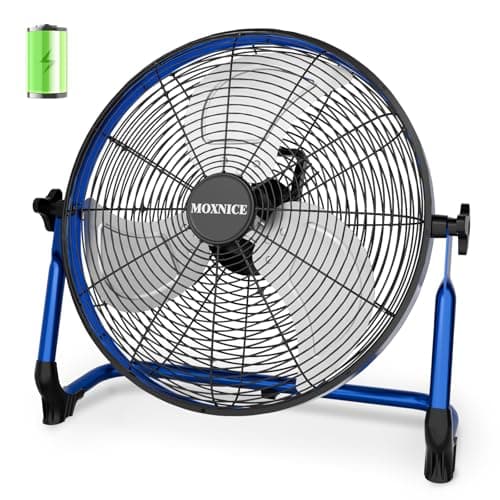
A fan moves air; it does not remove heat. What makes you feel cooler is evaporation from your skin, which is why a fan pointed at a person works and a fan stirring a hot tent does nothing. Point it at the sleeper, not at the tent. The second job, moving humid air out and drier air in, is what actually lowers the temperature inside, and that requires the doors open.
This matters for placement. The best position is usually low, near a vent or an open door, blowing across the sleeping area toward another opening, so the fan is both cooling people and driving a through-draft. A fan hung in the peak blowing down stirs the hottest air in the tent back over you.
In genuinely hot weather the fan is one of several things and not the main one. Shade, pitching for the prevailing breeze and stripping the fly where the forecast allows do more, and they are covered in how to stay cool camping in hot weather.
Compared on published numbers
Fan
Airflow
Power
Run time
Recharge
Water rating
MOXNICE 18 in.
3,200 CFM at 1,500 RPM
not published
6 h high, up to 60 h low
3 to 4 h
not published
O2COOL 10 in.
not published
6x D cells or AC adapter
22 h high, 53 h low
not applicable
not published
Figures as published by each manufacturer.
The gaps in that table are the useful part. O2COOL publishes hours and no airflow; MOXNICE publishes airflow and hours but neither a battery capacity nor a water rating. Neither is dishonest and neither lets you compare directly, which is normal in this category and worth knowing before you read a specification as a promise.
What CFM means when you are lying under it
Cubic feet per minute is the volume of air the fan moves. As a rough sense of scale, a six-person tent at 100 sq ft with a 6 ft ceiling holds roughly 600 cubic feet of air, so a fan at 600 CFM could in principle exchange the whole volume once a minute — if the air had somewhere to go.
That last clause is the catch. With the doors zipped, a high-CFM fan is recirculating the same hot air and adding a small amount of motor heat. Airflow figures only convert into cooling when there is an inlet and an outlet, which is the same reason tent condensation is a ventilation problem rather than a fabric one.
Neither of these publishes a water rating
Fans in this category are often sold on an IPX4 claim, which means splash resistance from any direction: humidity, a bit of blown drizzle through a mesh door, a wet hand on the controls. It does not mean a fan can sit out in a storm or stand in a puddle in a vestibule. That is worth knowing here because neither of these fans publishes a rating at all, so treat both as inside-the-tent items, and bring anything with a battery in it inside before you go to bed in weather.
Power, and the mistake worth avoiding
Rechargeable fans are quieter, lighter and cheaper to run, and they need a plan for recharging on trips longer than a night or two — see best portable power stations.
D cells hold a lot of energy and you can buy more anywhere. Six alkaline D cells is roughly two pounds of batteries and a recurring cost.
USB fans run off a power bank you already carry, which is the lightest answer for a small tent. They also move far less air than either fan here.
The mistake is buying a large rechargeable fan and no way to charge it. MOXNICE does not publish a battery capacity, but a fan that empties in 6 hours on its top speed is a substantial recharge demand, and a small power station or a second battery is what makes it work past night one.
Noise, which nobody publishes
No maker here publishes a decibel figure, and it is the specification most likely to decide whether a fan actually gets used at night. Larger blades turning slower move the same air more quietly than small blades turning fast, which is a general argument for the biggest fan the space allows run on a low setting rather than a small one on high.
Some people sleep better with the white noise and some cannot sleep through it at all. Since nothing is published, test it at home before a trip rather than discovering it at 1am.
Which to buy
Buy the MOXNICE 18 in. if you camp somewhere reliably hot, have a family tent to move air through, and want a fan that runs several nights on low before it needs power. Buy the O2COOL 10 in. if you want 22 hours on high with no charging to manage and you camp in heat occasionally rather than always.
And if the problem is sleeping rather than temperature specifically, the rest of the fixes are in how to sleep better in a tent.
The picks in full
1. Best overall
MOXNICE 18 in. Battery Operated Floor Fan
MOXNICE
3,200 CFM at 1,500 RPM on high, 6 hours at that setting and up to 60 on low, recharging in 3 to 4 hours with a USB port for phones.
MOXNICE publishes 3,200 CFM of airflow at 1,500 RPM on its highest speed, a run time of 6 hours on high and up to 60 hours on low, a recharge time of 3 to 4 hours, an 18 in. blade, and a USB-A output that charges phones and other small devices from the fan.
Sixty hours on low is the number that matters for camping, because low is the setting you actually sleep under. A fan pointed across you at low speed for several nights without a recharge is a different proposition from one you have to plan power around, and it is worth more on a trip than a bigger number on the top speed.
What you give up is disclosure. This is an Amazon-native brand with no manufacturer spec sheet behind the listing, so there is no published battery capacity to sanity-check the runtime against, and no water rating to tell you how it copes with damp. Figures that circulate for a “41,500 mAh” MOXNICE belong to its solar models rather than this one, so they are not repeated here.
The drawback
MOXNICE publishes no battery capacity, no noise level and no IP water rating, so three of the things you would most want to compare are simply absent. Six hours on high is an evening rather than a night, and the 60-hour figure is the lowest speed only.
Published specs
Airflow
3,200 CFM at 1,500 RPM on high
Run time
6 h on high, up to 60 h on low
Recharge
3 to 4 h
Size
18 in. blade
Extra
USB-A output charges phones and small devices
Note
MOXNICE publishes no battery capacity, noise level or IP water rating for this model. The 41,500 mAh figure circulating online belongs to its solar siblings and the 45 dB figure belongs to a different brand, so neither is claimed here
22 hours on high and 53 on low from six D-cell batteries, with an AC adapter option and a folding handle.
O2COOL publishes a 10 in blade, power from six D-cell batteries or the AC adapter, a run time of 22 hours on high and 53 hours on low, two speeds, and a folding design with a built-in carry handle. O2COOL does not publish a CFM figure or a weight.
Twenty-two hours on high is the specification that matters, and it beats every rechargeable fan here at full output by a wide margin. Alkaline D cells hold a lot of energy, and for someone who camps three weekends a year that is simpler than managing another lithium battery.
The drawback
Six D cells is a meaningful ongoing cost and a lot of weight in batteries, and O2COOL does not publish an airflow figure so it cannot be compared on CFM.
Not by removing heat. A fan makes you feel cooler by speeding evaporation from your skin, so point it at the sleeper rather than at the tent. It lowers the actual temperature only when the doors are open and it is driving a through-draft.
QHow many CFM does a camping fan need?
Airflow only converts into cooling when air has an inlet and an outlet. A six-person tent holds roughly 600 cubic feet, so a few hundred CFM is plenty with doors open, and 3,200 CFM in a zipped tent just recirculates hot air.
QShould I buy a rechargeable or battery camping fan?
Rechargeable if you camp often and carry a power station, because running costs are near zero. D cells if you camp in heat occasionally: O2COOL publishes 22 hours on high, and you can buy replacements anywhere with nothing to charge.
QWhere should I put a fan in a tent?
Low, near an open door or vent, blowing across the sleeping area toward another opening. That cools people by evaporation and drives a through-draft at the same time. A fan hung in the peak blowing down just stirs the hottest air back over you.
How we picked
Everyone else in this category will tell you they tested twenty of these. We have not tested any of them, and we would rather say so than pretend. There is no gear closet here and no test lab.
What we did instead: pulled the published specifications from each manufacturer's own spec sheet or manual, named the standard behind every rating so you can check what it actually promises, did the arithmetic that turns a spec into a decision, and pulled today's real retail price rather than quoting one from memory. Every pick states a drawback, because a list where nothing is wrong with anything is an advert.
The limits of that method, stated plainly: published specs do not capture zipper quality, seam durability, or how a tent behaves at 2am in a storm. Where that matters, we say so on the pick. The full method is here.