The Best Camping Pillows, and Why a Stuff Sack of Clothes Is Not One
It is the cheapest item in a sleep system and the one that most reliably decides whether you sleep. A bad night camping is usually a neck problem, not a cold problem.
A bag of clothes has no consistent loft and no structure, so it compresses to nothing under your head within an hour and redistributes every time you move. It is a fine emergency solution and a poor plan. A real pillow is the cheapest and lightest upgrade in a sleep system, and the one most likely to turn a bad night into a good one.
There is a second problem with the clothes trick, and it is the one that catches people out on cold trips: the clothes you are using as a pillow are the clothes you are not wearing. On the night you actually need that fleece, your pillow is gone. Keep the spare layers for insulation and carry three ounces of pillow.
Pillow
Type
Inflated size
Weight
Packed size
Therm-a-Rest Compressible Cinch (regular)
Foam fill
18 x 13 x 6 in
10 oz
Compresses, does not pack small
Sea to Summit Aeros Premium
Inflatable
13.4 x 9.4 x 4.3 in
2.8 oz
3.3 x 2.8 in
Trekology Aluft 2.0
Inflatable
16 x 12 x 4 in
3.9 oz
5 x 2 in
All figures as published by the manufacturers.
Inflatable, foam, or hybrid
Inflatable wins on weight and packed size by an enormous margin — 2.8 oz against 10 oz, and a fist against a loaf of bread. It loses on feel, because air moves away from pressure instead of compressing under it, and on failure mode: a puncture is total.
Foam wins on comfort and reliability. Nothing to inflate, nothing to puncture, and it behaves like the pillow you sleep on at home. It loses on volume, which is irrelevant in a car and disqualifying in a pack.
Hybrids put a foam or down layer over an air bladder, aiming for both. They largely succeed and they cost the most; if you camp often and are neither ounce-counting nor car-camping exclusively, they are worth knowing about.
The honest rule: if it goes in a car, buy foam. If it goes on your back, buy inflatable and accept the feel.
Set the loft to your sleeping position
Side sleepers need the most loft, because the gap between your ear and the pad is as wide as your shoulder. Inflate firm, or cinch a foam pillow tight. Back sleepers need much less; an overinflated pillow pushes the chin toward the chest and produces the stiff neck people blame on the ground. Front sleepers want the thinnest option available. Almost everybody overinflates on the first night, so start softer than feels right and add air only if you sink through to the pad.
Stopping it sliding away
Sleeping pads are made of slippery coated nylon, and so are most pillows, which is why the pillow ends up somewhere else by morning. Three fixes work, in ascending order of effort: a pillow with grip dots and a strap, as on the Trekology; a pad with a dedicated pillow pocket or lip; or the cheapest one, which is to put the pillow inside the hood of your sleeping bag. Most mummy bags have a hood drawcord that will hold a pillow captive all night for nothing.
Where a pillow sits in the priority list
Below the pad and below the bag, but not far below. The pad is what keeps you warm — the ground takes heat out of you far faster than the air does, which is the argument in why you get cold in a sleeping bag and measured by R-value. The bag needs to match the temperature. But once those two are right, the pillow is the next thing that decides whether you sleep, and it costs and weighs the least of the three by a wide margin.
If you are sleeping on a camp cot, note that cots are usually higher and firmer than the ground, so a slightly thicker pillow than you would use on a pad often works better.
The picks in full
1. Best for car camping and side sleepers
Therm-a-Rest Compressible Pillow Cinch
Therm-a-Rest
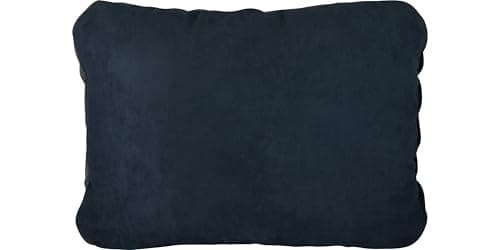
Foam fill in a soft polyester cover at 18 x 13 x 6 in for the regular, with a cinch cord to set the loft.
Therm-a-Rest publishes three sizes: small at 15 x 11 x 5 in and 7 oz, regular at 18 x 13 x 6 in and 10 oz, and large at 22 x 15 x 7 in and 15 oz. The fill is urethane foam offcuts from sleeping pad production with a polyester insulation layer, the cover is 60% recycled polyester, and a cinch cord adjusts the firmness.
Foam fill is why this leads for car camping. An inflatable pillow is a sealed bag of air: press on one part and the air moves somewhere else, so your head is always slightly on top of it rather than in it. Foam compresses locally, which is what a pillow at home does and what your neck expects.
The cinch cord matters more for side sleepers than anyone else. Side sleeping needs enough loft to fill the gap between shoulder and ear, and being able to tighten the pillow to raise its height rather than swapping it for a different one is a genuinely useful adjustment.
The drawback
10 oz and it does not pack down to anything, which rules it out for backpacking. There is no way to make it thinner than its foam.
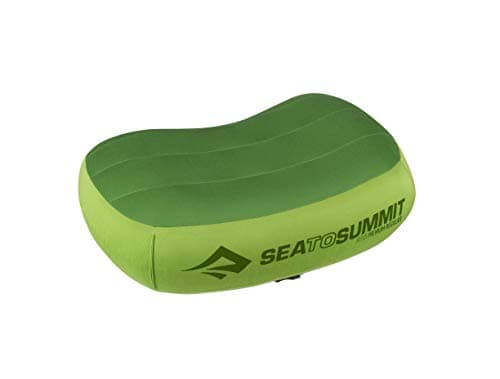
2.8 oz, inflating to 13.4 x 9.4 x 4.3 in and packing to 3.3 x 2.8 in, on a curved internal baffle.
Sea to Summit publishes 2.8 oz, inflated dimensions of 13.4 x 9.4 x 4.3 in, a packed size of 3.3 x 2.8 in, and low-impact certified recycled nylon and polyester fabrics.
2.8 oz and a packed size smaller than a mug is the whole argument. On a first backpacking trip, comfort items are the first things cut and the first things regretted, and this is light enough that the decision never comes up.
The curved profile is the design detail that separates it from a flat air bag: the contour holds a head rather than letting it roll to one side, and the brushed surface stops the skin-on-plastic feeling that makes cheap air pillows unpleasant. Adjust the firmness downward — almost everybody overinflates an air pillow, and a half-inflated one is far more comfortable than a taut one.
The drawback
It is still an air pillow, so it feels bouncier than foam, and a puncture ends its usefulness completely rather than partially.
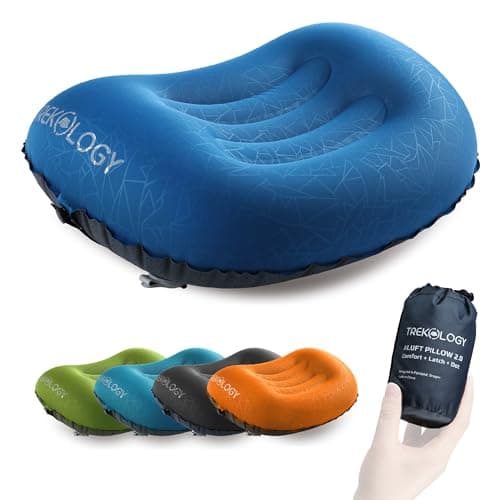
16 x 12 x 4 in inflated at 3.9 oz, with anti-slip dots and a strap that ties it to the pad.
Trekology publishes 3.9 oz (110 g), inflated dimensions of 16 x 12 x 4 in, a packed size of 5 x 2 in, water-resistant elastic TPU fabric, rubber anti-slip dots and a latch strap for attaching it to a sleeping mat.
The migration problem is real and underrated. An inflatable pillow on a slippery nylon sleeping pad slides out from under your head within about twenty minutes of falling asleep, and you wake at 3am with your ear on the pad wondering what went wrong. Grip dots plus a physical strap is the only complete fix.
It is also the largest inflated size here, at 16 in wide, which suits people who move around at night and end up off the edge of a smaller pillow. The trade is the fabric: TPU is durable and water-resistant, and it feels like it. A cotton pillowcase or a folded t-shirt over it solves that completely.
The drawback
TPU fabric is more clammy against skin than brushed polyester, and the strap only works with pads it fits around.
Yes, and they are the cheapest and lightest part of a sleep system. A stuff sack of clothes has no consistent loft, compresses to nothing within an hour, and uses up the spare layers you may need for warmth on a cold night.
QInflatable or foam camping pillow?
Foam for car camping, where volume does not matter and comfort does. Inflatable for backpacking: the Sea to Summit Aeros Premium is 2.8 oz and packs to 3.3 x 2.8 in, against 10 oz for a regular Therm-a-Rest Compressible Cinch that does not pack small.
QHow firm should a camping pillow be?
Softer than most people set it. Side sleepers need the most loft to fill the gap between ear and shoulder; back sleepers need much less, and an overinflated pillow pushes the chin toward the chest. Start soft and add air only if you sink through to the pad.
QHow do I stop my camping pillow sliding off the pad?
Use a pillow with grip dots and an attachment strap, a pad with a pillow pocket, or put the pillow inside the hood of your sleeping bag and pull the drawcord. The last one costs nothing and works with any pillow.
How we picked
Everyone else in this category will tell you they tested twenty of these. We have not tested any of them, and we would rather say so than pretend. There is no gear closet here and no test lab.
What we did instead: pulled the published specifications from each manufacturer's own spec sheet or manual, named the standard behind every rating so you can check what it actually promises, did the arithmetic that turns a spec into a decision, and pulled today's real retail price rather than quoting one from memory. Every pick states a drawback, because a list where nothing is wrong with anything is an advert.
The limits of that method, stated plainly: published specs do not capture zipper quality, seam durability, or how a tent behaves at 2am in a storm. Where that matters, we say so on the pick. The full method is here.