The Best Instant Tents, Judged on What the Speed Actually Costs
An instant tent buys you eight minutes on arrival and charges for it in weight, bulk and repairability. Whether that is a good deal depends entirely on who is putting it up.
An instant tent has its poles permanently attached to the tent body, usually telescoping rather than sectioned. You unfold it, extend the legs and stake it. A quick-pitch tent has pre-attached poles that still need raising and clipping. Both are faster than threading sectioned poles through sleeves; only the first is genuinely a one-minute job.
The reason the distinction matters is the failure mode. Sectioned poles are shock-corded and replaceable: break one and you can splint it or order a section. Telescoping legs and fixed hubs are integral to the tent, and when one bends the repair is a warranty claim rather than a field fix. That is the real cost of the speed, and it is worth knowing before you buy rather than on a Saturday.
Tent
Floor
Center height
Setup
Weight
Fly
CORE 6P Instant Cabin
11 x 9 ft (99 sq ft)
72 in
from 60 seconds
27 lb
Full
CORE 9P Instant Cabin
14 x 9 ft (126 sq ft)
78 in
from 2 minutes
40 lb
Full
Coleman Skydome 6
10 x 8 ft 6 in (85 sq ft)
6 ft
under 5 minutes
about 16.8 lb
Pre-attached poles
All figures as published by the manufacturers.
The weight you are paying for speed
A conventionally poled six-person dome runs 12 to 18 lb. The instant equivalents here run 27 to 40 lb, because telescoping steel legs and permanent hubs are heavier than shock-corded fiberglass or aluminum sections. That is 10 to 25 lb of car boot, and a packed bag that is both longer and fatter.
In a car, none of that matters. It starts to matter at a walk-in site where you carry the tent two hundred yards from a parking area, and it matters absolutely on a trail, which is why no instant tent is a backpacking tent. The line between the two categories is in car camping tent vs backpacking tent.
Who should genuinely buy one
The case is strongest for three people: somebody camping alone with children, somebody who consistently arrives after dark, and somebody who found pitching a conventional tent stressful enough that they nearly stopped camping. For all three, eight minutes saved at the worst moment of the day is worth 10 lb of steel. If you arrive in daylight with two adults and enjoy the ritual, a conventional tent is lighter, cheaper per square foot and easier to repair.
Setup speed is also a waterproofing feature
This sounds like a stretch until you have pitched a tent in rain that had already started. A conventional dome spends ten to fifteen minutes with an open inner exposed to the weather while you thread poles, and everything that goes in afterwards goes in damp. An instant tent puts a roof over the floor before it soaks.
It does not, however, change what happens overnight. Every tent here publishes 1200 mm of hydrostatic head, which is a floor rather than a differentiator, and staying dry still comes down to fly coverage, taped seams and a fly tensioned clear of the inner. That case is made in tent waterproof ratings explained, and the pitching sequence in how to pitch a tent in wind.
Two things instant tents are worse at
Wind. Tall cabin walls and rigid hubs present a large flat surface to a gust, and the load goes into the hinges rather than flexing through a pole. Guy every roof loop, not just the corners, and pitch the shortest wall into the wind.
Packing away. Folding a tent with permanently attached poles back into its bag is a specific skill, and it is much harder when the tent is wet. Practice once in the garden, and never pack one away damp for more than a day — the storage rules are in how to clean and store a tent.
What we did not do
We have not pitched, timed or weather-tested any of these. Every setup time, floor area, height and weight above is the manufacturer's published figure with a link to where it was read, which is the only kind of number this site uses. See how we research.
The picks in full
1. Best all-round instant tent
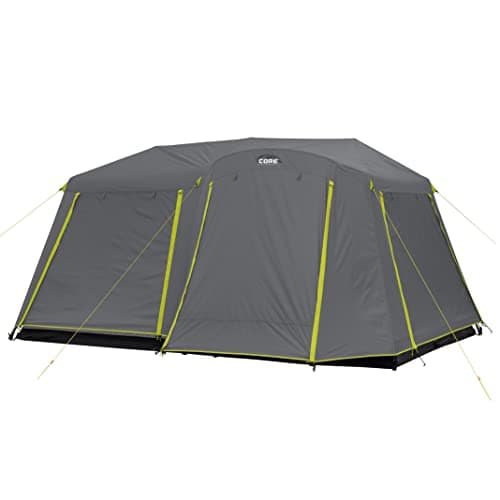
CORE 6 Person Instant Cabin Tent
CORE Equipment
99 sq ft under a 72 in center height, pitched from 60 seconds with a full rainfly, for 27 lb.
CORE publishes an 11 by 9 ft floor (99 sq ft), a 72 in center height, a stated capacity of 6 standard or 3 plus gear, 68D polyester at 1200 mm, a 27 lb weight and setup from 60 seconds, with a full rainfly.
Sixty seconds is not marketing. The poles are permanently attached to the roof panels and telescope out, so pitching is unfolding the tent, extending four legs and staking. One adult can do it, in the dark, in rain, which is the entire argument for the category.
The full fly matters more than the speed. Many instant tents ship a partial fly over the roof only, which is fine in a shower and poor in wind-driven rain. Full coverage down the sides is the spec to filter on, and the reason this one leads. Compare it against the conventional-pole alternatives in instant tent vs traditional tent.
The drawback
27 lb and a long packed bag, and 1200 mm is a mid-range fabric rating rather than a high one.
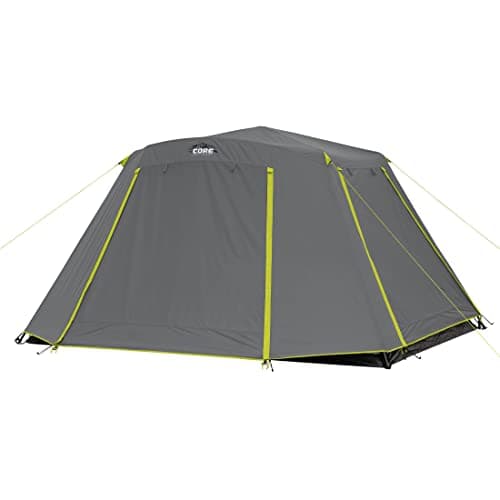
126 sq ft at a 78 in center height, pitched from 2 minutes, with a room divider and a full fly.
CORE publishes a 14 by 9 ft floor (126 sq ft), a 78 in center height, a stated capacity of 9 standard or 4 plus gear, 68D polyester at 1200 mm, a 40 lb weight and setup from 2 minutes, with a full fly.
Read the capacity honestly. Nine adults shoulder to shoulder is the industry-standard figure and it is useless for planning; CORE publishes the second number, 4 plus gear, which is the one to use. At 126 sq ft that is 31 sq ft each, well above the 20 to 25 sq ft per sleeper this site uses for car camping, and that surplus is what makes a rained-off afternoon bearable.
The 78 in center height is the other reason to size up. Standing to dress rather than kneeling is the difference most families notice on day two, and the sizing arithmetic is in what size tent do I need.
The drawback
40 lb and a bag that dominates a car boot. Nobody carries this anywhere, and pitching it alone is awkward rather than impossible.
3. Best quick-pitch that is not a true instant tent
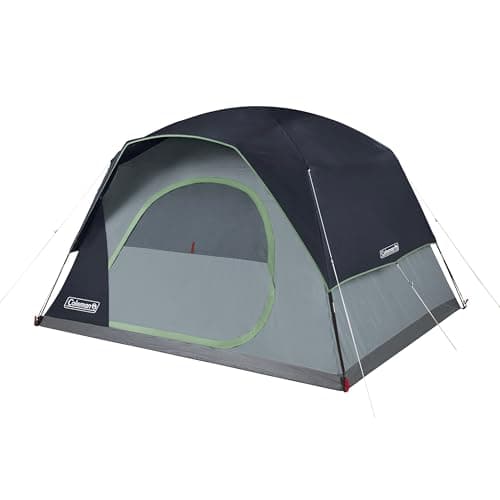
Coleman Skydome 6-Person Tent
Coleman
85 sq ft under a 6 ft center height for about 16.8 lb, with pre-attached poles and setup under 5 minutes.
Coleman publishes a 10 by 8 ft 6 in floor (85 sq ft), a 6 ft center height, a weight of about 16.8 lb, capacity for two queen airbeds, and setup in under 5 minutes.
This is the honest middle of the category and the one most beginners should look at first. Ten pounds lighter than the CORE 6 and less than half the CORE 9, it still pitches in a few minutes because the poles never come out of their sleeves, and it packs into a bag a person can carry across a campground in one hand.
The compromise is floor and headroom: 85 sq ft at 6 ft is a genuine four-person tent rather than a six, and the walls slope more than a cabin. For two adults plus gear, or two adults and a small child, that is plenty. For a family of four wanting to sit out a wet afternoon, it is not.
The drawback
Not literally instant: the poles are pre-attached but you still raise and clip. Fits two queen airbeds, which is less floor than the CORE tents.
One whose poles are permanently attached to the tent body, usually telescoping rather than sectioned. You unfold it, extend the legs and stake it. CORE publishes setup from 60 seconds for its 6-person instant cabin and from 2 minutes for the 9-person.
QAre instant tents worth it?
For somebody camping alone with children, arriving after dark, or put off by pitching a conventional tent, yes. The cost is 10 to 25 lb of extra weight over a conventionally poled tent of the same size, and a pole system you cannot repair in the field.
QCan you use an instant tent for backpacking?
No. The lightest instant tents start around 27 lb, which is most or all of a beginner's entire pack weight budget. Instant tents are a car camping product and always will be, because the telescoping pole system is what makes them heavy.
QDo instant tents hold up in wind?
Less well than a low dome. Tall cabin walls catch wind and the load goes into rigid hinges rather than flexing through a pole. Guy every roof loop rather than just the corners, and pitch the shortest wall into the wind.
How we picked
Everyone else in this category will tell you they tested twenty of these. We have not tested any of them, and we would rather say so than pretend. There is no gear closet here and no test lab.
What we did instead: pulled the published specifications from each manufacturer's own spec sheet or manual, named the standard behind every rating so you can check what it actually promises, did the arithmetic that turns a spec into a decision, and pulled today's real retail price rather than quoting one from memory. Every pick states a drawback, because a list where nothing is wrong with anything is an advert.
The limits of that method, stated plainly: published specs do not capture zipper quality, seam durability, or how a tent behaves at 2am in a storm. Where that matters, we say so on the pick. The full method is here.