The Best 12V Coolers for Camping, Sized by the Air Temperature Outside Them
A 12V cooler does not hold a temperature. It holds a difference. Every honest decision about one starts from that sentence, because it is the reason the same cooler is excellent in October and close to useless in August.
17 L / 18 qt and 23 cans in a deliberately slim body Koolatron says fits between the front seats of most minivans, cooling 40 F below ambient and warming to 135 F.
The footwell or the gap between two front seats, where a square cooler will not go
A 12V cooler is a thermoelectric cooler. It does not set a temperature the way a fridge does — it moves heat out of the box, cooling the inside to a fixed number of degrees below whatever the air around it is. Igloo publishes 36 F below ambient and Koolatron publishes 40 F below ambient. That means the interior temperature changes every time the weather does, it cannot freeze anything, and it only works while it is plugged in.
Everything that confuses people about this category comes from that one property. A thermoelectric cooler is often sold beside compressor fridges, looks like a fridge, and is called a “portable fridge” in half the listings, but it is a different machine doing a different job for a fifth of the money. It is not a cheap fridge. It is a cooler that never needs ice.
The mechanism is a Peltier element: run a current across a junction of two dissimilar semiconductors and one side gets cold while the other gets hot. A fan blows the heat off the hot side into your campsite. There is no compressor, no refrigerant and almost nothing to break, which is why these are cheap and why they are limited.
The arithmetic that decides whether food is safe in one
The USDA puts perishable food below 40 F, and treats 40 to 140 F as the danger zone where bacteria multiply fastest. A thermoelectric cooler's interior temperature is just the air temperature minus its published difference, so you can work out in advance whether a given day is safe. Here is that arithmetic for both figures on this page.
Air temperature
Igloo, 36 F below
Koolatron, 40 F below
Safe for perishable food?
60 F
24 F
20 F
Yes, and cold enough to partly freeze things
70 F
34 F
30 F
Yes, comfortably
80 F
44 F
40 F
Marginal. Koolatron is on the line, Igloo is over it
90 F
54 F
50 F
No. Both are well inside the danger zone
100 F
64 F
60 F
No, and not close
Interior temperatures calculated from each maker's published cooling difference against the USDA's 40 F threshold. These are not measured figures and they assume a closed, pre-chilled cooler out of direct sun.
Read that table before you read the product section, because it is the whole purchase. In spring, fall and a mild summer evening, a 12V cooler holds food perfectly well and you never buy a bag of ice. In a hot car park in July it is a drinks cooler and nothing more, and putting chicken in one is a genuinely bad idea.
Three practical consequences follow. Keep it out of direct sun, because the sun heats the box faster than the Peltier element cools it. Pre-chill it, and pre-chill the contents, since it drops temperature slowly and has no capacity to pull a warm load down. And put a cheap fridge thermometer inside, which costs almost nothing and converts all of the above from arithmetic into a number you can see — how to keep food cold camping covers the rest of the discipline.
Compared on published numbers
Cooler
Capacity
Cools
Warms
AC cable included?
Notable
Igloo IE24
32 cans
36 F below ambient
to 136 F
Yes
Cool Riser base
Koolatron 26 qt hard
24 L / 26 qt, 31 cans
40 F below ambient
not published
No, sold separately
2 L bottles stand upright; brushless fan
Igloo IE42C
66 cans
36 F below ambient
to 136 F
Yes
Cool Riser base
Koolatron 18 qt slim
17 L / 18 qt, 23 cans
40 F below ambient
to 135 F
No, sold separately
fits between minivan front seats
Figures as published by each maker on 2026-10-18. Neither Igloo nor Koolatron publishes a wattage, a weight or exterior dimensions for any of these four coolers.
That table has a hole in it that is worth naming, because it is the same hole in every listing in this category: nobody publishes a power draw. For a product whose defining characteristic is that it runs continuously off your car, that absence is remarkable, and it is why the power section below tells you how to measure it rather than quoting a figure we cannot source.
Thermoelectric, ice, or compressor — the three-way choice
This site already compares the other two against each other. A 12V cooler is the third option, it sits between them on price and on capability, and it is the one most people have never had explained to them.
Ice cooler
12V thermoelectric
12V compressor fridge
Holds a set temperature
No
No
Yes
Coldest it gets
About 32 F while ice remains
36 to 40 F below the air around it
Dometic CFX3 35 publishes -7 F to +50 F
Can freeze
No
No
Yes
Needs power
No
Yes, continuously
Yes, cycling
Loses volume to ice
Yes, roughly a third
No
No
Rough price band
Lowest
Low to middle
Highest, by a wide margin
Compressor figures from the Dometic CFX3 35 published specification; thermoelectric figures from the makers on this page.
Buy an ice cooler if you camp mostly in summer, want the coldest food temperatures for the least money, and do not mind buying ice — that is still the right answer for most people and the options are in best coolers for camping, with the retention arithmetic in how long does ice last in a cooler.
Buy a 12V cooler if the ice itself is the problem: you want the full volume of the box, you are tired of soggy packaging and a drain plug, you camp in shoulder season or mild weather, and you have a vehicle socket. Cold drinks for a weekend with no shop run is a real quality-of-life upgrade for the money.
Buy a compressor fridge if you need a set temperature regardless of weather, want to freeze, or are away long enough that ice runs are the limiting factor. That is a several-hundred-dollar decision and it has its own page in best 12V camping fridges; the crossover point against an ice cooler is worked through in cooler vs 12V fridge for camping.
Never run one off a parked car with the engine off
A thermoelectric cooler draws continuously for as long as it is plugged in, and a car starter battery is built to deliver a huge current for a few seconds rather than a small one for hours. Deep-discharging it damages the battery and can leave you unable to start the car in the morning. Run it while you drive, then switch to house power, a leisure battery or a portable power station at the site. Many cars also cut power to the 12V socket with the ignition off, which saves you from the mistake — and many do not.
Working out the power draw yourself, since nobody publishes it
You do not need the maker's figure. Plug the cooler into a power station, let it settle for a minute, and read the output in watts off the station's display. Divide the station's capacity in watt-hours by that number and you have the runtime in hours, less roughly 10 to 15% for conversion losses.
Do that once and write it down. It is the same one-minute method that answers every other “how long will my power station run this” question at a campsite, and what size power station do I need works the arithmetic through in full. The thing to keep in mind is duty cycle: a compressor fridge switches off once it reaches temperature and a thermoelectric cooler does not, so a 12V cooler drawing less power can still use more energy over a night than a fridge drawing more.
The warming function, which is half the product and almost nobody uses it
Flip the current through a Peltier element and the cold side becomes the hot side, which is why three of the four coolers here publish a warming temperature as well — 136 F for the two Igloos and 135 F for the Koolatron 18 qt. It costs the maker nothing to add, which is why it is there.
It is genuinely useful in exactly one scenario: keeping a cooked dish hot on the drive to a site or between a camp kitchen and a picnic table. It is not a cooking device and it will not bring cold food up to a safe temperature, so treat 135 F as a holding figure for food that was already hot. If keeping food hot is the actual problem you are solving, a vacuum food jar does it better with no power at all — best thermoses and insulated food jars has those.
What these are genuinely good at
Drinks, in any weather. Nobody cares whether a can of soda is at 38 F or 52 F, and the box never needs ice. This is the use case that justifies the purchase on its own.
Shoulder-season and cold-weather trips. At 60 to 70 F ambient these hold proper refrigerator temperatures, which makes them a genuinely good food cooler for most of the camping year outside high summer.
Long drives. Running off the car while you move is free cooling, and you arrive with a cold box instead of a melted one.
Keeping the full volume. An ice cooler gives up roughly a third of its interior to ice. A 26 qt thermoelectric cooler is 26 qt of food.
And one thing they are bad at that is worth stating plainly: holding perishable food through a hot day. The table near the top of this page is the test, and on a 90 F afternoon every cooler here fails it.
What to buy
Buy the Igloo IE24 if you want one box that works out of the car and in the house, because both cables are in the box and pre-chilling on house power is the habit that makes these coolers perform.
Buy the Koolatron 26 qt hard-sided if you want the biggest published cooling difference and the ability to stand 2 L bottles upright, and budget for the AC adapter separately. Buy the Igloo IE42C if you are cooling drinks for a family and 32 cans is not enough. Buy the Koolatron 18 qt slim only if the shape solves a real problem in your car, because you pay for it in capacity.
And if, having read the arithmetic, what you actually need is a set temperature rather than a difference, do not buy any of these — go to best 12V camping fridges and spend the money once. A 12V cooler bought expecting a fridge is the most common disappointment in this category, and it is entirely avoidable.
The picks in full
1. Best overall
Igloo IE24 Thermoelectric Cooler & Warmer
Igloo
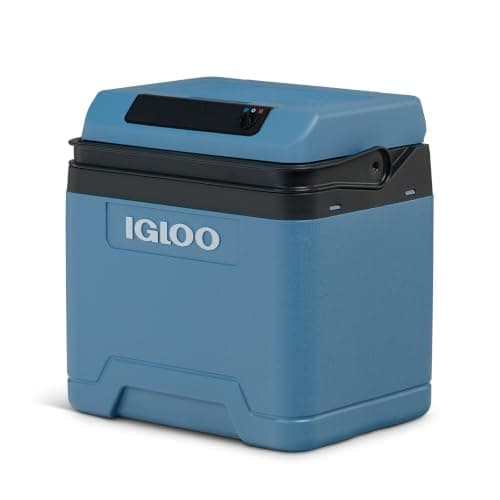
32 cans, cooling to 36 F below ambient and heating to 136 F, with the 12V and the 100-240V AC cables both included.
Igloo publishes a 32-can capacity, cooling to up to 36 F below the surrounding air temperature, warming to up to 136 F, Cool Riser Technology that lifts the body off hot surfaces, a cord storage compartment, a carry handle that locks the lid, and — the part that decides this pick — both a 12V DC cable for a vehicle outlet and a 100-240V AC cable for a wall socket, in the box.
Both cables included is worth more than it sounds. The single most useful habit with a thermoelectric cooler is pre-chilling it indoors on house power the night before you leave, because these things cool slowly and arrive at a campsite having fought your warm car for two hours. Koolatron sells its AC adapter separately, so buying the Igloo is the cheaper route to the behaviour that makes the category work.
Cool Riser is a real design point rather than a trade name. The hot side of the unit dumps heat out of the base, and a cooler sitting flat on a sun-warmed truck bed is re-absorbing its own waste heat. Raising it an inch is free performance, and you can replicate it with any other cooler by putting it on a crate.
The drawback
36 F below ambient is the smallest cooling difference on this page, and Igloo publishes no wattage, no weight and no exterior dimensions, so you cannot plan a power budget or check it fits your trunk without measuring the box when it arrives.
Published specs
Capacity
32 cans
Cooling
up to 36 F below the surrounding air temperature
Warming
up to 136 F
Power
12V DC vehicle outlet and 100-240V AC; BOTH cables are in the box
Design
Cool Riser Technology lifts the body off hot surfaces
Extras
cord storage compartment; the carry handle locks the lid
Note
Igloo publishes no wattage, weight or exterior dimensions for this cooler
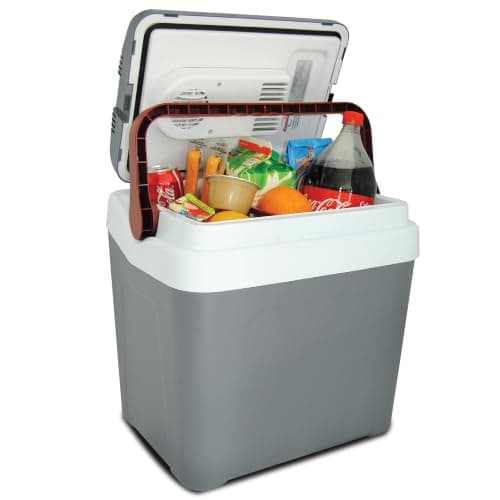
24 L / 26 qt and 31 cans, cooling to 40 F below ambient on a brushless fan, in an injection-molded hard body tall enough for 2 L bottles.
Koolatron publishes a 24 L (26 qt) capacity holding up to 31 standard cans, interior height for 2 L bottles standing upright, cooling to up to 40 F (22 C) below the surrounding temperature, a brushless fan motor, an injection-molded hard exterior with a stain-resistant interior, a carry handle, cord storage and a self-locking lid. The 12V DC adapter is included; AC use needs a 110V adapter sold separately.
Four degrees more cooling difference than the Igloo is the largest published gap on this page, and in this category four degrees is not a rounding error — it is the difference between 44 F and 40 F on an 80 F afternoon, which is the difference between over the food-safety line and on it. If you only compare one number across brands, compare this one.
The brushless fan deserves a mention too. These coolers run their fan continuously for as long as they are plugged in, so the fan is the part that wears out and the part you listen to all evening. Brushless motors last longer and run quieter than brushed ones, and Koolatron is the only maker here that says which it uses.
The drawback
The AC adapter is sold separately, which is exactly the accessory you want for pre-chilling. The listing says cooler and warmer in the product name but publishes no warming temperature for this model, and like Igloo it publishes no wattage, weight or dimensions.
Published specs
Capacity
24 L / 26 qt, up to 31 cans
Bottles
tall enough for 2 L bottles standing upright
Cooling
up to 40 F (22 C) below the surrounding air temperature
Fan
brushless motor
Build
injection-molded hard exterior, stain-resistant interior
Power
12V DC adapter included; AC use needs a 110V adapter, sold separately
Extras
carry handle, cord storage, self-locking lid
Note
the product name says cooler and warmer, but this listing publishes no warming temperature; no wattage, weight or exterior dimensions are published either
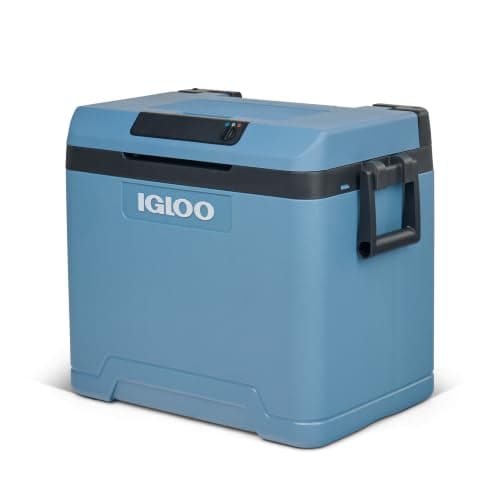
66 cans — double the IE24 — on the same 36 F cooling difference, the same Cool Riser base and the same pair of included cables.
Igloo publishes 66 cans, cooling to up to 36 F below ambient, warming to up to 136 F, the same Cool Riser base, cord storage, a locking carry handle, and both the 12V DC and 100-240V AC cables included.
Buy this one on capacity and nothing else, because that is the only published figure that differs from the IE24. The cooling difference is identical, which is the honest way to read it: a bigger thermoelectric cooler does not cool harder, it just has more inside it, so it takes longer to pull down and recovers more slowly every time somebody opens the lid.
For a family that drives to a campground this is still the right size. Four people over two days is comfortably past 32 cans once you count water, and running two small coolers means two 12V sockets, which most cars do not have — see best power inverters for camping for what a second socket actually costs you.
The drawback
Twice the air to cool on the same published cooling difference, so it is slower to come down to temperature and less forgiving of being opened. Still no published wattage, weight or dimensions, and at 66 cans this is a two-handed object in a car that is already full.
Published specs
Capacity
66 cans
Cooling
up to 36 F below the surrounding air temperature
Warming
up to 136 F
Power
12V DC vehicle outlet and 100-240V AC; BOTH cables are in the box
Design
Cool Riser Technology lifts the body off hot surfaces
Extras
cord storage compartment; the carry handle locks the lid
Note
Igloo publishes no wattage, weight or exterior dimensions for this cooler
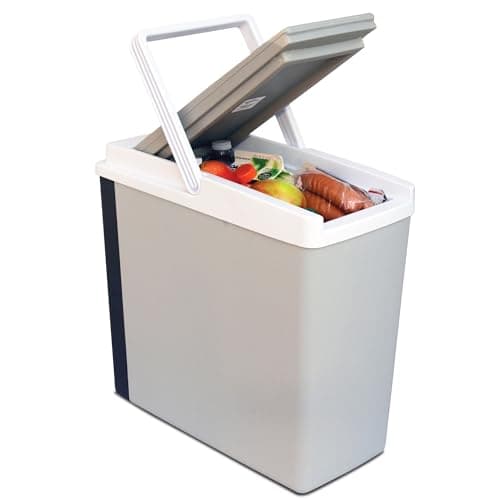
17 L / 18 qt and 23 cans in a deliberately slim body Koolatron says fits between the front seats of most minivans, cooling 40 F below ambient and warming to 135 F.
Koolatron publishes a 17 L (18 qt) capacity holding up to 23 cans, a slim design it states fits between the front seats of most minivans, cooling to up to 40 F (22 C) below ambient, warming to up to 135 F (57 C), a latch-free lid that opens one-handed, a fold-away handle, cord storage, a stain-resistant lining, and North American manufacture. The 12V cord is included; AC needs a separate 110V adapter.
Shape is a real specification in a loaded car, and it is the one nobody shops on until the tailgate will not close. A cooler that lives between the seats is reachable from the driver's seat, does not eat trunk space you need for a tent, and keeps its 12V cord nowhere near the load you are going to pile on top of it.
Check the live prices on this and the 26 qt before you decide, because the slim body has at times carried a premium over the larger box. If the gap is real, buy the shape only if you actually need the shape. The rest of the loading problem is in how to pack a car for camping.
The drawback
You are paying for the shape rather than the capacity: it holds fewer cans than Koolatron's cheaper 26 qt hard-sided model, and has at times cost more. AC adapter sold separately, and no wattage, weight or dimensions are published.
Published specs
Capacity
17 L / 18 qt, up to 23 cans
Shape
slim; Koolatron states it fits between the front seats of most minivans
Cooling
up to 40 F (22 C) below the surrounding air temperature
Warming
up to 135 F (57 C)
Power
12V DC cord included; AC use needs a 110V adapter, sold separately
QWhat is the difference between a 12V cooler and a 12V fridge?
A 12V thermoelectric cooler cools to a fixed number of degrees below the surrounding air temperature - 36 F below for the Igloos here, 40 F below for the Koolatrons - so its interior temperature changes with the weather and it cannot freeze. A 12V compressor fridge sets an absolute temperature regardless of ambient; the Dometic CFX3 35 publishes a range of -7 F to +50 F. The fridge costs several times more.
QHow cold does a 12V cooler get?
It depends entirely on the air temperature around it. At 70 F ambient, a cooler rated 36 F below reaches about 34 F; at 90 F ambient the same cooler reaches about 54 F. That is why these are reliable food coolers in spring and fall and drinks-only coolers in high summer.
QIs it safe to keep food in a 12V cooler?
Only when the air temperature allows it. The USDA keeps perishable food below 40 F, so a cooler rated 36 F below ambient is safe up to about 76 F outside and one rated 40 F below is safe up to about 80 F. Above that you are in the danger zone, and the honest answer is to use it for drinks and keep perishables in an ice cooler.
QWill a 12V cooler drain my car battery?
Yes, if you run it with the engine off. These draw power continuously rather than cycling like a compressor fridge, and a starter battery is not designed for a sustained small discharge. Run it while driving, then switch to house power, a leisure battery or a portable power station at the campsite.
QHow many watts does a 12V cooler use?
Neither Igloo nor Koolatron publishes a wattage for any of the four coolers on this page, so there is no figure to quote honestly. Plug it into a power station on a settled load and read the watts off the station's own display, then divide the station's watt-hours by that number for a runtime.
QDo you still need ice in a 12V cooler?
No, and that is the main reason to own one. The box keeps its full interior volume instead of giving roughly a third of it to ice, there is no meltwater and no drain plug, and there are no mid-trip ice runs. The trade is that it only works while plugged in and it cannot beat the weather.
How we picked
Everyone else in this category will tell you they tested twenty of these. We have not tested any of them, and we would rather say so than pretend. There is no gear closet here and no test lab.
What we did instead: pulled the published specifications from each manufacturer's own spec sheet or manual, named the standard behind every rating so you can check what it actually promises, did the arithmetic that turns a spec into a decision, and pulled today's real retail price rather than quoting one from memory. Every pick states a drawback, because a list where nothing is wrong with anything is an advert.
The limits of that method, stated plainly: published specs do not capture zipper quality, seam durability, or how a tent behaves at 2am in a storm. Where that matters, we say so on the pick. The full method is here.