The Best Power Inverters for Camping, and Why They Are Not Batteries
An inverter holds no power at all. It turns your car battery into a wall socket, which is either the cheapest solution at the campsite or the fastest way to need a jump start.
A power inverter converts 12 V DC from a battery into 120 V AC for a wall plug. It has no capacity of its own, so every watt-hour it delivers comes out of the battery it is clipped to - usually the one that starts your engine. A power station is a battery with an inverter already inside it. If you do not already have a battery you are willing to drain, you want a power station, not an inverter.
This is the distinction that decides the purchase, and the listings blur it on purpose, because "1,100 watts" sounds like a quantity of power when it is a rate. An inverter rated at 1,100 W will run an 1,100 W load, but only for as long as the battery behind it lasts, and a typical car starter battery has perhaps 500 usable watt-hours before you are not starting anything. Eleven hundred watts for twenty-seven minutes is the honest version of that spec.
So the question is never "how many watts do I need" first. It is "what battery is this hanging off". A second battery, a leisure battery or a van install makes an inverter the cheap, efficient answer. A starter battery and no jump pack makes it a risk you take with the engine running.
What to look for
Specification
What to want
Why
Waveform
pure sine wave unless you only run tools
modified sine buzzes, heats and is wrong for medical equipment
Continuous watts
the real draw of your biggest single device, plus a third
continuous is the number that matters; peak is a two-second allowance
How it connects
12 V socket under 150 W, clamps or hardwire above
a cigarette-lighter socket is fused near 10 to 15 A, so it caps you well below the rating
No-load draw
under 1 A
an inverter left switched on drains the battery doing nothing
Efficiency
90 percent or better
the missing 10 percent is heat, and it comes out of your battery
Voltage display
yes, if you are clipping to a starter battery
it is the only warning you get before the engine will not turn over
What decides whether an inverter suits your setup, rather than how big a number is on the box.
Note the absence of "peak watts" from the things to buy on. Peak is a surge allowance for the moment a motor spins up, and every unit here publishes roughly double its continuous rating. It is not spare capacity.
Compared on published numbers
Inverter
Continuous
Surge
Waveform
Connection
Weight
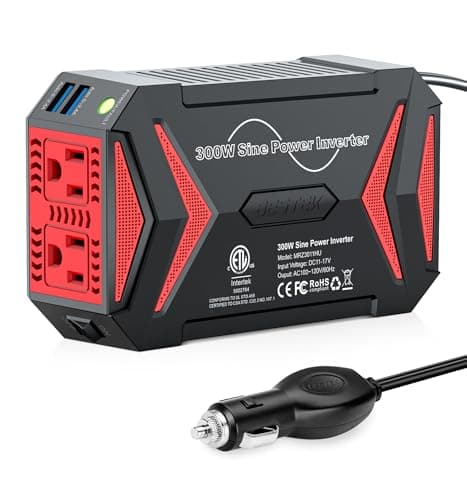
BESTEK 300W
300 W (360 W max)
700 W
pure sine
12 V socket
not published
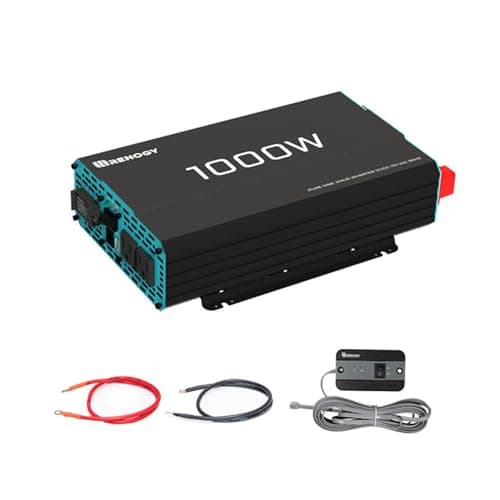
Renogy P2 1000W
1,000 W
2,000 W
pure sine, THD under 3%
4 AWG to terminals
6 lb
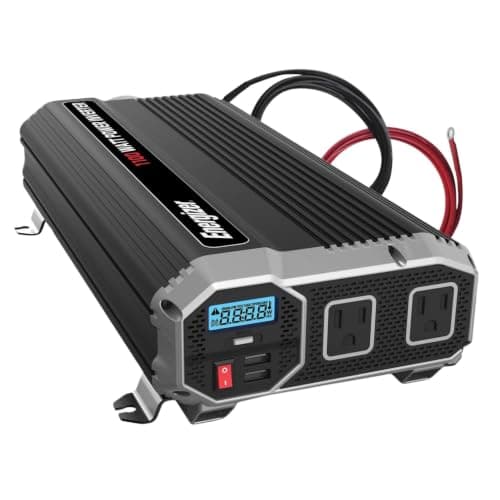
Energizer 1100W
1,100 W
2,200 W
modified sine
battery clamps
3.16 lb
Figures as published by each manufacturer. Prices on this page carry their own as-of date.
What a camper actually plugs in
The useful exercise is to list what you own with a wall plug and read the brick. Almost everything on a camping trip charges over USB, which needs no inverter at all - a power bank does that job at a quarter of the weight and none of the complication.
Device
Typical draw
Inverter needed?
Phone, headlamp, watch, most camera batteries
USB
no - use a power bank
Laptop brick
45 to 100 W
yes, 300 W is ample
Small tent fan on mains
under 50 W
yes, or buy the 12 V version
Drill or other cordless tool charger
60 to 100 W
yes, and modified sine is fine
Electric kettle or coffee maker
900 to 1,500 W
technically yes, but it will flatten a starter battery in minutes
CPAP
30 to 60 W through the night
a power station, not a car inverter - see the sizing page
Draw figures are the ranges this site uses across its power pages; read your own device's brick for the real number.
The kettle row is the one to take seriously. An inverter will happily run it, and the arithmetic is brutal: 1,200 W for four minutes is 80 watt-hours, which sounds trivial until you do it twice a day for three days off a battery that also has to start an engine.
If you are clipping to your starter battery, run the engine
The one rule that prevents the only genuinely bad outcome here. A starter battery is designed to deliver a huge current for three seconds, not a moderate current for three hours, and deep-discharging one damages it as well as stranding you. With the engine running, the alternator carries the load and the battery is a buffer. With the engine off, watch the voltage display and stop at 12.2 V. The alternative is a second battery or the battery-plus-inverter-in-one-box answer in best portable power stations.
Inverter or power station?
A power station is a LiFePO4 battery with an inverter already inside, measured in watt-hours of capacity as well as watts of output. It costs several times what a bare inverter does, because you are buying the battery.
Buy an inverter when the battery is already solved: a van with a leisure battery, a camper with a split-charge relay, or a trip where the engine will be running anyway. Buy a power station when it is not, which for most people car camping two or three times a season is the honest answer. The decision tree is in power banks vs power stations, and the capacity arithmetic is in what size power station do I need.
Which to buy
Buy the BESTEK 300W if you want to charge a laptop and a camera at a campsite and nothing more. It plugs into the 12 V socket you already have, it is pure sine so nothing complains, and 300 W is more than the socket will give you anyway. This is the one most people should stop reading at.
Buy the Renogy P2 1000W if you have a van, a second battery or a camper worth wiring properly. Over 90 percent efficiency, under 1 A idle draw and a wired remote are the three specifications that make an installed inverter livable rather than a slow leak, and the GFCI protection is the right call for a damp environment.
Buy the Energizer 1100W if you need a thousand watts occasionally, with the engine running, for tools or a brick that does not care about waveform. The LCD voltage readout is the reason to pick it over a cheaper clamp-on, and the modified sine wave is the reason not to use it for anything medical. If your real need is a quiet source of overnight AC power, you want a battery instead - start at best portable power stations.
The picks in full
1. Best overall
BESTEK 300W Pure Sine Wave Power Inverter
BESTEK
300 W of pure sine wave through a 12 V socket, with two 2.4 A USB ports, for about the price of a cooler bag.
BESTEK publishes 300 W rated output, 360 W maximum, 700 W peak, a pure sine wave waveform, 12 V DC input through a cigarette-lighter plug, 110 to 120 V AC output across two outlets, two smart USB ports at 2.4 A each for 4.8 A total, a built-in 40 A fuse and a 4.92 by 3.39 by 1.93 in body.
This wins because it is the one that fits the actual job. The honest list of what a camper needs AC power for is short: a laptop brick, a camera battery charger, a drone charger, a small fan. All of those are well under 150 W, which is what a 12 V socket will really deliver. Buying a 2,000 W inverter to charge a laptop is paying for headroom you cannot physically reach through that socket.
Pure sine wave at this price is the part worth noticing. A modified sine wave is a stepped approximation of mains AC, and sensitive electronics - some laptop bricks, anything with a motor controller, medical equipment - either buzz, run hot, or refuse. Pure sine is the waveform your house actually supplies, so nothing has to tolerate anything.
The drawback
A cigarette-lighter socket is fused at 10 to 15 A on most vehicles, which caps you near 150 W in practice regardless of the inverter's 300 W rating. Anything with a heating element is out.
2. Best for a real 12 V setup, and the most honest spec sheet
Renogy 1000W 12V Pure Sine Wave Inverter (P2)
Renogy
1,000 W continuous and 2,000 W surge of pure sine wave at over 90 percent efficiency, with under 1 A of no-load draw.
Renogy publishes 1,000 W continuous output, 2,000 W surge, a pure sine wave with total harmonic distortion under 3 percent, 115 V AC at 60 Hz, efficiency over 90 percent, a no-load current draw under 1 A, a 5 V / 2.1 A USB port, a 13.0 by 7.0 by 3.0 in body, a 6 lb weight, ETL listing with GFCI protection, and 4 AWG cables with a wired remote in the box.
Two of those numbers are the reason this is here. Over 90 percent efficiency means a 1,000 W load pulls about 1,100 W from the battery rather than 1,300, and a no-load draw under 1 A means leaving it switched on overnight costs you roughly 12 watt-hours rather than fifty. On a battery you are trying not to flatten, idle draw is the specification that quietly decides the morning.
The wired remote matters more than it sounds. An inverter installed under a seat or in a bed box is an inverter you cannot reach to switch off, and one you leave on is one that drains. Renogy shipping the remote in the box is the difference between a tidy installation and a dead battery. Size the battery behind it with the watt-hours-per-day arithmetic.
The drawback
It is not a plug-in device. The 4 AWG cables go straight to battery terminals, so this belongs on a second battery or a wired installation, not clipped to your starter battery for the weekend.
3. Best clip-on, and the cheapest route to 1,000 W
Energizer 1100W Power Inverter
Energizer
1,100 W continuous and 2,200 W peak through battery clamps, with an LCD showing output watts and input volts.
Energizer publishes 1,100 W continuous output, 2,200 W peak, a modified sine wave waveform, 12 V DC input through battery clamps, 120 V AC output across two outlets, two USB ports at 2.4 A each, an LCD showing either output wattage or input voltage, a 3.16 lb weight, approval under UL STD 458 and CSA C22.2, and 3 ft 4 AWG battery cables included.
The LCD is the feature that makes this safe to use casually. It shows input voltage, which is a direct readout of how flat your battery is getting: a resting lead-acid battery at 12.4 V is about 75 percent charged, at 12.0 V it is near half, and starting an engine below about 11.8 V is a conversation with a jump pack. An inverter without that display is an inverter you use blind.
Modified sine wave is the real trade. For a drill, a kettle you should not be running anyway, or a laptop brick that tolerates it, the waveform is irrelevant. For a CPAP it is not, and this is not the device for that job - the right answer there is the battery path in power banks vs power stations.
The drawback
Modified sine wave, so it is the wrong choice for medical equipment or anything with a sensitive motor controller. The clamps go on your starter battery, which is the battery you need to get home.
Size it from the continuous draw of your largest single device, plus about a third. For a laptop and camera chargers, 300 W is ample and a 12 V socket caps you near 150 W anyway. Above that you need battery clamps or a hardwired install, which means you need a battery you are willing to drain.
QCan a power inverter drain my car battery?
Yes, and quickly. An inverter stores nothing - every watt-hour comes out of the battery it is attached to, and a car starter battery has roughly 500 usable watt-hours before it will not turn an engine over. Run the engine while you use one, or watch the voltage and stop at 12.2 V.
QIs pure sine wave worth it for camping?
For a drill charger or a tolerant laptop brick, no. For anything with a sensitive motor controller or for medical equipment such as a CPAP, yes - a modified sine wave is a stepped approximation of mains and some devices buzz, run hot or refuse. Pure sine costs little at 300 W, which is why the pick here is pure sine.
QWhat is the difference between an inverter and a power station?
An inverter is only the converter: 12 V DC in, 120 V AC out, with no capacity of its own. A power station is a battery with an inverter already inside it, rated in watt-hours as well as watts. If you already have a battery to drain, an inverter is far cheaper; if you do not, a power station is the thing you actually need.
QCan I run a CPAP off a car inverter?
It is the wrong tool. A CPAP draws roughly 30 to 60 W through the night, so eight hours is 240 to 480 watt-hours - a large fraction of a starter battery, drawn while the engine is off and nobody is watching the voltage. Use a power station sized from your machine's nameplate instead, and turn the humidifier off, which roughly doubles consumption.
How we picked
Everyone else in this category will tell you they tested twenty of these. We have not tested any of them, and we would rather say so than pretend. There is no gear closet here and no test lab.
What we did instead: pulled the published specifications from each manufacturer's own spec sheet or manual, named the standard behind every rating so you can check what it actually promises, did the arithmetic that turns a spec into a decision, and pulled today's real retail price rather than quoting one from memory. Every pick states a drawback, because a list where nothing is wrong with anything is an advert.
The limits of that method, stated plainly: published specs do not capture zipper quality, seam durability, or how a tent behaves at 2am in a storm. Where that matters, we say so on the pick. The full method is here.