The Best Extension Cords for Camping, Where Gauge Beats Length
Every cord says 50 feet on the packaging and hides the number that matters in the small print. Gauge decides whether your cord runs warm or runs your heater.
Gauge is the specification, length is the marketing
The short answer
Wire gauge runs backwards: 12 AWG is thicker than 16 AWG. Thicker wire has less resistance, so it drops less voltage and makes less heat over a long run. For a campsite cord, buy 12 AWG (12/3) rated 15 A / 1,875 W and an SJTW outdoor jacket, in the shortest length that reaches your pitch. A 16 gauge "50 ft outdoor" cord costs half as much and runs warm the whole way.
The reason this matters outdoors more than indoors is that a cord at home runs along a skirting board in free air. At a campsite it runs under a groundsheet, through long grass, or coiled in a bag with the unused half still plugged in - all of which trap the heat the resistance makes. A cord sized for the load does not care. A thin one in a coil is the classic way to melt a jacket.
The letters after the gauge describe the jacket. SJTW is the one to look for: S for service, J for junior (300 V), T for thermoplastic, W for weather and water resistant. A cord without the W is an indoor cord whatever the packaging photograph shows.
What to look for
Specification
What to want
Why
Gauge
12 AWG (12/3) for any run over 25 ft
thinner wire drops voltage and converts the difference to heat
Jacket code
SJTW, or SJTOW if oil is a risk
the W is the only part that means weather resistant
Amp rating
15 A / 1,875 W for household posts
it is the honest ceiling for everything you will plug in
Connector type
match the post: household 5-15 or RV TT-30
a TT-30 post will not accept a household plug at all
Lighted end
yes
the only way to tell a dead post from dead gear, in the dark
Length
the shortest that reaches
every extra foot is more resistance and more to trip over
What decides whether a cord suits a campsite, rather than how long the number on the packaging is.
Compared on published numbers
Cord
Length
Gauge
Rating
Outlets
Lighted
Iron Forge 50 ft
50 ft
12 AWG, 12/3 SJTW
15 A, 1,875 W
3
yes
Go Green Power 25 ft
25 ft
12 AWG, 12/3 SJTW
15 A, 1,875 W
1
yes
Camco PowerGrip 50 ft
50 ft
10 AWG copper
30 A, 3,750 W
1, L5-30R locking
no
Yellow Jacket power block
6 ft
14 AWG
15 A, own breaker
8 plus 2 USB
no
Figures as published by each manufacturer. Prices on this page carry their own as-of date.
The Camco sits in a different column of the world from the other three. Thirty amps at 125 V is 3,750 W, which is twice what any household cord here will pass, and the plug shape is different so you cannot accidentally mix them.
What 1,875 watts actually covers
Fifteen amps at 125 V is 1,875 W, and almost nothing a tent camper owns gets close. The exception is heat.
Device
Typical draw
On a 15 A cord?
String lights, lantern charging, phone bricks
under 50 W total
trivial
Tent fan on mains
under 50 W
trivial
Electric cooler or 12 V fridge on its mains adapter
60 to 100 W
fine
Electric blanket
60 to 150 W
fine
Ceramic tent heater on low
750 W
fine alone, nothing else on the cord
Ceramic tent heater on high plus a kettle
2,400 W+
no - this is what trips the post
Draw figures are the ranges this site uses across its power pages; read your own device's label for the real number.
If you are running a heater, read best tent heaters for camping and then run it on its own cord with nothing else sharing it. The arithmetic above is also the reason not to daisy-chain: two cords in series add their resistance, and the breaker is still at the post.
Three things not to do at a powered pitch
Do not leave a cord coiled while it is loaded. A coil is a heater; uncoil the full length even if you only need half of it. Do not daisy-chain cords. Resistance adds, the protection does not. Do not leave the connection on the ground. Lift the joint onto something, or use a cord with a locking ring, because a plug sitting in a puddle is the one genuine electrical hazard in this entire category. Everything else here is about efficiency.
You may not need a cord at all
Most campers who think they want a powered pitch want three things: light, phone charging and a fan. All three run off a battery, silently, on any pitch, with no cable across the grass. A power bank covers the charging, a rechargeable lantern covers the light, and a USB tent fan covers the fan.
The cord earns its place when something needs mains in a way a battery cannot practically cover: a heater, an electric blanket, a mains-pump air bed, or several days of working from the site. That is the honest test, and it is the same one applied in what size power station do I need.
Which to buy
Buy the Iron Forge 50 ft if you book powered pitches and do not know how far the post will be. Twelve gauge at 50 feet with three outlets and a lighted end is the configuration that actually matches a campsite, and the -40 F to 140 F jacket rating means it stays flexible in shoulder-season cold.
Buy the Go Green Power 25 ft, plus the Yellow Jacket power block, if your pitches are close to the post. It is the cheapest setup here that is still to specification: one heavy feed, one breakered strip inside the tent, no daisy-chaining. Together they cost less than the 50-footer.
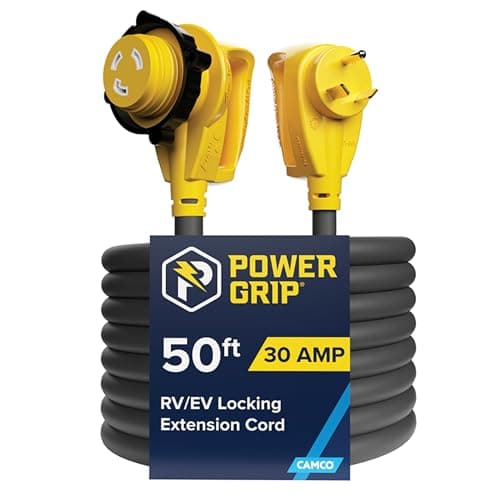
Buy the Camco PowerGrip 50 ft if your site has a 30 amp TT-30 post - a trailer, a camper, or the better powered pitches at a state park. Nothing in the household aisle will connect to that post, the locking ring keeps the joint dry and together, and 10 gauge copper is what 30 amps requires.
The picks in full
1. Best overall
Iron Forge Cable 50 ft Lighted Outdoor Extension Cord, 3 Outlets
Iron Forge Cable
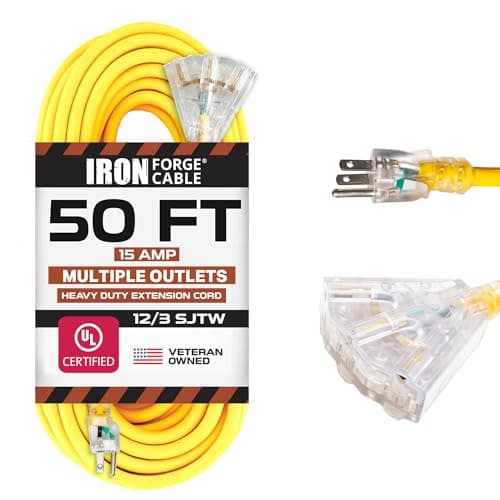
50 ft of 12 AWG rated 15 A and 1,875 W, with three outlets at the tent end and a lighted plug, good from -40 F to 140 F.
Iron Forge publishes a 50 ft length, 12 AWG 12/3 SJTW construction, a 15 A / 125 V / 1,875 W rating, three outlets at the far end, a lighted end that shows when power is present, a flexible vinyl jacket rated against moisture, abrasion and sunlight, a -40 F to 140 F temperature range, nickel-coated reinforced blades and UL certification.
This wins because of two features that sound like extras and are not. Three outlets at the tent end mean one cord does the whole pitch - a string of lights, a fan and a charger - instead of a cord plus a separate strip plus another trip hazard. And the lighted end is the only way to know the post actually has power before you start diagnosing your own gear in the dark.
Twelve gauge at 50 ft is the right pairing. Wire resistance rises with length, so a long thin cord drops voltage and sheds the difference as heat in the cable: a 16 gauge 50-footer carrying 10 A is warm along its whole length, which is wasted power and a real risk under a groundsheet. The gauge is the specification you are buying.
The drawback
Fifty feet of 12 gauge copper is heavy and stiff in the cold, and it does not coil back into a neat loop. Three unprotected outlets sitting on wet grass is a decision you have to manage.
Published specs
Length
50 ft
Gauge
12 AWG, 12/3 SJTW
Rating
15 A, 125 V, 1,875 W
Outlets
3, at the far end
Lighted end
yes - shows when power is present
Jacket
flexible vinyl, moisture, abrasion and sunlight resistant
50 ft of 10 AWG copper rated 30 A / 125 V / 3,750 W, with a TT-30P plug, a locking L5-30R connector and 90-degree heads.
Camco publishes a 50 ft length, 10 AWG 100 percent copper wire, a 30 A / 125 V / 3,750 W rating, a NEMA TT-30P male plug, a NEMA L5-30R locking female connector with a threaded locking ring, 90-degree heads to take strain off the connection, a flame-retardant heat-resistant PVC sheath, PowerGrip handles and a limited 12-month warranty.
The reason this is on a camping page rather than only an RV one is that the better powered pitches at state parks and private campgrounds are wired as 30 amp TT-30 posts, and a household cord physically will not connect. If your site has a three-prong post with one angled blade, this is the cord, and nothing in a hardware store's household aisle will do.
The locking ring is the feature that earns the price. A standard connector pulls apart when somebody trips over the cord or when it swings in the wind for two days; a threaded ring does not, and it keeps water out of the joint. The 90-degree heads do the same job at the other end, by stopping the cable's own weight from levering the plug out of the post.
The drawback
It is a 30 amp RV cord with a TT-30 plug, so it will not go into a household outlet without an adapter, and it is both the heaviest and the most expensive cord here. Overkill for a tent with a phone charger.
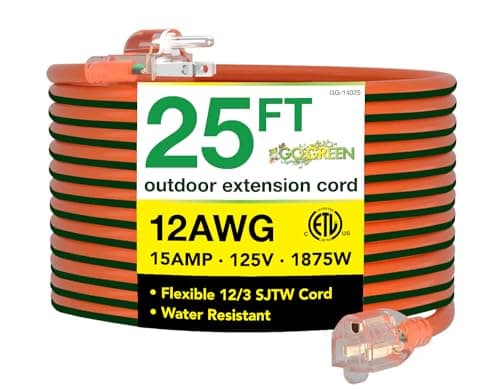
25 ft of the same 12 AWG 12/3 SJTW at 15 A and 1,875 W, with a lighted end, for about a third of the price.
Go Green Power publishes a 25 ft length, 12 AWG 12/3 SJTW construction, a 15 A / 125 V / 1,875 W rating, one outlet, a lighted end, and suitability for indoor and outdoor use.
The argument for a short heavy cord over a long one is that you lose less in the cable and carry less to the site. Twenty-five feet of 12 gauge at 10 A barely warms; the same current over a hundred feet of thin cord is a measurable voltage drop. If the post is close, do not buy length you do not need.
Paired with the power block below, this is the cheapest complete campsite power setup that is actually to specification: one heavy cord to the tent, one protected strip with a breaker where the devices are, nothing daisy-chained.
The drawback
One outlet, so you will want a strip with it, and 25 ft is not far - on a large pitch you will be measuring from the post to the tent and finding you are short.
Southwire Yellow Jacket 8-Outlet Metal Power Block
Southwire
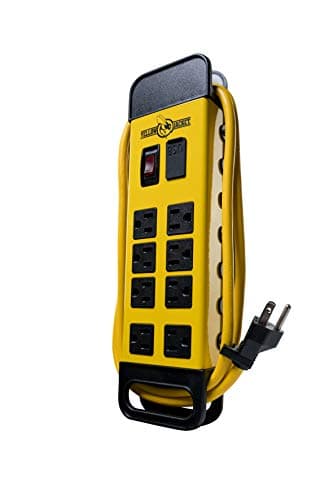
Eight outlets and two 2.4 A USB ports in a metal housing with its own 15 A breaker, on a 6 ft 14 AWG cord.
Southwire publishes eight outlets including two adapter outlets, a 15 A / 125 V rating, 14 AWG construction, a 6 ft cord, two 2.4 A USB ports with a rubber debris cover, a built-in 15 A breaker, a heavy-duty metal housing and UL listing.
The built-in breaker is the whole point. A campsite post may be protected 50 feet away where you cannot see it, and the thing you want between a wet field and your own equipment is a local 15 A breaker that trips before the cable does anything interesting. The metal housing survives being stood on in a tent porch, which plastic strips do not.
Two USB ports at 2.4 A also quietly remove the need for half your plugs. Most of a camping kit charges over USB - headlamps, lanterns, phones, the pad pump - so a strip with ports built in means fewer bricks and fewer things to lose.
The drawback
It is a workshop strip, not a weatherproof one, so it has to live inside the tent or under cover. Fourteen gauge means it is the feed cord that must carry the load, not this.
12 AWG (12/3) for any run over 25 feet, with an SJTW outdoor jacket and a 15 A / 1,875 W rating. Gauge runs backwards, so 12 is thicker than 16: thicker wire drops less voltage and makes less heat over a long run, which matters outdoors where the cord is often under a groundsheet or in grass rather than in free air.
QCan I use a regular extension cord at a campsite?
Only if it is rated for outdoor use, which means the jacket code ends in W - SJTW is the one to look for. An indoor cord has no weather-resistant jacket, and the packaging photograph is not the specification. You also need the right plug: a 30 amp TT-30 post will not accept a household plug at all.
QIs it safe to leave an extension cord coiled while in use?
No. A coil traps the heat that the wire's own resistance produces, which is how a jacket ends up soft or melted. Uncoil the whole length even if your pitch only needs half of it, and keep the unused run flat rather than in the bag.
QWhat can I run on a 15 amp campsite cord?
Fifteen amps at 125 V is 1,875 W, which covers everything a tent camper normally owns - lights, charging, a fan, an electric cooler, an electric blanket - with room to spare. The exception is heat: a ceramic tent heater on high plus a kettle is well over 2,400 W, and that is what trips the post. Run a heater on its own cord with nothing sharing it.
QDo I need a 30 amp RV cord for tent camping?
Only if the post is a 30 amp TT-30 outlet, which some state park and private campground pitches are. It is the plug shape rather than the power that forces the choice - no household cord will physically connect. For a tent on a standard 15 amp post, a 12 gauge household cord is the right tool and a 30 amp RV cord is overkill.
How we picked
Everyone else in this category will tell you they tested twenty of these. We have not tested any of them, and we would rather say so than pretend. There is no gear closet here and no test lab.
What we did instead: pulled the published specifications from each manufacturer's own spec sheet or manual, named the standard behind every rating so you can check what it actually promises, did the arithmetic that turns a spec into a decision, and pulled today's real retail price rather than quoting one from memory. Every pick states a drawback, because a list where nothing is wrong with anything is an advert.
The limits of that method, stated plainly: published specs do not capture zipper quality, seam durability, or how a tent behaves at 2am in a storm. Where that matters, we say so on the pick. The full method is here.