For developed campgrounds with a potable water supply, no. A filter earns its place when you walk beyond the campground, camp somewhere with an untreated or unknown supply, or take a trip where you cannot carry all the water you need. It is not a safety item at a site with a mains tap. It becomes one the moment the tap is a standpipe of unknown provenance or the water is a stream.
Filter
Pore size
Flow
Weight
Cartridge life
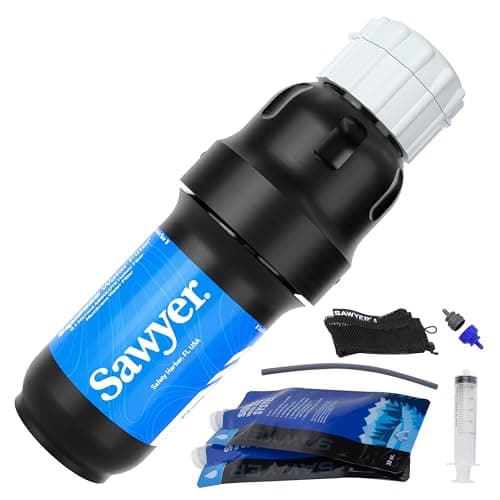
Sawyer Squeeze
0.1 micron absolute
Squeeze-driven
3 oz
Cleanable, no scheduled replacement
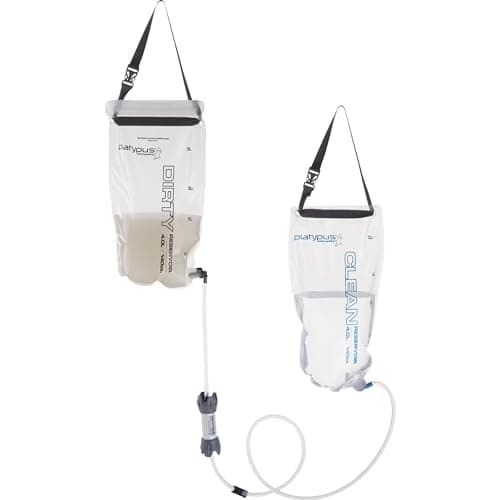
Platypus GravityWorks 4 L
0.2 micron
Up to 1.75 L/min
11.5 oz (system)
Up to 1,500 L
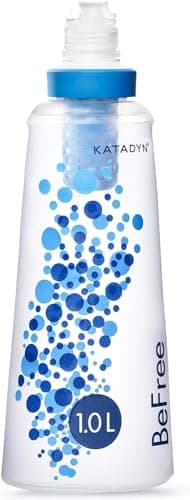
Katadyn BeFree 1.0 L
0.1 micron
Up to 2 L/min
63 g
Up to 1,000 L
All figures as published by the manufacturers.
What a micron rating actually promises
Pore size tells you the size of the largest thing that can get through. The two categories that make campers ill in North America and Europe are bacteria, at roughly 0.2 to 5 microns, and protozoa such as giardia and cryptosporidium, at roughly 1 to 300 microns. Both are comfortably larger than a 0.1 or 0.2 micron pore, which is why every filter here handles them and why the difference between 0.1 and 0.2 micron is much smaller in practice than it looks.
Viruses are the exception. At roughly 0.004 to 0.1 microns they pass straight through a hollow-fiber filter, and no filter here claims otherwise. In North America and Western Europe, waterborne viral illness from backcountry water is rare enough that hollow-fiber filtration is the standard choice. In regions where it is not rare, you want a purifier — chemical, UV, or a filter specifically rated for viruses — and that is a different purchase from anything on this page.
What no filter here removes
Dissolved chemicals, heavy metals, agricultural runoff and salt all pass through a hollow-fiber membrane untouched. A filter makes biologically unsafe water safe; it does not make chemically contaminated water safe. Do not filter from a stream running out of a mine, a field of livestock, or an industrial site and assume the problem is handled. Collect from moving water, upstream of camps and trails, and away from obvious sources.
Match the filter to how you collect
Refilling as you move — one or two people, walking, drinking from bottles: a squeeze or bottle filter. Low weight, no setup, and you never carry more water than the next few miles need.
Filling for a camp — a group, cooking, washing up, coffee in the morning: a gravity system. The metric that matters is liters per minute unattended, because the alternative is one person squeezing bags while everyone else waits.
Both is the usual answer for a family that also walks, and it is not an extravagance: a squeeze filter is small enough to live permanently in a daypack, and a gravity system lives in the camp bin with the rest of the kit.
Freezing is what kills filters
Hollow-fiber filters work by forcing water through microscopic tubes. If water inside those tubes freezes, it expands and splits them — and a split fiber does not look any different, does not slow down, and quietly passes everything through. There is no way to test for it in the field.
So: on any trip where the temperature may drop below freezing, the filter sleeps in your sleeping bag with you, and it is stored dry at home. This is the single most common way a good filter becomes a useless one, and it happens on shoulder-season trips where nobody expected a frost.
Backups worth carrying
Filters clog, split and get left at home. Chemical tablets weigh almost nothing, cost very little, and belong in the same pocket as the first aid kit. They are slow and they taste of chemistry, which is exactly why they are a backup and not a primary system. Boiling also works and always has: bringing water to a rolling boil kills everything a camper needs to worry about, at the cost of fuel and an hour of cooling.
The picks in full
1. Best all-round, and the one to buy first
Sawyer Squeeze Water Filter (SP129)
Sawyer
0.1 micron absolute at 3 oz, backwashable in the field, with published removal of 99.99999% of bacteria and 99.9999% of protozoa.
Sawyer publishes 0.1 micron absolute filtration, removal of 99.99999% of bacteria such as salmonella, cholera and E. coli, removal of 99.9999% of protozoa including giardia and cryptosporidium, removal of 100% of microplastics, a 3 oz weight, and a hollow-fiber membrane that survives backwashing with the included syringe, restoring up to 98.5% of the original flow rate each time.
Two things put it first. The first is the finest pore size here at 0.1 micron. The second is the maintenance model: there is no cartridge to replace on a schedule, and no moment where the filter is quietly past its life and you do not know. You clean it, the flow comes back, you carry on.
The practical weakness is not the filter, it is the bags. The soft pouches supplied with squeeze filters split at the seams eventually. Most long-term users thread the filter onto a standard soft flask or a threaded bottle instead, which is worth knowing before you conclude the system has failed.
The drawback
Slow when you need volume, and it needs regular backflushing or the flow rate collapses. The included pouches are the part that fails.
Up to 1.75 L per minute unattended, four liters in about two and a half minutes, at 11.5 oz for the whole system.
Platypus publishes a 0.2 micron pore size, removal of 99.9999% of bacteria and 99.9% of protozoa, a flow rate of up to 1.75 L per minute, four liters filtered in roughly 2.5 minutes, an 11.5 oz total system weight, a cartridge life of up to 1,500 L, and field-backflushing to maintain performance.
The relevant number is the flow rate, and the reason is social rather than technical. Squeezing four liters through a hand filter for a family of four before dinner is a fifteen-minute job with sore hands. Hanging a bag from a branch and going back to the stove is not a job at all. That difference decides whether the group treats water properly on day three or starts taking shortcuts.
The two-reservoir design also solves the storage problem nobody plans for. You end up with four liters of clean water in a bag at camp, which is what you actually want for cooking, washing and morning coffee — and it stops the endless walk back to the stream. See washing up at camp for the other half of that water budget.
The drawback
0.2 micron rather than 0.1, a 1,500 L cartridge life that does end, and it needs a branch or a tent pole to hang from.
0.1 micron at 63 g, filtering up to 2 L per minute, cleaned by shaking rather than backflushing.
Katadyn publishes a 0.1 micron pore size, removal of bacteria, cysts and sediment, a flow rate of up to 2 L per minute, a 63 g weight for the standard version, an output of around 1,000 L depending on water quality, a 43 mm wide mouth for filling, and an EZ-Clean membrane cleaned by shaking or swishing.
Two liters a minute is the fastest here, and the cleaning method is the reason it deserves a place: no syringe, no backflush kit, no small parts to lose. You swish the filter in water and the flow returns. On a cold morning with numb fingers that is worth a great deal.
Its limitation is capacity. One liter at a time is a drinking system for a person on a day walk, not a supply for a campsite. It is the natural companion to a gravity system rather than a replacement for one, and it is the filter that fits in a jacket pocket for a walk from the tent.
The drawback
A 1 L soft flask is a small reservoir, cartridge life is published at up to 1,000 L, and it is a drinking system rather than a camp water supply.
Not at developed campgrounds with a potable supply. A filter is worth carrying when you walk beyond the campground, camp somewhere with untreated water, or take trips where you cannot carry all the water you need.
QWhat micron rating removes giardia?
Giardia and cryptosporidium are protozoa in roughly the 1 to 300 micron range, so any filter rated 0.1 or 0.2 micron removes them. Sawyer publishes 0.1 micron absolute for the Squeeze and Platypus publishes 0.2 micron for GravityWorks.
QDo camping water filters remove viruses?
No. Hollow-fiber filters at 0.1 to 0.2 micron do not remove viruses, which are far smaller. In North America and Western Europe that is an accepted trade. Where waterborne viruses are a real risk you need a purifier rather than a filter.
QCan a water filter freeze?
Yes, and it is the most common way a filter is ruined. Water trapped inside the hollow fibers expands as it freezes and splits them, after which the filter passes contaminants without any visible change. Sleep with the filter in your sleeping bag when frost is possible and store it dry.
How we picked
Everyone else in this category will tell you they tested twenty of these. We have not tested any of them, and we would rather say so than pretend. There is no gear closet here and no test lab.
What we did instead: pulled the published specifications from each manufacturer's own spec sheet or manual, named the standard behind every rating so you can check what it actually promises, did the arithmetic that turns a spec into a decision, and pulled today's real retail price rather than quoting one from memory. Every pick states a drawback, because a list where nothing is wrong with anything is an advert.
The limits of that method, stated plainly: published specs do not capture zipper quality, seam durability, or how a tent behaves at 2am in a storm. Where that matters, we say so on the pick. The full method is here.