Decide insulated or not, then decide what the lid does. Insulated means stainless, roughly 15 oz empty, and cold water all day. Uninsulated means plastic, roughly 6 to 7 oz, and water that matches the air. A wide mouth pours and takes a filter; a straw lid makes you drink more. Capacity barely matters, because almost everything in this category is 32 oz.
The reason 32 oz dominates is that it is one liter, which is the unit every hydration guideline, electrolyte tablet and water filter is specified in. A one-liter bottle makes the arithmetic in how much water do you need camping trivial: fill it four times and you have had four liters.
Compared on published numbers
Bottle
Capacity
Weight empty
Material
Insulated
Lid
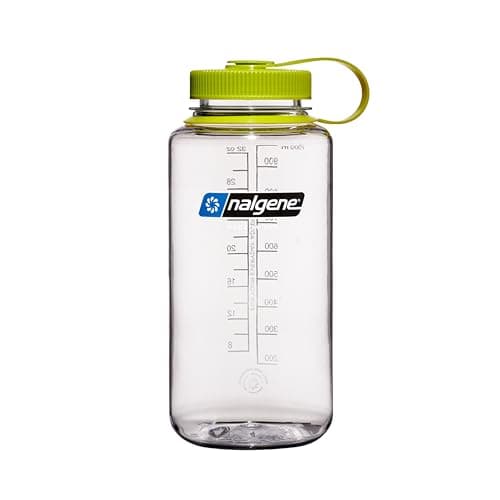
Nalgene Wide Mouth Sustain
32 oz
6.25 oz
Tritan Renew, 50% recycled
no
wide mouth screw cap
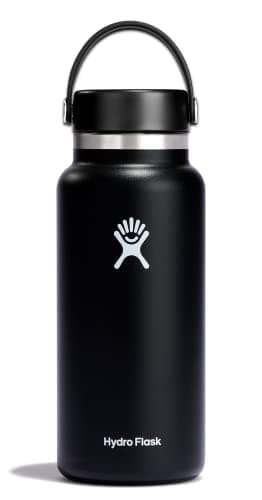
Hydro Flask Wide Mouth
32 oz
about 15.5 oz
18/8 stainless
yes, 24 h cold / 12 h hot
wide mouth, multiple cap options
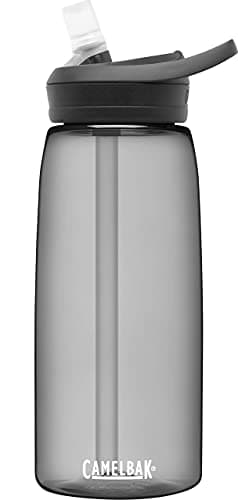
CamelBak Eddy+
32 oz
about 7 oz
Tritan Renew, 50% recycled
no
straw with bite valve
Figures as published by each manufacturer.
The weight column is the whole comparison. Two of these are about the weight of an empty mug; the third weighs as much as a small paperback before you put anything in it. A full 32 oz bottle is about 2.1 lb of water regardless, so the empty weight is a smaller share than it looks — but it is the part you carry home empty.
Mouth width decides what else the bottle can do
A wide mouth is a 63 mm opening, which is the informal standard that most camping accessories are built around. It takes ice cubes, it takes a bottle brush, and crucially it threads onto common squeeze and gravity water filters, which turns your bottle into the clean side of a filtration setup. The filter side of that is in best water filters for camping.
A narrow mouth is easier to drink from while moving and much less likely to slosh down your chin. A straw lid is easiest of all to drink from and cannot pour at all.
Lid type
Good at
Bad at
Wide mouth screw
pouring, ice, filters, cleaning
drinking while walking
Narrow mouth screw
drinking on the move
ice, filter threads, scrubbing
Straw / bite valve
drinking often, hands-free, kids
pouring, parts to clean
Chug or flip spout
a compromise between the first two
adds a part that can leak
Our summary of the trade-offs in each cap design.
The freezer trick only works with a single-wall bottle
Fill a Nalgene two-thirds full, freeze it flat, and you have a block of ice that melts into drinking water — the highest-value thing in a cooler, because block ice lasts far longer than cubes and this block does not flood your food as it goes. Never do this with an insulated bottle: the vacuum layer prevents it freezing properly and the expansion can deform the inner wall. Leave the headspace, or the plastic will bulge too.
Stainless, plastic and taste
Tritan is the copolyester used in both plastic bottles here, and both makers state their bottles are free of BPA and BPS. It does pick up flavors over time, particularly from electrolyte drinks and coffee, and the wide mouth exists partly so you can scrub that out.
Stainless does not absorb flavor, but it does conduct it: a stainless bottle that held coffee will taste of coffee until it is properly washed, and 18/8 steel is the alloy used because it resists that and does not corrode. Neither material is meaningfully healthier than the other. Choose on weight and insulation.
How many bottles a camping household needs
One per person, plus the jug. This is the part people get wrong in both directions: bottles are not water storage, and a water container is not something you carry on a walk.
The working setup is a 5 to 7 gallon jug at the site as the reservoir, and one bottle per person that gets refilled from it. That also solves the labeling problem — nobody drinks from the washing-up water — which is covered in campsite toilets and hygiene.
What the specifications do not tell you
Insulation claims are not tested to a common standard. Hydro Flask's 24-hours-cold figure is its own protocol, with its own starting temperature, ambient temperature and definition of “cold”, and no two brands use the same one. The claims are useful for ranking a brand's own line and useless for comparing across brands, which is the same problem as cooler ice claims.
Durability is not published by anyone. Nalgene's reputation for survival comes from decades of use rather than a drop rating, and there is no figure we can quote for any of these.
What to buy with it
A bottle brush set with a straw brush is the accessory that determines whether a bottle lasts a season or five years, particularly for the CamelBak. For hot drinks at camp, an insulated bottle overlaps with the insulated drinkware decision, and a 20 L water carrier is the reservoir those bottles refill from.
Which to buy
Buy the Nalgene if you buy one bottle. It is the lightest, the cheapest, the most versatile, and the only one here that can hold boiling water or become a block of ice. Buy the Hydro Flask as a second bottle if you camp in heat and want cold water at 4pm. Buy the CamelBak Eddy+ for a child, or for yourself if you know you do not drink enough.
The picks in full
1. Best overall
Nalgene Wide Mouth 32 oz Sustain
Nalgene
32 oz of Tritan at 6.25 oz, rated from -40 to 212 F, with a wide mouth that takes a filter and ice.
Nalgene publishes a 32 oz / 1 L capacity, a 6.25 oz / 178 g weight, 8.25 in of height and 3.5 in of diameter, Tritan Renew construction with 50 percent recycled content and no BPA or BPS, a temperature range of -40 to 212 F, and top-rack dishwasher safety.
The temperature range is the underrated specification. You can pour boiling water into this bottle, which makes it a hot water bottle in a sleeping bag on a cold night, and you can freeze it solid and use it as a block of ice in the cooler that becomes drinking water as it melts. No insulated bottle does either.
The 63 mm mouth is the other reason it endures. It takes a standard water filter thread, it takes ice cubes, and you can get a hand inside to scrub it — which matters after a week of electrolyte tablets.
The drawback
No insulation at all. Water left in the sun gets warm, and the hard plastic sweats in humidity and is loud when it hits a rock.
24 hours cold and 12 hours hot from TempShield double-wall vacuum insulation in 18/8 stainless.
Hydro Flask publishes a 32 oz capacity, a weight of about 15.5 oz, TempShield double-wall vacuum insulation rated to keep drinks cold up to 24 hours and hot up to 12, 18/8 pro-grade stainless steel construction, and dimensions of 3.55 in diameter by 10.2 in tall.
Vacuum insulation is a genuine physical barrier rather than a marketing claim: there is nothing between the walls to conduct heat. The practical effect at a campsite in summer is that ice put in at breakfast is still there at dinner, which no single-wall bottle approaches.
The cost is exactly the weight. Nine extra ounces is negligible in a car and significant on a long day walk, which is the real reason many people own both.
The drawback
About 15.5 oz empty, which is roughly two and a half times the Nalgene. You are carrying the vacuum flask everywhere to get cold water at 4pm.
A bite-valve straw lid on a 32 oz Tritan Renew body at about 7 oz, leakproof closed and spill-proof open.
CamelBak publishes a 32 oz / 1 L capacity, a weight of about 7 oz / 198 g, dimensions of 3.5 by 3.5 by 10 in, Tritan Renew construction with 50 percent recycled material, a straw cap with a bite valve that is leakproof when closed and spill-proof when open, and dishwasher safety.
The straw is not a gimmick, it is a behavior change. Drinking from a bite valve takes no hands and no head tilt, so people do it while driving, while walking and while sitting around a fire, and they drink measurably more as a result. For children it is the difference between a full bottle at the end of the day and an empty one.
Take the valve apart when you get home. Everything that goes wrong with these bottles happens in the parts people do not remove.
The drawback
The straw and bite valve are two extra parts to clean and the usual failure point. A straw lid also cannot be used to pour, which rules it out for filling a pot.
32 oz, which is one liter. Every hydration guideline, electrolyte tablet and water filter is specified in liters, so a one-liter bottle makes tracking your intake simple. It is also the size the whole category is built around, so lids and accessories fit.
QAre insulated water bottles worth it for camping?
In hot weather, yes. Hydro Flask publishes up to 24 hours cold from its double-wall vacuum insulation, which no single-wall bottle approaches. The cost is weight: about 15.5 oz empty against 6.25 oz for a Nalgene. Many people carry the plastic bottle walking and keep the insulated one in the car.
QCan you put boiling water in a Nalgene?
Yes. Nalgene publishes a temperature range of -40 to 212 F for its Tritan bottles, so boiling water is within spec. That is what makes it usable as a hot water bottle in a sleeping bag on a cold night, which an insulated bottle cannot do because it keeps the heat inside.
QWide mouth or narrow mouth for camping?
Wide mouth for most people. A 63 mm opening takes ice, fits a bottle brush and threads onto common water filters, which turns the bottle into the clean side of your filtration setup. Narrow mouths are easier to drink from while moving but do none of that.
How we picked
Everyone else in this category will tell you they tested twenty of these. We have not tested any of them, and we would rather say so than pretend. There is no gear closet here and no test lab.
What we did instead: pulled the published specifications from each manufacturer's own spec sheet or manual, named the standard behind every rating so you can check what it actually promises, did the arithmetic that turns a spec into a decision, and pulled today's real retail price rather than quoting one from memory. Every pick states a drawback, because a list where nothing is wrong with anything is an advert.
The limits of that method, stated plainly: published specs do not capture zipper quality, seam durability, or how a tent behaves at 2am in a storm. Where that matters, we say so on the pick. The full method is here.