The Best Camping Mugs, Compared on Hours Rather Than Looks
A vacuum mug keeps coffee hot for seven hours. That is a feature at a campsite and a problem on a summit, and the difference is worth understanding before you buy.
A double-wall vacuum mug holds heat for hours because there is no air between the walls to conduct it away. An insulated sleeve mug only slows the loss. Vacuum is heavy and unbeatable at a campsite; a sleeve is a few ounces and adequate for a drink you finish in twenty minutes.
The reason this is not simply a case of buying the better one is weight. The Stanley is 5.8 oz for 16 oz of capacity; the GSI is 3.5 oz for 17.5 oz. That two-ounce difference is trivial in a car and significant in a pack where the mug is competing with a stove and fuel.
There is also a genuine downside to vacuum insulation nobody warns you about: it works both ways. Water poured in at boiling stays too hot to drink for a long time, which is precisely wrong when you are cold and want a hot drink now.
Compared on published numbers
Mug
Capacity
Insulation
Hot for
Weight
Lid
Stanley Classic Trigger-Action
16 oz
double-wall vacuum stainless
7 hours
0.36 lb
trigger action, one-handed
YETI Rambler 14 oz Mug
14 oz
double-wall vacuum stainless
not published
not published
MagSlider magnetic
GSI Infinity Backpacker
17.5 oz / 500 ml
neoprene sleeve
not published
3.5 oz
sealable sip-through
Figures as published by each manufacturer. Only Stanley publishes retention hours for these models.
A mug at camp is three things
A drinking vessel. Obvious, and the only job a sealed tumbler does well.
A bowl. On a backpacking trip a wide mug rehydrates a meal, holds oatmeal, and saves you carrying a second item. This is why the GSI is 17.5 oz rather than 12.
A measuring cup. Almost every dehydrated meal and coffee method needs a known volume of water. A mug with graduations on the inside is genuinely more useful than one without.
That third one is the argument for reading the capacity carefully rather than just the shape. The methods that need measured water are compared in camp coffee methods compared.
Lids are the part that fails and the part you clean
Every mechanism — a trigger, a magnetic slider, a screw seal — is a place coffee oils and milk collect, and none of them come apart as far as you would like. Rinse the lid rather than just the mug, take the gasket out when it is removable, and expect to replace a silicone seal eventually rather than the whole mug. A magnetic slider is splash resistant rather than leakproof, so do not put one sideways in a pack.
What to look for beyond the specification
A handle, if the mug is for sitting around camp. Wrapping a hand round hot metal works for thirty seconds; a handle is what lets you hold it while a conversation happens.
A wide base, because campsites are not level and picnic tables are not flat. Most spilled camp drinks are geometry rather than clumsiness.
And a color that is not black, if you are the kind of person who leaves a mug on a rock. This is not a specification and it is the most common way camp mugs are lost.
Stainless, plastic or titanium
Stainless is heavy, tough, tastes of nothing and can go directly on a stove in some designs. Polypropylene is light, cheap, cannot be heated, and picks up flavors over time. Titanium is very light and very expensive, conducts heat fast so it burns your lips, and is the classic ultralight choice for people who accept that.
For most camping, stainless at a campsite and polypropylene in a pack is the sensible split, which is how the picks above line up. The cookware alongside it is in best camping cookware sets.
Keeping water cold is the other half
The same vacuum construction works in reverse, and Stanley publishes 10 hours cold and 30 hours iced against 7 hours hot. In summer that is the more useful figure of the two: a mug of cold water at a hot campsite in the afternoon does more for you than coffee does.
Buy the Stanley Classic Trigger-Action if you drive to your campsites and want coffee that outlasts breaking camp. Buy the YETI Rambler 14 oz if you want something to drink and eat from while sitting still. Buy the GSI Infinity Backpacker if you are carrying it, and accept that the drink will be warm rather than hot.
The picks in full
1. Best overall
Stanley Classic Trigger-Action Travel Mug, 16 oz
Stanley
16 oz staying hot for 7 hours and cold for 10, in 18/8 stainless with a one-handed trigger lid.
Stanley publishes a 16 oz capacity, 7 hours hot, 10 hours cold and 30 hours iced, dimensions of 2.9 by 2.9 by 8.9 in, a weight of 0.36 lb, 18/8 BPA-free stainless steel construction, double-wall vacuum insulation, a trigger-action lid for one-handed drinking, and dishwasher-safe components.
Seven hours is the specification that changes a campsite morning. Coffee made at 6am is still drinkable while you break camp, which means one brew rather than a second stove session, and that is a real saving in fuel and time.
The drawback
8.9 inches tall and 0.36 lb. It fits a car cup holder and not a pack side pocket, and the trigger lid has moving parts that need cleaning.
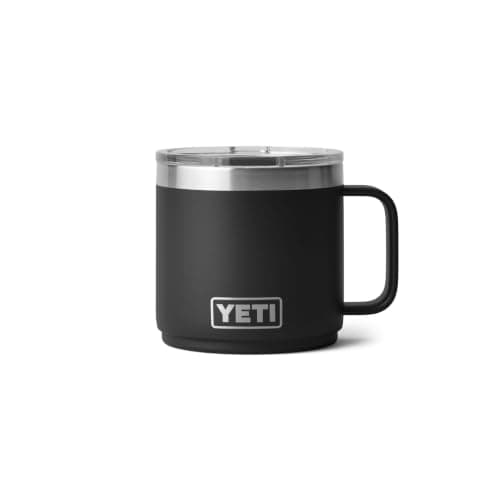
14 oz of double-wall vacuum stainless with a handle, a magnetic slider lid and a base that nests for storage.
YETI publishes a 14 oz capacity, kitchen-grade stainless steel construction, double-wall vacuum insulation, an included MagSlider magnetic lid, base grooves that let mugs nest for storage, and dishwasher-safe mug and lid.
The handle and the wide mouth are why this is a different object from the Stanley. You can drink from it normally, eat oatmeal or chili out of it, and see what is inside. A sealed travel tumbler does none of those things well.
The drawback
YETI does not publish hours-hot or hours-cold figures for this mug, so it cannot be compared numerically with the Stanley. The MagSlider lid is splash resistant rather than leakproof.
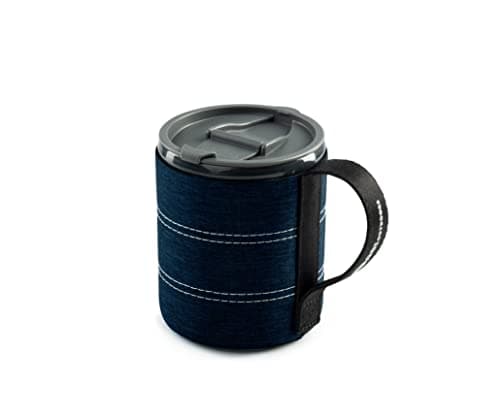
17.5 oz of capacity for 3.5 oz of weight, in polypropylene with an insulated neoprene sleeve.
GSI publishes a 17.5 oz / 500 ml capacity, a 3.5 oz weight, dimensions of 4.6 H by 4 W by 3.6 D in, an insulated neoprene sleeve wrapped in recycled rPET cloth, a sealable sip-through lid, a webbing handle that collapses flush, and BPA-free polypropylene construction.
Three and a half ounces against the Stanley's 5.8 is the whole argument. On a backpacking trip the mug is also the bowl and the measuring cup, and 17.5 oz is enough volume to rehydrate a meal in.
The drawback
The sleeve is insulation rather than a vacuum, so it slows heat loss instead of stopping it. Expect a warm drink in twenty minutes, not a hot one in seven hours.
At a campsite, yes. Stanley publishes 7 hours hot for the Classic Trigger-Action, which means one brew lasts through breaking camp rather than needing a second stove session. For backpacking the weight is harder to justify, and a sleeve mug at 3.5 oz is the usual compromise.
QWhat size camping mug should I get?
Around 16 to 18 oz. That is enough for a full coffee, enough to rehydrate most dehydrated meals, and enough to work as a bowl on a backpacking trip where the mug is doing several jobs.
QIs a vacuum mug or a sleeve mug better for backpacking?
A sleeve mug, for weight. A vacuum mug holds heat for hours and costs a couple of ounces you are also carrying a stove and fuel for. A sleeve mug slows heat loss enough for a drink you finish in twenty minutes.
QWhy is my insulated mug too hot to drink from?
Because vacuum insulation works. Water poured in at boiling stays near boiling for a long time, which is exactly wrong when you are cold and want a drink now. Let it stand with the lid off for a few minutes before sealing it.
How we picked
Everyone else in this category will tell you they tested twenty of these. We have not tested any of them, and we would rather say so than pretend. There is no gear closet here and no test lab.
What we did instead: pulled the published specifications from each manufacturer's own spec sheet or manual, named the standard behind every rating so you can check what it actually promises, did the arithmetic that turns a spec into a decision, and pulled today's real retail price rather than quoting one from memory. Every pick states a drawback, because a list where nothing is wrong with anything is an advert.
The limits of that method, stated plainly: published specs do not capture zipper quality, seam durability, or how a tent behaves at 2am in a storm. Where that matters, we say so on the pick. The full method is here.