Two people need one 2 L pot and a pan. Four people need a 3 L pot as well, and four of everything else. A set that is one size too small does not fail gracefully — it means cooking in two batches, and the first batch is cold before the second is ready. Piece counts on the box are inflated by plates and sporks; the pot volume is the specification that decides whether dinner works.
Set
Serves
Largest pot
Pan
Weight
GSI Pinnacle Ceramic Camper
4
3 L
9 in
3 lb 10.1 oz
Stanley Wildfare Core Full Serve
4
4 qt / 3.7 L
8 in tri-ply
4 lb 11 oz
MSR Trail Lite Duo
2
2 L
None
1 lb 5.8 oz
All figures as published by the manufacturers.
What the material actually changes
Anodized aluminum heats fast and evenly and is light, which is why almost every backpacking pot is made of it. It dents, and the hard anodized surface can be scoured through.
Stainless steel is nearly indestructible, takes fire and metal utensils, and conducts heat poorly — so it produces hot spots and sticks unless you cook gently. It is also roughly twice the weight for the same volume.
Non-stick coatings, ceramic or PTFE, make eggs and washing up dramatically easier and are the first thing to fail. Treat them with the discipline of a good pan at home: no metal utensils, no scourers, no dry heating, no stacking gritty items inside them.
Cast iron is not in this roundup and belongs in a car camping kit anyway. Nothing else cooks like it over a fire, and nothing else weighs like it either.
The pieces that never get used
Every set contains some ballast. Plates are the usual candidate — most camping food is eaten from a bowl, and a bowl handles both. Sporks split the difference badly and please nobody; take real cutlery for car camping. Kettles duplicate a pot with a lid. Whatis always used and is almost never in a set: a decent sharp knife, a chopping board, tongs, a tea towel and a washing-up basin. Add those, and consider leaving the plates at home.
Check it fits your stove before you buy
A wide pan on a narrow single-burner canister stove is unstable and heats only in the middle. A two-burner propane stove such as the Coleman Triton+ publishes a 12 in plus 10 in pan fit, which comfortably takes a 9 in fry pan and a 3 L pot side by side. A backpacking canister stove is happiest with a pot in the 1 to 2 L range, sitting low.
Check the pot handles too. Fold-out handles are what let a set nest, and they get hot — a pot gripper or a folding handle with an insulated sleeve is not optional over a real flame. The full stove comparison is in best camp stoves and propane vs butane.
Living with a set
Nest it the way it came out of the box, or it will not go back in. Put a piece of kitchen paper or a cloth between non-stick surfaces, which stops the coating being scoured by its own stablemates in a car boot. Wash and dry everything fully before it goes back into the kitchen bin, because a damp pot in a sealed box for three weeks is how a set starts to smell.
And keep the set with the rest of the kitchen, permanently packed. The whole argument of the camp kitchen setup guide is that a kitchen which lives in one box is a kitchen you will actually take.
The picks in full
1. Best set for a family of four
GSI Outdoors Pinnacle Ceramic Camper
GSI Outdoors
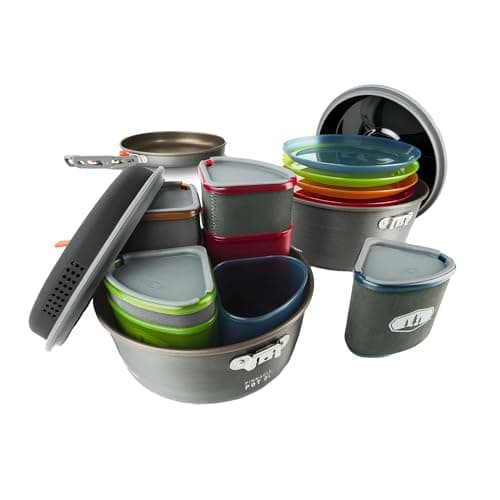
A 3 L and a 2 L pot with strainer lids, a 9 in fry pan, and plates, bowls and insulated mugs for four, at 3 lb 10.1 oz.
GSI publishes a 3 lb 10.1 oz weight, a 3 L pot and a 2 L pot both with strainer lids, a 9 in fry pan, four 14 oz color-coded insulated mugs with sip lids, four 14 oz bowls and four 7.5 in plates, hard-anodized aluminum pots and pan with a ceramic non-stick coating, polypropylene tableware, a pot gripper, and a carry bag that doubles as a washing-up sink.
Two pots with strainer lids is the specification that matters for feeding a family. The standard camp dinner is pasta plus a sauce, and doing that with one pot means cooking in series and eating something lukewarm. Two pots, one of them 3 L, means everything is ready at once.
The bag that becomes a sink is the underrated part. Washing up is the least pleasant job at a campsite and most sites do not provide a basin. Getting one for free, that also stores the set, removes an item from the checklist entirely. See how to wash dishes at a campsite for why the basin matters beyond convenience.
The drawback
Ceramic non-stick is the least durable coating here and will not survive metal utensils or a scouring pad. Anodized aluminum dents.
Published specs
Serves
4
Weight
3 lb 10.1 oz / 58.1 oz
Packed size
9.1 x 9.1 x 5.8 in
Pots
3 L and 2 L with strainer lids
Pan
9 in fry pan
Material
ceramic non-stick over hard-anodized aluminum
Tableware
4 insulated 14 oz mugs with sip lids, 4 bowls, 4 plates, color-coded
Extras
folding pot gripper; storage bag doubles as a camp sink
Stanley Wildfare Core Full Serve Cookset, 20-Piece
Stanley
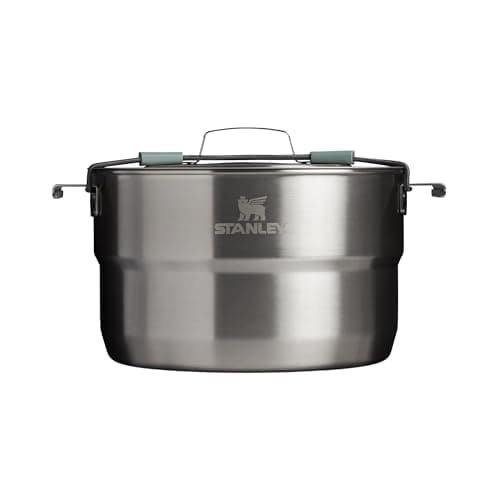
A 4 qt 18/8 stainless pot, an 8 in tri-ply pan, four plates, bowls and cutlery sets, a cutting board and a trivet, for four people at 4 lb 11 oz.
Stanley publishes a 2,133 g (4 lb 11 oz) weight and a 20-piece set containing a 4 qt (3.7 L) 18/8 stainless steel stock pot, a stainless lid with vent and strain holes, an 8 in tri-ply stainless fry pan, a nonslip cutting board with a removable silicone trivet, four 7 in stacking plates, four 16 oz stacking bowls, four dual-end cutlery sets, a two-piece spatula, a two-piece serving spoon and a bungee closure, all in food-grade 18/8 stainless and BPA free.
Stainless is the reason to buy it. Non-stick coatings on camp cookware have a hard life — sand, campfire heat, metal cutlery, being packed under a stove — and they do not survive it for long. Stainless does not care. It scours, it goes over a fire, it takes a metal spatula, and it will outlast the car you carry it in.
The trade is honest: stainless conducts heat unevenly, so a thin stainless pan burns in the middle and stays cold at the edges unless you cook lower and slower than you would at home. The 3-ply pan mitigates that with an aluminum core, and the extending-handle utensils are a genuinely good idea for a pot on a high-output burner.
The drawback
4 lb 11 oz, the heaviest here, and stainless steel means hot spots and food sticking unless you manage the heat. Bulky in a small car, and it is roughly four times the price of the GSI set for a comparable serves-four spread.
Published specs
Serves
4
Weight
2,133 g (4 lb 11 oz)
Pot
4 qt / 3.7 L, 18/8 stainless, vented straining lid
Pan
8 in tri-ply stainless
Tableware
4 x 7 in stacking plates, 4 x 16 oz stacking bowls, 4 dual-end cutlery sets
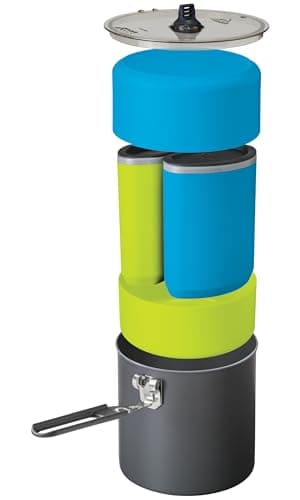
A 2 L hard-anodized pot with a ceramic coating, plus two insulated mugs and two bowls, nesting together at 1 lb 5.8 oz.
MSR publishes a 1 lb 5.8 oz weight, a 2.0 L hard-anodized aluminum pot with a ceramic non-stick coating that is PTFE and PFOA free, a clear strainer lid, two double-wall insulated mugs and two DeepDish bowls, with the mugs and bowls nesting inside the pot.
A quarter of the weight of the Stanley for half the people, which is the whole point: this is the only set here you would put in a backpack. The nesting is genuine rather than notional — everything really does go inside the pot, and a canister stove and a small gas cartridge fit in there too.
The insulated mugs deserve a mention on their own. On a cold morning a single-wall metal mug goes from scalding to lukewarm in about ninety seconds, and a double-wall one does not. It is a small thing that is disproportionately noticeable at 7am in a field.
The drawback
No frying pan, so this is a boil-and-simmer kit rather than a cooking kit. Two people means exactly two, with nothing spare.
For two people, a 2 liter pot and a pan. For four, add a 3 liter pot. The largest pot volume decides whether you can cook a meal in one go; the piece count on the box is mostly plates and sporks.
QIs stainless steel or aluminum better for camp cookware?
Aluminum heats faster and more evenly and weighs about half as much, which is why backpacking pots are made of it. Stainless is far more durable, takes fire and metal utensils, but conducts heat unevenly so food sticks unless you cook gently.
QDo camping cook sets include plates and cutlery?
Most family sets do. GSI's Pinnacle Ceramic Camper includes four plates, bowls and insulated mugs, and Stanley's Wildfare Core Full Serve includes four plates, four bowls, four dual-end cutlery sets, a cutting board and a trivet. Backpacking sets like the MSR Trail Lite Duo include mugs and bowls but no plates or pan.
QWhat happened to the Stanley Adventure Base Camp Cook Set 4x?
It has been discontinued and no longer has a live listing. The Base Camp 4x was the serves-four stainless set this page used to recommend - a 3.7 qt pot, a 3-ply pan, four plates and bowls, sporks and a dish drying rack at 5.7 lb. Stanley's current equivalent is the Wildfare Core Full Serve, which keeps the 18/8 stainless build and the four-person tableware in a 20-piece set at 4 lb 11 oz, with a slightly larger 4 qt pot. It does not include a drying rack, so a mesh drying bag is worth adding.
QHow do you clean non-stick camping cookware?
Warm water, a soft cloth or sponge, and no scourers or metal utensils. Let food soak rather than scraping it off, dry it fully before packing, and put a cloth between nesting non-stick surfaces so they do not abrade each other in transit.
How we picked
Everyone else in this category will tell you they tested twenty of these. We have not tested any of them, and we would rather say so than pretend. There is no gear closet here and no test lab.
What we did instead: pulled the published specifications from each manufacturer's own spec sheet or manual, named the standard behind every rating so you can check what it actually promises, did the arithmetic that turns a spec into a decision, and pulled today's real retail price rather than quoting one from memory. Every pick states a drawback, because a list where nothing is wrong with anything is an advert.
The limits of that method, stated plainly: published specs do not capture zipper quality, seam durability, or how a tent behaves at 2am in a storm. Where that matters, we say so on the pick. The full method is here.