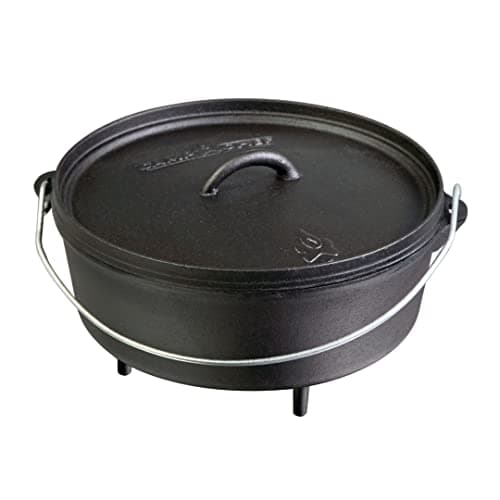
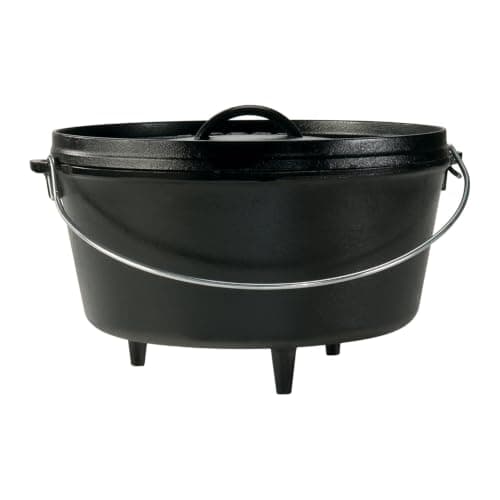
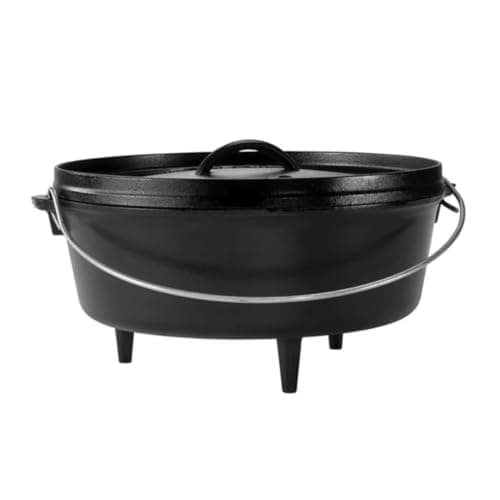
A camp dutch oven has three legs and a flanged lid; a kitchen dutch oven has a flat bottom and a domed lid. The legs hold the pot above the coals underneath it, and the flange keeps coals on top from rolling off. Neither works properly without the other. A kitchen dutch oven sits directly on the coals and scorches, and its lid cannot carry heat from above.
That second point is what people underestimate. Baking needs heat from above as well as below, and in a camp dutch oven that comes from briquettes sitting on the lid. Without a flange there is nowhere for them to sit, and without top heat you have a pot rather than an oven.
Compared on published numbers
Oven
Capacity
Diameter
Weight
Lid
Legs
Lodge L12CO3
6 qt
12 in
not published
flanged, inverts to a griddle
3 integral
Camp Chef DO-12
7 qt base, 9.33 qt total
12 in inside
24 lb
deep dish, works as a skillet
3
Lodge L10CO3
4 qt
10 in
not published
flanged, inverts to a griddle
3 integral
Figures as published by each manufacturer. Lodge does not publish weights for these models on the listings we read.
The briquette rule
This is the arithmetic that turns a dutch oven from a mystery into a tool. The widely used rule of thumb: take the diameter in inches, double it, and that is the total number of standard charcoal briquettes for roughly 325 F. For a 12 in oven that is 24 briquettes. Add or subtract two briquettes for each 25 F you want up or down.
Distribution matters as much as the count. For baking, put about two thirds of the coals on the lid and one third underneath, so heat comes mostly from above and the base does not scorch. For roasting or a stew, split them closer to even. For frying or browning, put nearly all of them underneath.
Oven size
Coals for about 325 F
Baking split, top / bottom
Roasting split
10 in
20 total
13 / 7
11 / 9
12 in
24 total
16 / 8
13 / 11
14 in
28 total
19 / 9
15 / 13
Our working figures from the double-the-diameter rule, at roughly two thirds top for baking.
Wind, cold and altitude all push the count up, and a dark oven in full sun runs hotter than the chart says. Rotate the oven a third turn and the lid a third turn the other way every fifteen minutes, which evens out the hot spots every fire has.
Coals are not the same as campfire embers
The briquette counts above assume standard uniform charcoal briquettes, because that is the only fuel consistent enough to count. Wood embers vary enormously in heat output and burn down far faster, so cooking over a wood fire is a matter of feel rather than arithmetic. Start with charcoal until you know what the food should look like. And check the campground fire rules before you plan around either — see campfire safety basics.
Seasoning, and the one thing that ruins them
All three arrive pre-seasoned, which is a working surface rather than a finished one. It improves with every fatty thing you cook and degrades with every acidic one: tomato sauce and wine strip seasoning, which is why the classic dutch oven recipes are chilis, cobblers and roasts rather than marinara.
Rust is the failure mode and it comes from storing the oven damp or storing it sealed. Dry it over heat, oil it thinly, and put a folded paper towel between the lid and the rim so air can move. The full routine is in how to clean and season cast iron at camp, and the material comparison is in cast iron vs stainless camp cookware.
What you need besides the oven
A lid lifter is not optional. A coal-covered lid at 400 F cannot be moved with a glove, and tipping it dumps ash into dinner. Camp Chef includes one; Lodge does not. Long tongs for moving coals, and heavy welding-style gloves rather than kitchen mitts, complete the set.
A lid lifter and coal tongs cost very little against the oven and are the difference between cooking and improvising. A chimney starter is the fourth item, because counting briquettes only works if they are all lit at the same time.
Which to buy
Buy the Lodge L12CO3 if you are buying one, because every recipe and chart assumes 12 inches. Buy the Camp Chef DO-12 if you want the lid to work as a second pan and the thermometer notch to take the guesswork out. Buy the Lodge L10CO3 if there are two of you or the weight is a genuine obstacle.
For everything a dutch oven cannot do — boiling, fast frying, breakfast for six — the other surfaces are in best camping griddles and best camp stoves.
The picks in full
1. Best overall
Lodge 6 qt Camp Dutch Oven (L12CO3)
Lodge
6 quarts at 12 in across, with a flanged lid that holds coals and inverts as a griddle, on three integral legs.
Lodge publishes a 6 quart capacity, a 12 in diameter, a 3.75 in interior depth, exterior dimensions of 13.25 in by 7.375 in high, a flanged lid that holds coals and inverts as a griddle, three integral fire-safe legs, a wire bail handle for a tripod, and a pre-seasoned cast iron finish made in the USA.
Twelve inches is the reference size. Nearly every camp dutch oven recipe and briquette chart you will find is written for a 12 in oven, which makes this the one to own if you are only owning one.
The drawback
Cast iron at this size is heavy enough that lifting it full and hot over a fire needs a lid lifter and real care. Lodge does not publish a weight on its listing.
A 7 quart base plus a 2.33 quart deep-dish lid that works as a full-size skillet, with a thermometer notch and a lid lifter included.
Camp Chef publishes a 7 quart base volume, a 2.33 quart lid volume, 9.33 quarts total, a 12 in inside and 12.75 in outside diameter, a 24 lb weight, a deep dish lid that doubles as a full-size skillet, a built-in thermometer notch and an included lid lifter.
The thermometer notch is genuinely useful and almost unique. Lifting a coal-covered lid to check dumps ash into the food and drops the temperature by fifty degrees or more; reading the inside without opening it is the difference between a cobbler and a burnt cobbler.
The drawback
24 lb. That is a serious object to lift, carry and wash, and the deep lid holds more coals than a flat one needs, so it burns through charcoal faster.
4 quarts at 10 in across, with the same flanged lid, integral legs and bail handle as the 12 in model.
Lodge publishes a 4 quart capacity, a 10 in diameter, exterior dimensions of 11.1 in by 6.8 in high, a flanged coal-holding lid that inverts as a griddle, three integral legs, a wire bail handle and a pre-seasoned cast iron finish made in the USA.
Four quarts feeds two to four people, and the weight difference against the 12 in model is the reason to consider it. A dutch oven you can carry to the fire ring one-handed gets used; one you dread lifting stays in the garage.
The drawback
10 in ovens need their own briquette counts, and most published charts and recipes assume 12 in. You will be converting every time.
Twelve inches, about 6 quarts, for four to six people, and it is the size every published recipe and briquette chart assumes. Ten inches, about 4 quarts, feeds two to four and is much easier to carry and clean.
QHow many charcoal briquettes for a dutch oven?
Double the diameter in inches for roughly 325 F, so 24 briquettes for a 12 in oven. Add or subtract two for each 25 F. Put about two thirds on the lid for baking and closer to half underneath for roasting.
QCan I use a regular dutch oven for camping?
Not well. A camp dutch oven has three legs that hold it above the coals and a flanged lid that keeps coals on top from rolling off. A flat-bottomed kitchen model sits directly on the coals and scorches, and its domed lid cannot carry top heat.
QDo camp dutch ovens come pre-seasoned?
Lodge and Camp Chef both publish pre-seasoned finishes, but treat that as a starting surface rather than a finished one. It improves with fatty cooking and degrades with acidic food, which is why the classic recipes are chilis, roasts and cobblers.
How we picked
Everyone else in this category will tell you they tested twenty of these. We have not tested any of them, and we would rather say so than pretend. There is no gear closet here and no test lab.
What we did instead: pulled the published specifications from each manufacturer's own spec sheet or manual, named the standard behind every rating so you can check what it actually promises, did the arithmetic that turns a spec into a decision, and pulled today's real retail price rather than quoting one from memory. Every pick states a drawback, because a list where nothing is wrong with anything is an advert.
The limits of that method, stated plainly: published specs do not capture zipper quality, seam durability, or how a tent behaves at 2am in a storm. Where that matters, we say so on the pick. The full method is here.