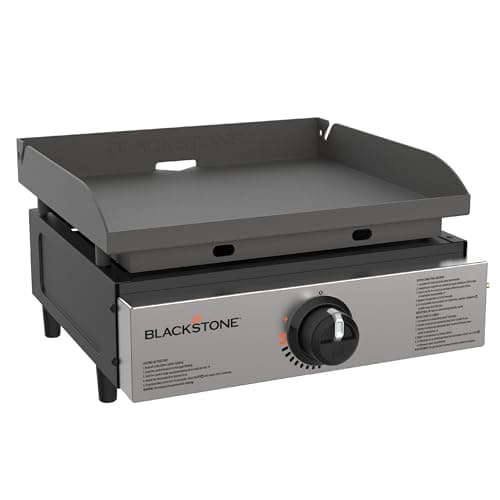
Divide published BTU by published square inches. Roughly 45 to 80 BTU per square inch is the working range for a camping flat top; below that, a surface covered in cold food drops the plate temperature faster than the burners can recover it. Cooking area alone tells you how much fits, not how well it cooks.
Run the arithmetic on these three. The Blackstone 17 is 12,500 BTU over 267 sq in, about 47 per square inch. The Blackstone 22 is 24,000 over 362, about 66. The Camp Chef VersaTop 2X is 32,000 over 416.5, about 77. All three are workable, and a cheap griddle claiming a huge surface on one small burner is where this goes wrong.
Compared on published numbers
Griddle
Cooking area
Output
BTU per sq in
Weight
Zones
Camp Chef VersaTop 2X
416.5 sq in
32,000 BTU/h
about 77
39 lb
2
Blackstone 22 in. with hood
362 sq in
24,000 BTU
about 66
not published for the tabletop
2
Blackstone 17 in.
267 sq in
12,500 BTU
about 47
25 lb
1
Figures as published by each manufacturer or their listings. BTU per square inch is our calculation.
Carbon steel, and the thing nobody warns you about
A camping griddle top is bare rolled carbon steel with a seasoned finish, not a non-stick coating. It arrives with a factory seasoning that is a starting point rather than a finished surface, and it will rust if it is put away damp. That is not a defect; it is the same material behavior as a cast iron pan.
Scrape while hot, wipe with a thin film of oil, let it cool dry, and store it indoors or under a cover. If it does rust, steel wool and a re-season brings it back. The routine transfers directly from how to clean and season cast iron at camp.
Grease management is a safety feature, not a convenience
Both Blackstone models publish a rear grease management system. Griddles produce far more running fat than a stove does, and a full or missing grease cup means hot fat reaching the ground, the table, or the burner. Empty it between meals rather than at the end of the trip, and never pour it on the ground — the disposal rules are the same as for washing dishes at a campsite.
Griddle or two-burner stove?
A griddle cooks breakfast for a group better than anything else, because pancakes, eggs, bacon and hash browns all want the same flat hot surface at slightly different temperatures. A two-burner stove boils water, holds a pot and simmers, none of which a griddle does at all.
If you can only take one, take the stove — the case is in best camp stoves. If you are cooking for four or more and there is car space, the griddle is the one that changes how the trip feels, because it turns breakfast from a queue into a single event.
Fuel, and the adapter worth buying
All three run on propane. The 1 lb green cylinders are convenient and expensive per meal; a 20 lb tank costs a fraction as much per hour and needs an adapter hose. Blackstone publishes a bulk adapter hose with the 22 in model, which is worth knowing because buying it separately is the usual first accessory.
Two long metal spatulas, not one. Everything about griddle cooking involves moving food and scraping the surface at the same time, and a single spatula makes both worse. A squeeze bottle of oil is second, because oiling a hot plate from a capped bottle is how people burn hands.
Buy the Blackstone 22 in. with hood for family breakfasts, because two heat zones and a hood is the combination that does the job. Buy the Camp Chef VersaTop 2X if you want the most heat density and a base that takes other accessories. Buy the Blackstone 17 in. if it is two of you and the table is small.
The picks in full
1. Best overall
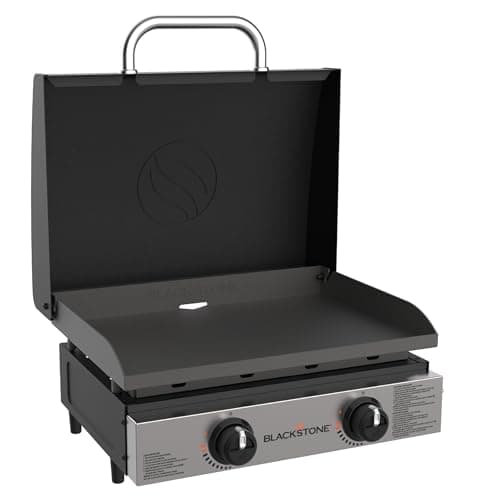
Blackstone 22 in. Tabletop Griddle with Hood
Blackstone
362 sq in with 24,000 BTU from two H burners and two independent heat zones, with a hood and a bulk tank adapter hose.
Published listing specifications give 362 sq in of cooking area, 24,000 BTU from dual H burners, two independently controlled heat zones, a rolled carbon steel griddle top, rear grease management, propane fuel with a bulk adapter hose for a 20 lb tank, and an included hood.
Two heat zones is the specification that matters most and gets discussed least. It lets you hold eggs on one side while bacon renders hard on the other, which is the entire point of a griddle over a frying pan. The hood turns it into something that can melt cheese and hold heat in wind.
The drawback
Two burners over 362 square inches works out to about 66 BTU per square inch, which is good, and the assembled unit is a big object that needs a table to itself.
416.5 sq in over two 16,000 BTU burners for 32,000 BTU total, with a griddle plate that lifts off the base.
Camp Chef publishes a 416.5 sq in cooking surface, 32,000 BTU/h total from two 16,000 BTU burners, a 39 lb total weight with a 26 lb griddle, a removable True Seasoned griddle surface and compatibility with Camp Chef 16 in accessories.
The removable top is the argument. Lift it off and you have a burner base that takes other Camp Chef accessories, which makes this the most versatile object here and the one most likely to still be earning its space in five years.
The drawback
39 lb total, of which 26 lb is the griddle plate alone. That is two separate lifts to load a car, and a two-piece unit is more to store.
267 sq in from a single 12,500 BTU H burner at 25 lb, in a 21.71 by 17.32 in body.
Blackstone publishes 267 sq in of cooking area, 12,500 BTU from a single H burner, a 21.71 by 17.32 by 8.62 in size, a 25 lb weight, piezo ignition and a rear grease management system.
That works out at roughly 47 BTU per square inch, and it shows: this small griddle recovers temperature faster than its size suggests. The price is that you cannot run a hot zone and a warm zone at the same time.
The drawback
One burner means one heat zone. Everything on the surface cooks at the same temperature, which is a real limitation once you are cooking two things at once.
About 250 to 270 square inches feeds two people, and 360 or more feeds four to six at once. Check output as well as area: divide published BTU by square inches and look for roughly 45 to 80 BTU per square inch.
QDo camping griddles rust?
Yes, if stored damp. The top is bare rolled carbon steel with a seasoned finish rather than a non-stick coating, so it behaves like cast iron. Scrape while hot, wipe on a thin film of oil, cool it dry and store it covered.
QIs a camping griddle better than a camp stove?
For breakfast for a group, yes, because everything wants the same flat hot surface. For everything else, no: a griddle cannot boil water, hold a pot or simmer. If you can only take one, take the stove.
QHow many BTU should a camping griddle have?
Enough to keep the plate hot when it is covered in cold food. Camp Chef publishes 32,000 BTU across 416.5 square inches, about 77 per square inch; the Blackstone 17 publishes 12,500 across 267, about 47. Well below 45 is where recovery gets slow.
How we picked
Everyone else in this category will tell you they tested twenty of these. We have not tested any of them, and we would rather say so than pretend. There is no gear closet here and no test lab.
What we did instead: pulled the published specifications from each manufacturer's own spec sheet or manual, named the standard behind every rating so you can check what it actually promises, did the arithmetic that turns a spec into a decision, and pulled today's real retail price rather than quoting one from memory. Every pick states a drawback, because a list where nothing is wrong with anything is an advert.
The limits of that method, stated plainly: published specs do not capture zipper quality, seam durability, or how a tent behaves at 2am in a storm. Where that matters, we say so on the pick. The full method is here.