The Best Portable Grills for Camping, Compared on Square Inches per Pound
A camp stove boils and simmers. A grill sears and chars. They are not competitors, which is why the honest question is whether you want the second thing enough to carry it.
Buy the two-burner stove first. It boils water for coffee, cooks pasta, simmers a sauce and fries eggs, and no grill does any of that well. A grill is what you add when you want char, smoke or a large flat surface — and it is worth adding, because those are the meals people remember. A Coleman Triton+ publishes 22,000 BTU total across two burners; a Weber Q 1200 publishes 8,500 BTU on one. They are not the same tool.
Grill
Cooking area
Output
Fuel
Weight
Best at
Weber Q 1200
189 sq in
8,500 BTU
16.4 oz propane
29.8 lb
Searing, and roasting with the lid down
Blackstone 17 in. griddle
267 sq in
12,500 BTU
Propane
25 lb
Breakfast, volume, anything diced
Weber Smokey Joe 14 in.
147 sq in
n/a, charcoal
Charcoal
9 lb
Flavour, and packing light
All figures as published by the manufacturers. BTU is not comparable to a charcoal grill, so we have left that cell blank rather than estimating.
How much cooking area do you need?
A rough working figure: about 40 sq in per person for a main course cooked in one pass. That puts the Smokey Joe at three to four people, the Weber Q at four to five, and the Blackstone at six or more — which broadly matches the capacities the makers publish.
Cook in shifts and any of them feeds more, at the cost of everybody eating at different times. For a family that matters more than it sounds, which is the practical argument for the griddle: not that it is better, but that everyone sits down together.
BTU is the wrong number to shop on
A grill's BTU figure tells you how much gas it can burn, not how hot the cooking surface gets or how evenly. What actually decides that is the grate material, the distance from burner to grate, and whether there is a lid.
Weber's 8,500 BTU over 189 sq in works out at about 45 BTU per square inch; Blackstone's 12,500 BTU over 267 sq in is about 47. Nearly identical, and the two cook completely differently because one has cast-iron grates and a lid and the other is a flat steel plate. Use BTU per square inch to sanity-check a suspiciously cheap grill, and judge everything else on construction. The same reasoning applies to stoves, in propane vs butane camp stoves.
Check the campground rules before you buy charcoal
Many campgrounds restrict open charcoal, some ban it entirely during fire season, and almost all require ash to go into a designated container rather than a fire ring or a bin. Gas grills are frequently permitted when charcoal is not, because there is no ember and no ash. One phone call or one page on the campground's own site settles it, and it is the same call that tells you the current fire ban status.
Fuel, and the arithmetic of a weekend
The 16.4 oz disposable propane cylinders that fit a Weber Q are the same ones that fit most two-burner camp stoves, which is a genuine convenience: one fuel, one spare, no adapters. Propane also keeps working below freezing, where butane canisters lose pressure — the reason this site defaults to propane for US camping.
For charcoal, plan on a full chimney per cooking session for a small kettle. Bring more than you think, because a charcoal grill that runs out mid-cook cannot be topped up quickly, and never transport partly used charcoal in a sealed bag it might still be warm in.
Cleaning, which decides whether you use it twice
Burn off and brush the grates while they are still hot — food comes off in seconds and welds itself on once cold. For the griddle, scrape while warm, wipe with a paper towel, then a thin film of oil before it goes away; it is a cast-iron surface in everything but shape.
Grease is also a wildlife attractant, so a grill left greasy overnight is stored food. Clean it before dark and store it with the rest of the kitchen kit, per how to store food safely when camping.
What we did not do
We have not cooked on any of these. There is no standardized test for grill heat output or evenness — unlike BTU, which is simply a fuel-burn rate — so every figure above is the manufacturer's published specification with a link, and the BTU per square inch column is our arithmetic on two published numbers. See how we research.
The picks in full
1. Best all-round portable grill
Weber Q 1200 Portable Gas Grill
Weber
189 sq in of porcelain-enameled cast iron over a single 8,500 BTU burner, in a cast aluminum body with folding side tables, for 29.8 lb.
Weber publishes 189 sq in of cooking area, an 8,500 BTU single burner running on a 16.4 oz liquid propane cylinder, porcelain-enameled cast-iron grates, electronic ignition, a cast aluminum lid and body with side tables, and a 29.8 lb weight.
The cast-iron grates are the specification that separates this from a folding camp grill. Cast iron holds heat, so the grate temperature does not collapse when cold food lands on it, which is the entire mechanism behind a proper sear. Thin steel grates lose heat instantly and steam what you put on them.
The lid matters as much as the burner. With it down, this behaves like an oven and will cook a whole chicken or a roast; with it up it is a searing surface. That flexibility is what a camp stove cannot do, and it is why a grill earns its place alongside a two-burner stove rather than instead of one.
The drawback
29.8 lb and a wide footprint with the tables out. One burner means one temperature zone, and the lid is the only way to control it.
2. Best for breakfast and for anything that falls through a grate
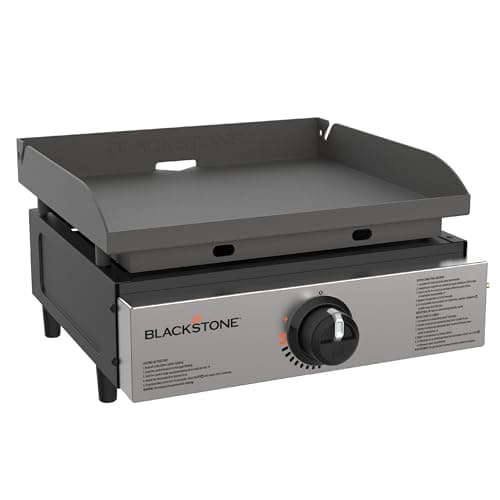
Blackstone Original 17 in. Tabletop Griddle
Blackstone
267 sq in of flat steel over a 12,500 BTU H burner, with piezo ignition and rear grease management, for 25 lb.
Blackstone publishes 267 sq in of cooking space, a 12,500 BTU single stainless H burner, dimensions of 21.71 by 17.32 by 8.62 in, a 25 lb weight, piezo ignition and a rear grease management system.
Two hundred and sixty-seven square inches is the largest surface here by a clear margin, and on a flat plate that translates directly into throughput: eight eggs, a pound of bacon and a stack of pancakes cooking at once rather than in shifts. For a family breakfast that is the difference between everyone eating together and the cook eating last.
It also catches everything a grate loses — onions, small vegetables, eggs, anything diced. The trade is that you never get char or smoke, because nothing touches flame. Treat it as an outdoor hob rather than a barbecue, and season and dry it like cast iron, per how to clean and season cast iron at camp.
The drawback
A griddle is not a grill: no flame contact, no char, no smoke. The cooking surface needs seasoning and it rusts if you put it away wet.
3. Lightest, cheapest and the only one that tastes like charcoal
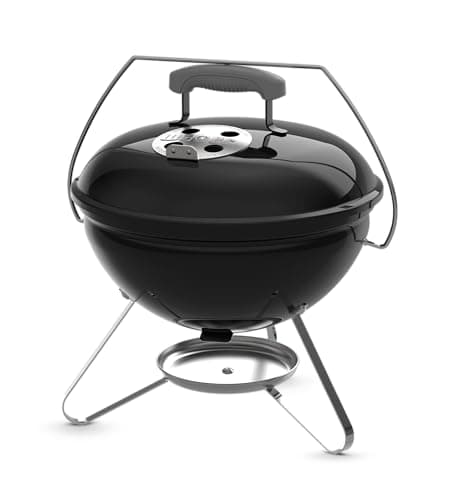
Weber Smokey Joe 14 in. Charcoal Grill
Weber
147 sq in over charcoal in a 9 lb enamelled kettle, with a lid lock that turns it into a carry handle.
Weber publishes 147 sq in of cooking area on a 14.5 in triple nickel-plated grate, dimensions of 14.2 W by 16.5 D by 17 H in, a 9 lb weight, a Tuck-N-Carry lid lock, rust-resistant aluminum dampers, and a stated capacity of 2 to 4 people.
Nine pounds is a third of the Weber Q and it needs no gas cylinder, which makes this the only grill here you would consider for a walk-in site or a small car. It is also the only one that produces charcoal flavour, which for a lot of people is the entire reason to bring a grill camping at all.
The costs are time and heat management. Charcoal needs about twenty minutes to reach cooking temperature, the only controls are the dampers and where you bank the coals, and the grill stays dangerously hot for a long time afterwards. Plan the ash disposal before you light it — hot ash is the single most common cause of campground fires, and the rules are in campfire safety basics.
The drawback
Charcoal means 20 minutes of preheat, ash to dispose of, no temperature dial, and a grill that stays hot long after you have finished.
QDo I need a grill if I already have a camp stove?
No, and they do different jobs. A two-burner stove boils, simmers and fries; a grill sears, smokes and roasts with the lid down. Buy the stove first. Add a grill when you want the meals a stove cannot produce.
QHow much grill cooking area do I need for camping?
About 40 sq in per person for a main course cooked in one pass. That makes a 147 sq in kettle right for three or four, a 189 sq in gas grill right for four or five, and a 267 sq in griddle right for six or more.
QIs a griddle better than a grill for camping?
For breakfast and for volume, yes: nothing falls through, and a 267 sq in plate cooks eggs, bacon and pancakes at once. You give up char and smoke entirely, because nothing touches flame. Treat a griddle as an outdoor hob rather than a barbecue.
QCan you use a charcoal grill at a campground?
Often, but check first. Many campgrounds restrict charcoal, some ban it in fire season, and nearly all require ash to go in a designated container. Gas grills are frequently allowed where charcoal is not, because there is no ember and no ash.
How we picked
Everyone else in this category will tell you they tested twenty of these. We have not tested any of them, and we would rather say so than pretend. There is no gear closet here and no test lab.
What we did instead: pulled the published specifications from each manufacturer's own spec sheet or manual, named the standard behind every rating so you can check what it actually promises, did the arithmetic that turns a spec into a decision, and pulled today's real retail price rather than quoting one from memory. Every pick states a drawback, because a list where nothing is wrong with anything is an advert.
The limits of that method, stated plainly: published specs do not capture zipper quality, seam durability, or how a tent behaves at 2am in a storm. Where that matters, we say so on the pick. The full method is here.