Plan about 1 gallon (3.8 L) per person per day for a trip where you cook and wash up, using the Ready.gov planning figure, and 1.5 gallons in hot weather. Water weighs 8.34 lb per US gallon, so a family of four on a two-night trip needs roughly 12 gallons — about 100 lb. That is nothing in a car and impossible on your back, which is why the answer changes completely the moment you walk in.
Container
Capacity
Empty weight
Full weight
Insulated
Igloo 6 Gallon Water Container II
6 gal / 22.7 L
2.6 lb
about 52 lb
No
Stanley Adventure Fast Flow, 2 gal
2 gal / 7.6 L
4.4 lb
about 21 lb
Yes, double-wall foam
Sea to Summit Watercell X 20L
20 L / 5.3 gal
11.8 oz
about 45 lb
No
Capacities and empty weights as published. Full weights are our arithmetic at 8.34 lb per US gallon.
Notice what the full-weight column does to the plan. A six-gallon jug at 52 lb is not something most people carry any distance, and it is why two smaller containers usually beat one large one even when the total is identical. Two containers also mean a split failure: if one splits or tips, you have not lost the trip.
Rigid, insulated or soft?
Rigid non-insulated is the default. Cheap, tough, stands up on its own, easy to clean, and it does not care about being dropped. This is what most campsites are full of and it is the right first purchase.
Insulated buys cold water on hot trips and nothing else. It costs weight and capacity for the same footprint, and it earns its place only if you are camping somewhere warm or want to stop people raiding the food cooler for drinks.
Soft buys packability. It weighs a fraction as much empty, it rolls away to nothing, and it hangs. It is the right choice for walk-in sites, water sports and small cars, and the wrong choice if it will be dragged across gravel by children.
Keep drinking water and washing water separate
Two containers, one labeled, and the discipline to keep them apart. It sounds fussy until somebody rinses a greasy pan under the drinking tap. It also lets you use the less precious water for the two-basin washing-up method, which is the biggest single reduction available in the whole water budget — see how to wash dishes at a campsite.
Filling, and whether the tap is safe
Developed campgrounds in the US almost always supply potable water and sign it when they do not. Treat anything from an unmarked standpipe, a trailhead or a dispersed site, and be aware that a container is not a filter — a jug filled from a doubtful source stays doubtful.
For those trips, filter into the container rather than out of it. A gravity system does this best because it fills volume unattended, and the comparison of filters, purifiers and tablets is in water filter vs purifier vs tablets, with product detail in best water filters for camping.
Cleaning and storage, which is where these go wrong
Water containers develop a smell because they are stored damp and dark with the cap on. The fix is simple: empty them completely, rinse, and store them open and dry with the cap off. A soft container should be inflated with air and hung to dry inside, which is why Sea to Summit publishes a wide mouth for filling, draining and drying as a design feature.
If one has already gone stale, a rinse with a weak bicarbonate or a sanitiser tablet, followed by a thorough freshwater rinse and open drying, usually resets it. Do not store water in a container between trips; the container is for carrying water, not keeping it.
What we did not do
We have not filled, carried, chilled or timed any of these. Every capacity, weight, dimension and retention claim above is the manufacturer's published figure with a link to where it was read, and the full-weight column is arithmetic on a published constant. There is no standard test for cold retention in an insulated jug, so Stanley's 13-hour and 2-day figures are its own protocol and are not comparable across brands — the same caveat this site applies to cooler claims. See how we research.
The picks in full
1. Best all-round campsite water jug
Igloo 6 Gallon Water Container II
Igloo
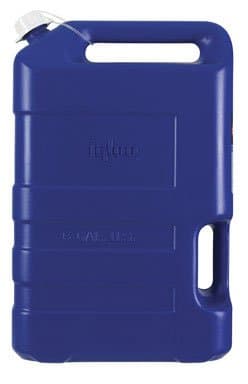
6 gallons of high-density polyethylene at 2.6 lb empty, with a spout that stores inside the container and a vent for a consistent pour.
Igloo publishes a 6 gallon capacity, dimensions of 13.82 by 7.32 by 20.63 in, a 2.6 lb empty weight, rugged non-insulated high-density polyethylene construction, a spout that stores inside the container when not in use, molded-in top and side handles, and a pull-up vent for smooth flow.
Six gallons is the right size for a family weekend because it is roughly one and a half days of everything for four people, on the one-gallon-per-person-per-day planning figure. Two of these carries a full weekend with a reserve, and refilling one at a time keeps the weight manageable.
The vent is the part that separates a good jug from an infuriating one. Without it, a sealed container glugs and stalls as it empties; with it, water flows steadily and you can fill a pot one-handed. The internal spout storage is the other quiet win, because a spout that lives in a different bag is a spout you eventually lose.
The drawback
Not insulated, so contents track the air temperature; and at 20.63 in tall it is an awkward shape in a packed boot.
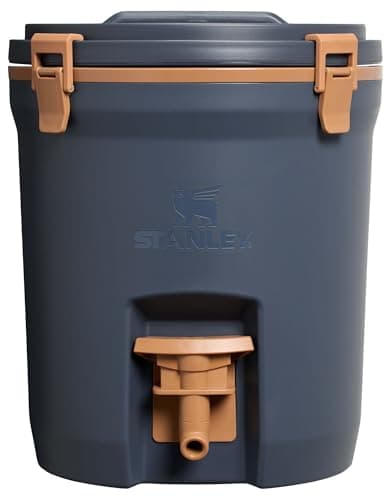
2 gallons in a double-wall foam-insulated body, published as chilled up to 13 hours and iced up to 2 days, with a removable high-flow spigot.
Stanley publishes a 2 gallon capacity, dimensions of 11.69 by 11.69 by 13.5 in, a 4.4 lb empty weight, double-wall foam insulation, cold retention of up to 13 hours chilled and up to 2 days iced, a high-flow spigot that removes for cleaning, four side latches on an insulated lid, and a built-in ice catch.
This solves a specific and genuinely annoying problem: in hot weather the only cold drinking water on a campsite is in the food cooler, and every time somebody opens it for a drink the cooler performs worse. An insulated dispenser separates the two, which protects the food cooler's ice budget — the arithmetic behind that is in how long does ice last in a cooler.
The ice catch is the detail worth knowing about. Ice cubes clog a spigot, and a jug that will not pour when it is full of ice is exactly the wrong failure. The removable spigot matters for the same practical reason as a removable cooler drain plug: it is the part that gets grim, and being able to take it off is the difference between cleaning it and living with it.
The drawback
4.4 lb empty for 2 gallons, which is the heaviest container here per unit of water carried.
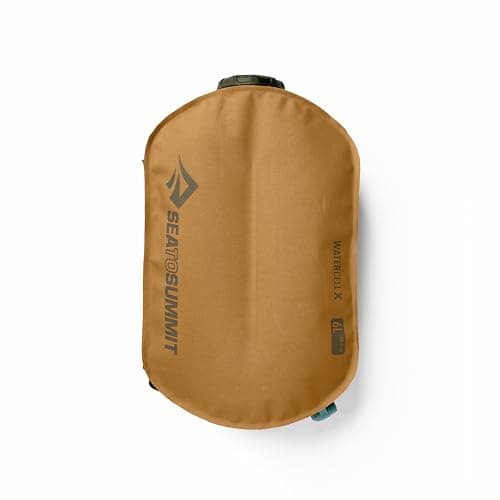
20 L in a welded TPU-and-recycled-nylon bladder at 335 g, with a 63 mm multifunction cap, lash points and a shower fitting.
Sea to Summit publishes a 20 L capacity at 335 g (11.8 oz), a bladder of nylon with TPU film using certified recycled 400D nylon, a low-profile 63 mm multifunction cap with variable flow control, an adjustable TPU strap with welded lash points, and a shower conversion using the included fitting. Smaller sizes run down to 4 L at 170 g.
Eleven point eight ounces for twenty liters of capacity is the number that makes this different. A rigid jug of similar volume weighs several pounds empty and takes the same space empty as full; this rolls to nothing on the way home, which matters more than people expect on a trip where the water is consumed and the container is not.
The lash points are the practical feature. Hung from a tree or a canopy leg, it becomes a hands-free tap at a sensible height, which is exactly what a camp kitchen wants for washing hands and rinsing dishes. The shower fitting is a genuine bonus at sites with no facilities, though it is a cold shower unless you leave the bag in the sun first.
The drawback
A soft container has no shape of its own, so it needs somewhere to hang or a flat surface, and it is far more puncturable than a rigid jug.
About 1 gallon per person per day for a trip where you cook and wash up, and 1.5 gallons in hot weather. Water weighs 8.34 lb per US gallon, so a family of four on a two-night trip needs roughly 12 gallons, or about 100 lb.
QWhat size water container is best for camping?
Two smaller containers beat one large one. A full 6 gallon jug weighs about 52 lb, which is more than most people want to carry, and splitting the supply means a split or a tipped container does not lose you the trip.
QIs an insulated water jug worth it for camping?
In hot weather, yes, for one specific reason: it keeps drinking water cold without anyone opening the food cooler. Every cooler opening costs ice. Stanley publishes up to 13 hours chilled and up to 2 days iced for its 2 gallon Fast Flow jug.
QHow do you stop a camping water container smelling?
Store it empty, open and dry with the cap off. Containers go stale because they are put away damp and sealed. A soft container should be inflated with air and hung to dry inside; a wide mouth is what makes that possible.
How we picked
Everyone else in this category will tell you they tested twenty of these. We have not tested any of them, and we would rather say so than pretend. There is no gear closet here and no test lab.
What we did instead: pulled the published specifications from each manufacturer's own spec sheet or manual, named the standard behind every rating so you can check what it actually promises, did the arithmetic that turns a spec into a decision, and pulled today's real retail price rather than quoting one from memory. Every pick states a drawback, because a list where nothing is wrong with anything is an advert.
The limits of that method, stated plainly: published specs do not capture zipper quality, seam durability, or how a tent behaves at 2am in a storm. Where that matters, we say so on the pick. The full method is here.