Trail & Tarp earns a commission from qualifying purchases made through links on this page, at no extra cost to you. Full disclosure.
The number, and where it comes from
The short answer
Plan on about 1 gallon (roughly 3.8 liters) per person per day for a campground trip where you cook and wash up, and add a full day's worth as reserve. Ready.gov gives one gallon per person per day for emergency water storage covering drinking and sanitation, and that is the right starting figure for camping too. Roughly half of it is drinking, and half is cooking, coffee and cleaning.
The reason a gallon surprises people is that they price the drinking only. Two liters of drinking water sounds like plenty and it is, until you add a liter for coffee, a liter to boil pasta, and two more to wash the pan and everyone's hands. Here is the same figure broken out.
Use
Per person per day
Notes
Drinking
2 L
More in heat, at altitude, or on a hiking day
Cooking
0.5 - 1 L
Pasta and rice absorb it; the pan uses more
Coffee and tea
0.3 - 0.5 L
A 30 oz press is nearly a liter for the group
Washing up
0.5 - 1 L per person
Two-basin method uses far less than a running tap
Hands, teeth, face
0.3 L
Small and non-negotiable
Total
about 3.6 - 4.8 L (1 - 1.3 gal)
Round to a gallon and carry a spare day
Our arithmetic, built on the Ready.gov one-gallon-per-person-per-day planning figure.
What that weighs, and why it matters
Water weighs about 8.34 lb per US gallon, or 1 kg per liter. A family of four on a two-night trip needs roughly 3 days of water if you count arrival and departure days — call it 12 gallons, or about 100 lb.
In a car that is irrelevant. On your back it is the dominant number in the whole pack: a single day of drinking water for one person is 2 kg, and there is no gear choice anywhere in camping that saves you 2 kg. This is why backpackers filter rather than carry, and why they plan routes around water sources rather than around distance.
The practical dividing line: if you are camping where a vehicle can reach you, carry it. If you are walking in more than about a mile, carry a day's drinking water and a filter, and refill.
Carrying it: what a container has to do
Bulk water at a campground wants to live in one or two rigid containers with a tap, not in a dozen bottles. A tap means you can wash your hands without asking someone to pour, and one big container means you know how much is left at a glance.
Two containers beats one big one, for a reason that has nothing to do with capacity: if a single container tips over or splits, you have lost everything. A 7-gallon rigid jug with a spigot plus a collapsible 5-gallon carrier covers a family weekend and packs down to almost nothing on the way home.
Keep one container for drinking and cooking only, and one for washing. It sounds fussy until somebody washes a muddy pan under the drinking tap.
Campground taps are usually potable. Usually.
Developed campgrounds in the US almost always supply potable water, and signage tells you when they do not. Standpipes at trailheads, dispersed sites and older private sites are a different matter, and “the tap worked last year” is not information. If the supply is not marked potable, treat it. The comparison of ways to do that is in water filter vs purifier vs tablets.
Filtering instead of carrying
A filter turns a water problem into a water source problem. Two shapes cover almost all beginner camping.
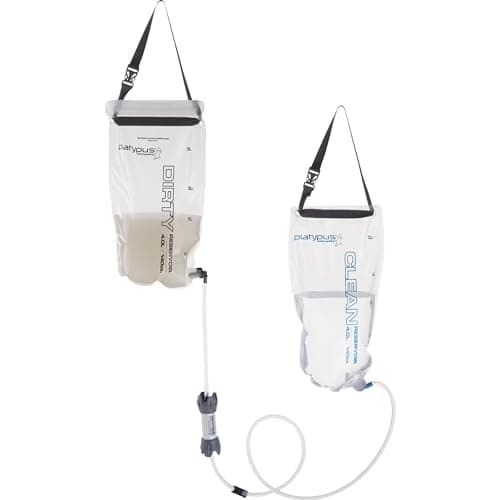
For a group in camp, a gravity system does the work while you do something else. A Platypus GravityWorks 4 L publishes a 0.2 micron rating, flow up to 1.75 L per minute, about 2.5 minutes to fill 4 L, an 11.5 oz system weight and up to 1,500 L of cartridge life. Hang it, walk away, come back to four liters.
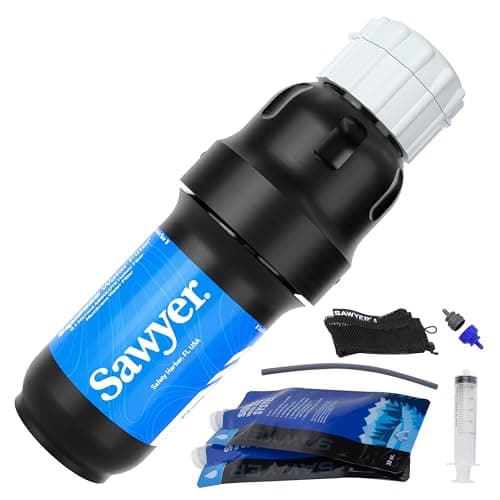
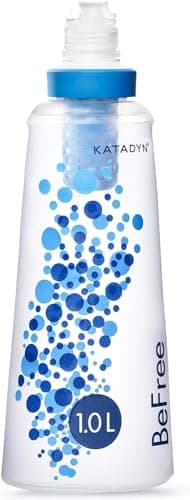
For one or two people moving, a squeeze filter is simpler. A Sawyer Squeeze publishes 0.1 micron absolute, removal of 99.99999% of bacteria and 99.9999% of protozoa, and a 3 oz weight. A Katadyn BeFree 1.0 L publishes 0.1 micron, flow up to 2 L per minute and 63 g. Both are covered in the water filter roundup.
Reducing the number rather than carrying more
The washing-up half of the budget is the compressible half. Four habits cut it by more than half:
Two basins, not a running tap. One wash, one rinse. A running tap uses several times as much and produces greywater faster than you can dispose of it.
Wipe pans with paper before washing. Fat and food come off dry; the water then only has to do the last 10%.
Cook things that share a pot. One-pan meals leave one pan. The plan is in easy camping meals.
Reuse pasta water. Once it has cooled it is perfectly good for the first wash basin.
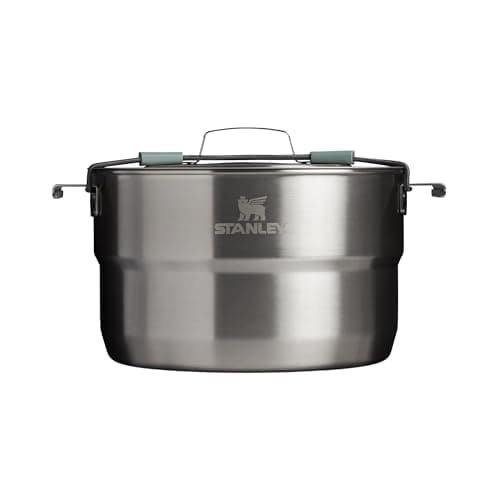
A four-person cookset with pots you can nest, like the Stanley Wildfare Core Full Serve Cookset at 4 qt and 4 lb 11 oz, also helps here for an unglamorous reason: one big pot doubles as the wash basin. The full method, including greywater disposal, is in how to wash dishes at a campsite.
Hot weather, and the number that changes
The drinking half of the budget is the part that moves. The CDC advises drinking more water than usual in hot conditions and not waiting until you are thirsty, and heat plus a day of walking can easily double an adult's drinking requirement from 2 L to 4 L. Children dehydrate faster than adults and are worse at noticing.
Plan a hot-weather trip at 1.5 gallons per person per day rather than 1, keep a full spare container in the car that nobody touches, and know where the nearest refill is before you need it. The rest of the heat management is in how to stay cool camping in hot weather.
The gear this page points to
Platypus GravityWorks 4 L
Platypus
0.2 micron, up to 1.75 L per minute and about 2.5 minutes for 4 L. Hang it and it fills the camp water while you do something else.
QHow much water do you need per person per day when camping?
About 1 gallon, or roughly 3.8 liters, for a trip where you cook and wash up. Ready.gov uses one gallon per person per day as its planning figure for drinking and sanitation. Roughly half is drinking and half is cooking, coffee and cleaning.
QHow much does camping water weigh?
About 8.34 lb per US gallon, or 1 kg per liter. A family of four on a two-night trip needs roughly 12 gallons, which is about 100 lb. That is nothing in a car and impossible on your back, which is why walk-in camping means filtering rather than carrying.
QDo I need to filter campground tap water?
Usually not. Developed campgrounds in the US almost always supply potable water and signage says when they do not. Treat anything from an unmarked standpipe, a trailhead, or a dispersed site.
QHow much extra water do you need in hot weather?
Plan on about 1.5 gallons per person per day rather than 1. The CDC advises drinking more than usual in heat and not waiting until you are thirsty; a hot day with walking can double an adult's drinking requirement from 2 L to 4 L.
Sources
Every figure on this page comes from a published source. We have not tested this gear, so the numbers are the manufacturer's or the standard body's, not ours. How we research.