No photo
Exped MegaMat 10
Exped
R 8.1 and 3.9 in thick. The line on this list worth spending on, because ground conduction is what makes winter nights fail.
A winter list is a summer list plus about fifteen items, and four of them are the ones that decide whether the trip works.
Trail & Tarp earns a commission from qualifying purchases made through links on this page, at no extra cost to you. Full disclosure.
The short answer
An insulated pad at R-value 5 or more. A bag whose ISO comfort rating is below the forecast. A dry sleep set that is never worn during the day. And propane rather than butane, because butane loses canister pressure near freezing. Get those four right and the rest of the list is comfort. Get any of them wrong and no amount of the rest compensates.
This list assumes a car camping trip at or a little below freezing, at a developed site, which is the right first winter trip. The reasoning behind each choice is in winter camping for beginners.
| Item | Why | Notes |
|---|---|---|
| Insulated pad, R 5 or more | Ground conduction is the main heat loss | MegaMat 10 publishes R 8.1; MondoKing 3D publishes R 7.0 |
| Closed-cell foam pad | R-values add when stacked; nothing to puncture | Z Lite Sol publishes R 2.0 at 14 oz |
| Sleeping bag rated below the forecast | Plan on ISO comfort, not the name on the bag | Cosmic Down 20 publishes ISO comfort 31 F |
| Sleeping bag liner | A few degrees at the margin, and keeps the bag clean | Reactor Extreme publishes 364 g |
| Camping blanket | Goes over the bag, never inside it | Argo publishes 78 x 72 in at 1 lb 10 oz |
| Pillow | Sleep quality collapses without one | Foam is warmer against the head than inflatable |
The layering logic is in how to layer for camping, and the fabric weights in best base layers for camping.
Two spares that are not optional in winter
Spare gloves and spare socks. Both get wet doing ordinary camp tasks, neither dries at a winter campsite, and cold hands make everything else — pitching, cooking, packing — slower and worse. Keep both in a dry bag with the sleep clothes, not loose in a duffel.
| Item | Why it changes in winter |
|---|---|
| Propane stove and more fuel than usual | Butane loses pressure near freezing; cold water takes longer to boil |
| Insulated mugs and a vacuum flask | A hot drink made once in the morning lasts hours |
| Water containers stored inside the tent or vehicle | Anything outside freezes solid overnight |
| Filter kept in your sleeping bag | A frozen filter is invisibly destroyed and cannot be tested |
| Simple one-pot food | Cooking with cold hands in the dark should be as short as possible |
Cotton, in every form. A low-R summer pad, which is worse than no pad in the sense that it gives false confidence. Anything that only works if the weather cooperates. And an ambitious itinerary: the first winter trip is one night close to home, and its purpose is to find out what is missing from this list for you specifically.
The full reasoning, including how the four key systems change, is in winter camping for beginners. For the three-season version of this list, see the car camping checklist.
Exped
R 8.1 and 3.9 in thick. The line on this list worth spending on, because ground conduction is what makes winter nights fail.
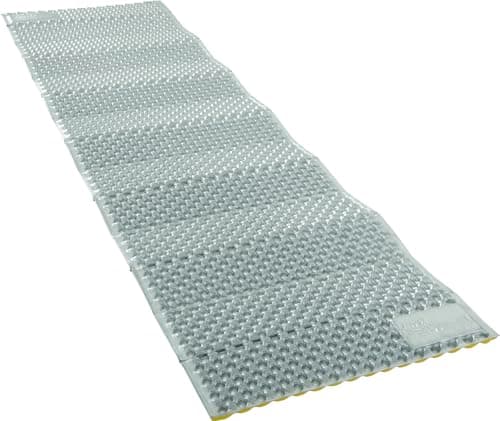
Therm-a-Rest
R 2.0 at 14 oz. Stack it under an inflatable and the R-values add, which is the cheap route to a winter-capable setup.
#ad how this is funded · price as of October 23, 2026
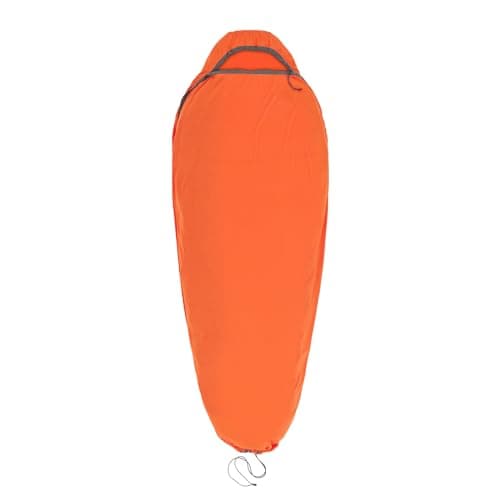
Sea to Summit
364 g of Thermolite Pro, recommended to 198 cm of user height. A few degrees at the margin, and it keeps the bag clean.
#ad how this is funded · price as of October 23, 2026
Therm-a-Rest
78 x 72 in at 1 lb 10 oz with snap loops. Over the bag, never inside it, where it would compress the fill.
R 5 or more on frozen ground. R-values are measured under ASTM F3340 and are additive, so a closed-cell foam pad stacked under an inflatable sums the two. The pad matters more than the bag, because body weight crushes the bag's fill flat underneath you.
A 200 gsm or heavier base layer, a mid layer, an insulated jacket for standing around, a waterproof shell, and two spares that are not optional: spare gloves and spare socks. Neither dries at a winter campsite and both get wet doing ordinary camp tasks.
Propane does. Butane canisters lose pressure near freezing and output falls off with it, which is why propane is the default for cold-weather US camping. Bring more fuel than summer, because very cold water takes considerably longer to boil.
Inside the tent or the vehicle. Anything left outside freezes solid overnight, and a frozen water filter is permanently destroyed - ice crystals crack the hollow fibers invisibly and there is no field test. Sleep with the filter.
Every figure on this page comes from a published source. We have not tested this gear, so the numbers are the manufacturer's or the standard body's, not ours. How we research.