The Best Zero Degree Sleeping Bags, and What Zero Actually Buys
A bag marked zero is not a bag you are comfortable in at zero. Kelty publishes both numbers on the same bag, four degrees apart, which tells you everything.
A temperature rating is a survival figure, not a comfort one, unless it is explicitly labelled as an ISO or EN comfort rating. The Kelty Cosmic 0 publishes a 0 F manufacturer's number and a 4 F EN result on the same bag — and the EN limit itself describes a curled-up sleeper on the edge of cold, not a comfortable one.
That means a zero degree bag is realistically a bag for nights in the teens and twenties if you want to sleep rather than endure. Plan around that and you will be warm; plan around the number on the stuff sack and you will not.
The weight gap is the material gap. Down reaches the rating at 4.34 lb; synthetic takes 7 lb to get somewhere comparable. That is the price of a fill that still works when it gets damp, and in winter it is a price a lot of people should pay.
The pad matters more in winter, not less
Body weight crushes the insulation underneath you completely flat, so on frozen ground the pad is doing most of the work and the bag is doing almost none on that side. A zero degree bag on an R 2 pad is a cold night regardless of what the bag cost.
For snow and frozen ground, aim for R 5 or more, and remember that R-values are additive: a foam pad under an insulated inflatable sums them. The arithmetic is in sleeping pad R-value explained and the options in best backpacking sleeping pads.
Down in winter is a moisture management problem
Cold air holds almost no water, so every gram of vapor you produce overnight condenses somewhere — on the tent inner, on the bag shell, and over several nights inside the fill itself. Down that has absorbed moisture loses loft and does not recover until it dries properly, which is difficult in the field. A water-resistant treatment like DriDown slows this rather than preventing it. On trips longer than two or three nights in genuine cold, air the bag out whenever the sun is on it, and consider synthetic.
The features that make a cold bag work
A draft collar. An insulated tube around the neck that seals the gap warm air escapes through. This is the single most important cold-weather feature and the first one budget bags drop.
A zipper draft tube. The insulated flap behind the zip. Without it the zip line is a cold stripe down your side.
A shaped hood that actually cinches. You lose real heat from your head, and a hood you cannot close around your face is decoration.
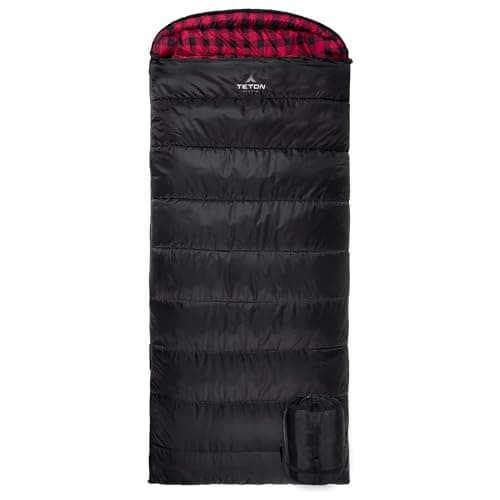
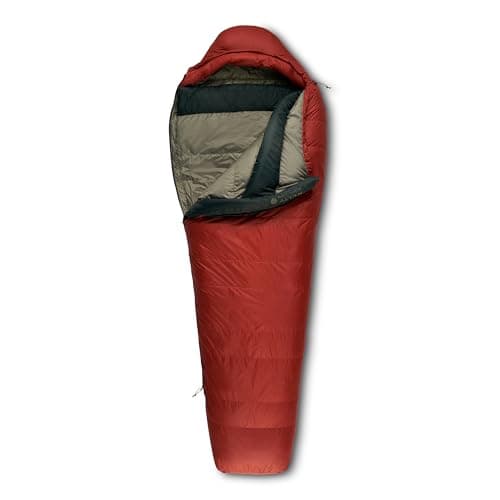
A mummy cut, because every extra inch of girth is air your body has to heat. Kelty publishes a mummy shape for the Cosmic line and TETON a rectangular one, which is part of the weight difference.
Getting more out of the bag you have
A liner adds a measurable amount of warmth for very little money and weight, and it keeps body oils out of the fill, which is what shortens a bag's working life. The case is made in do you need a sleeping bag liner.
Beyond that: eat something before bed, because digestion generates heat; put tomorrow's clothes in the foot of the bag to fill empty volume; and wear a hat. A thermal bag liner and a hat together weigh less than a pound and are worth several degrees.
Which to buy
Buy the Kelty Cosmic 0 if you will carry it at all, because 4.34 lb against 7 lb is the difference between a winter bag you take and one you leave at home. Buy the TETON Celsius XXL for winter car camping, for anyone over six feet, and for trips where damp is more likely than distance.
An EN rating of 4 F alongside a 0 F maker's figure, on 550-fill DriDown at 4.34 lb in the regular.
Kelty publishes a 0 F / -18 C maker's rating alongside an EN rating of 4 F / -16 C, 550-fill DriDown with a water-resistant treatment, a regular fill weight of 39.5 oz, a regular total weight of 4.34 lb, fits-to heights of 6 ft regular and 6 ft 6 in long, and a full draft collar, zipper draft tube and thermal comfort hood.
Publishing both numbers is unusually transparent, and the draft collar is the feature that earns the rating. In a cold bag, the gap around your neck is where warm air escapes, and an insulated tube that seals it is worth more than an extra ounce of fill anywhere else.
The drawback
550 fill power means 39.5 oz of down to reach that rating, so it is a bulky bag. Down also needs to stay dry, and winter condensation works against that.
Published specs
Maker's rating
0 F / -18 C
EN rating
4 F / -16 C
Fill
550-fill DriDown, water-resistant treated
Fill weight (regular)
39.5 oz / 1,120 g
Total weight (regular)
4.34 lb / 1.93 kg
Fits to
6 ft 0 in regular; 6 ft 6 in long
Features
full draft collar, draft tube, thermal comfort hood
A 90 by 39 in rectangular bag with a 0 F maker's rating on SuperLoft Elite synthetic fill, at 7 lb.
TETON publishes a 0 F rating, a 90 by 39 in size, a 7 lb weight, SuperLoft Elite hollow fiber fill and a 17.5 by 12.5 in packed size.
Synthetic fill is the right call for a winter car camping bag specifically. Winter tents condense heavily, a bag pressed against a frosted inner wall gets damp, and synthetic keeps most of its loft when that happens where down collapses.
The drawback
7 lb and a 17.5 by 12.5 in packed size, with a maker's rating rather than a tested one. Read 0 F as a survival figure and plan for the twenties.
QIs a 0 degree sleeping bag actually good to 0 degrees?
No. A temperature rating is a survival figure unless it is explicitly an ISO or EN comfort rating. Kelty publishes a 0 F maker's number and a 4 F EN result on the same bag, and the EN limit itself describes a curled-up sleeper on the edge of cold. Plan for the teens and twenties.
QShould a winter sleeping bag be down or synthetic?
Down for weight, synthetic for damp. Down reaches a 0 degree rating at 4.34 lb where synthetic takes 7 lb, but winter tents condense heavily and down that absorbs moisture loses loft until it dries properly, which is hard to do in the field.
QWhat R-value pad do I need with a 0 degree bag?
R 5 or more for snow and frozen ground. Body weight crushes the bag's insulation flat underneath you, so the pad is doing most of the work on that side. R-values are additive, so a foam pad under an insulated inflatable sums them.
QWhat makes a sleeping bag work in real cold?
A draft collar around the neck, an insulated draft tube behind the zip, a hood that cinches around your face, and a mummy cut that minimizes the air volume your body has to heat. The draft collar is the first feature budget bags drop.
How we picked
Everyone else in this category will tell you they tested twenty of these. We have not tested any of them, and we would rather say so than pretend. There is no gear closet here and no test lab.
What we did instead: pulled the published specifications from each manufacturer's own spec sheet or manual, named the standard behind every rating so you can check what it actually promises, did the arithmetic that turns a spec into a decision, and pulled today's real retail price rather than quoting one from memory. Every pick states a drawback, because a list where nothing is wrong with anything is an advert.
The limits of that method, stated plainly: published specs do not capture zipper quality, seam durability, or how a tent behaves at 2am in a storm. Where that matters, we say so on the pick. The full method is here.