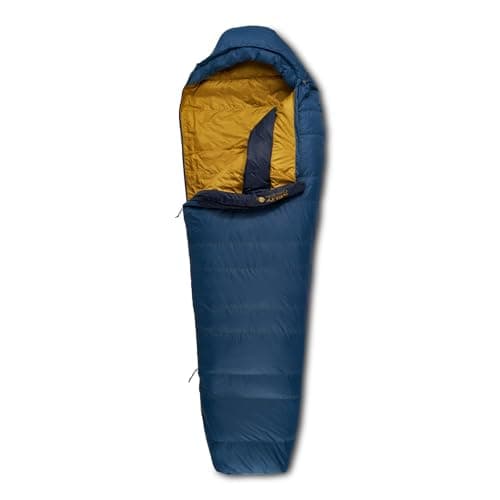
Kelty Cosmic Down 20
Kelty
The down side of the argument at a beginner price: ISO comfort 31 F and ISO limit 21 F for 2 lb 7 oz on 550-fill treated down.
$184.57 · Check price on Amazon
#ad how this is funded · price as of October 23, 2026
Compare two bags rated to the same temperature and the argument stops being philosophical. One of them weighs a pound more. That pound is the entire trade.
Trail & Tarp earns a commission from qualifying purchases made through links on this page, at no extra cost to you. Full disclosure.
The short answer
At an equivalent ISO rating, down is lighter and packs smaller; synthetic is cheaper, keeps insulating when damp, and does not care how you wash it. The Kelty Cosmic Down 20 publishes ISO comfort 31 F, ISO limit 21 F and a 2 lb 7 oz regular weight on 550-fill DriDown. The Marmot Trestles Elite Eco 20 publishes ISO comfort 32.2 F, ISO limit 21.6 F and a 3 lb 8.4 oz regular weight on synthetic HL-ElixR Eco fill. Same warmth to within a degree, a pound and an ounce apart.
That is the whole comparison in one paragraph, and it is worth noticing how small the difference is in absolute terms. For a car camper, a pound of sleeping bag is invisible. For somebody carrying everything on their back, it is one of the three or four biggest single savings available.
| Down (Cosmic Down 20) | Synthetic (Trestles Elite Eco 20) | |
|---|---|---|
| ISO comfort | 31 F | 32.2 F |
| ISO limit | 21 F | 21.6 F |
| Weight, regular | 2 lb 7 oz | 3 lb 8.4 oz |
| Fill | 550-fill DriDown | HL-ElixR Eco synthetic |
| Wet performance | Loses loft; treated down resists longer | Keeps most of its loft |
| Compressibility | High | Moderate |
| Care | Down-specific wash, long tumble dry | Normal detergent, quick dry |
Fill power is the volume in cubic inches that one ounce of down lofts to under a standard weight. It is a measure of quality, not quantity: 550-fill down needs more ounces to hit a given warmth than 800-fill does, so a 550-fill bag is heavier and bulkier than an 800-fill bag at the same rating — and dramatically cheaper.
This is why “down” on its own tells you almost nothing. A 550-fill down bag and a good synthetic bag are close on weight and packed size; an 800-fill down bag is in a different league from both, at three or four times the price. For a beginner, the honest framing is that entry-level down and good synthetic are near neighbors, and the decision should be made on wet performance and care rather than on the fill type as a badge.
Down insulates by trapping air in the loft of its clusters. Wet it and the clusters collapse, the loft goes, and the bag stops working — a genuinely serious failure in cold conditions, and one that takes a long time to reverse in the field. Synthetic fibers hold their structure when damp, so a wet synthetic bag is a cold, heavy, miserable bag that is still doing something.
The fair counter is that most bags never get properly wet. Hydrophobic treatments — DriDown on the Kelty, and equivalents elsewhere — delay saturation rather than prevent it, and a bag inside a dry bag inside a tent with a tensioned fly stays dry in almost every realistic trip. The wet case matters if you are canoeing, camping somewhere with sustained rain, or camping in a tent you have not yet learned to pitch tightly.
Neither one is what makes you cold
Whatever you choose, the bag is not the part of the system that decides whether you are warm. Body weight crushes the insulation beneath you flat, so the pad under the bag carries most of the load. A MegaMat 10 publishes an R-value of 8.1; a Klymit Static V Base publishes 1.3. That gap changes your night far more than down versus synthetic does. The mechanism is in why you get cold in a sleeping bag and the number itself in R-value explained.
A down bag needs down-specific wash, a front-loading machine, and a long tumble dry with dryer balls to break up the clumps. Skip any of that and you will finish with a bag that has lost loft permanently. A synthetic bag washes with normal detergent and dries quickly, and the process is hard to get wrong.
Storage matters more than washing for both. Neither bag should live compressed. Stored loose in a large cotton or mesh sack, a down bag can hold its loft for decades; stored crushed in its stuff sack, it will lose it in a couple of seasons. Synthetic fill is more fragile in this specific way — the fibers take a set and never fully recover — which is why a well-treated down bag typically outlives a well-treated synthetic one by a wide margin. The full routine is in how to wash a sleeping bag.
| If you are... | Choose | Because |
|---|---|---|
| Car camping, a few weekends a year | Synthetic | Weight is irrelevant, the price is lower, care is forgiving |
| Carrying it on your back | Down | A pound saved, and much less pack volume |
| Camping somewhere reliably wet | Synthetic | Keeps insulating damp; less to go wrong |
| Buying for a child | Synthetic | It will be spilled on, dragged and washed often |
| Buying one bag for everything | Down, kept in a dry bag | Lighter when it matters, fine everywhere else |
The rectangular family bags that dominate the shelf — a Coleman Brazos 20F at 5.3 lb, or a TETON Celsius XXL 0F at 7 lb — are all synthetic, and for good reason: they are cheap, washable, and nobody is carrying them anywhere. If your camping is a campground, that is the right end of the market and this whole comparison is academic.
The one thing to check before buying either, whatever the fill: whether the temperature number is an ISO figure or the maker's own claim. Bags rated under ISO 23537 publish comfort and limit figures separately, as both bags at the top of this page do. Bags with a single number and no standard named are making a claim nobody tested. That distinction is unpacked in sleeping bag temperature ratings explained, and the quilt option that sidesteps both is in sleeping bag vs quilt.
Kelty
The down side of the argument at a beginner price: ISO comfort 31 F and ISO limit 21 F for 2 lb 7 oz on 550-fill treated down.
#ad how this is funded · price as of October 23, 2026
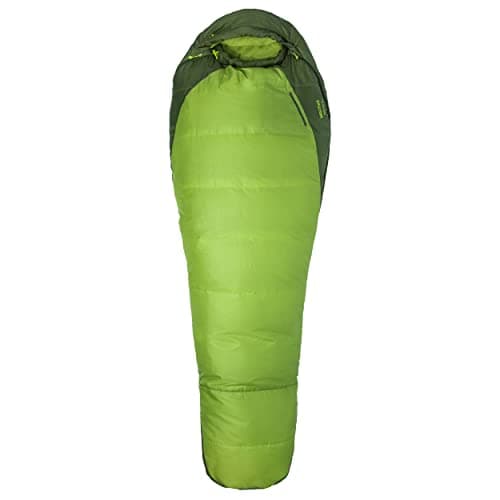
Marmot
The synthetic equivalent, rated within about a degree of it: ISO comfort 32.2 F, ISO limit 21.6 F, 3 lb 8.4 oz.
#ad how this is funded · price as of October 23, 2026
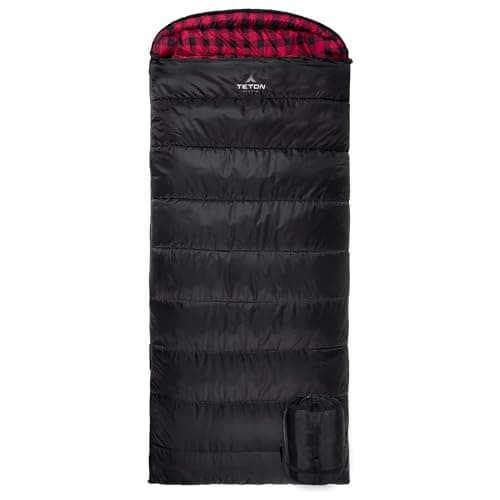
TETON
What synthetic does that down does not bother with: 90 x 39 in of rectangular room rated to 0 F, at 7 lb nobody has to carry.
#ad how this is funded · price as of October 23, 2026
Exped
The reason both bags work or do not: an R-value of 8.1 under you does more for warmth than the fill choice above you.
For car camping, synthetic: it is cheaper, washes easily and the extra pound costs you nothing. For backpacking, down: at the same ISO rating it saves around a pound and packs much smaller. The Kelty Cosmic Down 20 and Marmot Trestles Elite Eco 20 are rated within about a degree of each other and differ by 1 lb 1 oz.
Not well. Wet down clusters collapse and stop trapping air, so the bag loses most of its warmth and takes a long time to dry. Hydrophobic treatments such as DriDown delay saturation rather than prevent it. Synthetic fill keeps most of its loft when damp.
Fill power is the volume in cubic inches that one ounce of down lofts to under a standard weight. Higher fill power means fewer ounces are needed for a given warmth, so the bag is lighter and packs smaller. 550-fill down is close to good synthetic on weight; 800-fill is not.
Down, if it is stored uncompressed. Synthetic fibers take a permanent set when crushed and lose loft over a few seasons, while down stored loose in a large sack can hold its loft for decades. Storage matters more than washing for both.
Every figure on this page comes from a published source. We have not tested this gear, so the numbers are the manufacturer's or the standard body's, not ours. How we research.