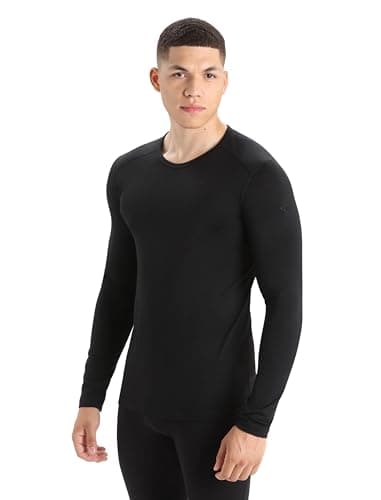
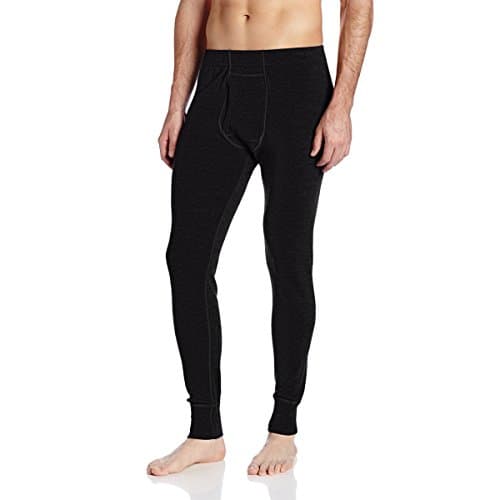
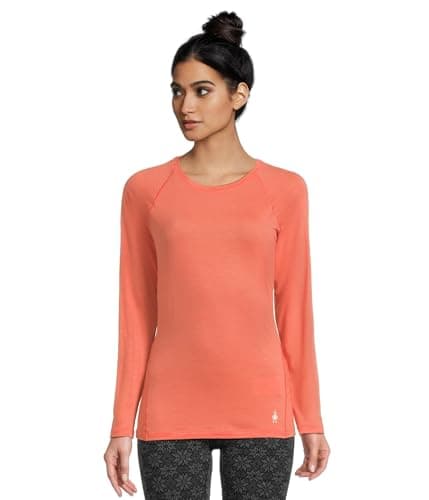
Base layer warmth is set by fabric weight in grams per square meter, and the three numbers you will meet are roughly 150 gsm (lightweight, year-round), 200 gsm (midweight, cold weather) and 250 gsm and up (heavyweight, genuinely cold). Everything else — brand, color, fit — is secondary. Smartwool publishes 150 g/m2; Minus33 publishes 235 g/m2; Icebreaker names its 200 weight class in the product itself.
Layer
Fabric weight
Composition
Knit
Best for
Smartwool Classic All-Season
150 g/m2
88% merino, 12% nylon
Jersey, core-spun
Year-round; the default
Icebreaker Merino 200 Oasis
200 class
100% merino
Jersey
Cold weather and sleepwear
Minus33 Chocorua
235 g/m2
100% merino, 18.5 micron
Interlock
Genuinely cold trips
All figures as published by the manufacturers.
What a base layer is actually for
Its job is moisture management, not warmth. A base layer sits against your skin and moves sweat away from it, because damp skin loses heat roughly twenty times faster than dry skin. The warmth comes from the layers over the top.
That is why cotton is disqualifying rather than merely suboptimal. Cotton absorbs moisture and holds it against you, which is the exact opposite of the job, and it is the same reason cotton socks cause blisters — see best hiking socks.
Merino or synthetic?
Merino resists odor because its fiber structure is inhospitable to the bacteria that cause it, which means a merino top can be worn for several days. It also feels warm when slightly damp and it is naturally fire-resistant, which matters near a campfire in a way people forget until a synthetic top meets a spark.
Synthetics dry faster, cost less, and last longer under abrasion. They also smell after one hard day, which is a genuine problem on a multi-day trip where you are carrying everything. For camping specifically, merino wins for most people on the odor point alone, and blends such as Smartwool's 88/12 close most of the durability gap.
Buy two, and keep one for sleeping
The single most useful thing you can do with base layers when camping is own a set that never gets worn during the day. Damp day clothes in a sleeping bag will keep you cold all night, however good the bag, and changing into dry sleep clothes at bedtime is free warmth. A 200 gsm top and bottoms plus dry socks and a hat is the standard kit, and the mechanism is in why you get cold in a sleeping bag.
Fit, and the seams nobody thinks about
A base layer should be close-fitting without being compressive. Loose fabric cannot wick, because wicking depends on skin contact; too tight restricts movement and is uncomfortable under a pack hip belt.
Two construction details are worth paying for. Flatlock seams lie flat rather than standing proud, so nothing rubs under a pack strap — both Icebreaker and Minus33 publish them. And offset shoulder seams move the seam off the exact line where a pack strap sits, which is a small thing on a walk and a real thing on a long day carrying weight.
Weights, in practice
150 gsm: summer camping worn alone, three-season worn under a fleece, shoulder-season sleepwear. If you buy one, buy this.
200 gsm: autumn and winter camping under a mid layer, and the best cold sleepwear you can own.
235 gsm and up: genuinely cold trips, low activity, or people who run cold. Too warm for a walk.
Note that a heavier base layer is not a substitute for a mid layer. Two thin layers trap more air than one thick one and give you the option to remove one, which is the entire logic of a layering system.
What we did not do
We have not worn or tested any of these. There is no standardized warmth rating for base layers — nothing equivalent to ISO 23537 for sleeping bags or ASTM F3340 for pads — so this page compares fabric weight, composition, knit and construction, which is what the makers publish and what genuinely differs. Every figure carries a link to its source. See how we research, and how to wash merino wool and base layers for keeping them alive.
The picks in full
1. Best all-round base layer
Smartwool Classic All-Season Merino Base Layer Crew
Smartwool
150 g/m2 of 88% merino wool with 12% nylon, built on a nylon core wrapped in merino so it survives being worn hard.
Smartwool publishes a 150 g/m2 fabric weight, a composition of 88% merino wool and 12% nylon, and a construction in which a nylon core is wrapped in merino for durability while keeping wool against the skin. It positions the Merino 150 range as light-to-midweight.
The core-spun construction is the reason to start here. Pure merino at this weight is beautiful and fragile; wrapping it around a nylon filament roughly doubles how long it survives a pack strap rubbing on a shoulder, which is where thin base layers die.
One hundred and fifty grams per square meter is the most useful single weight for camping because it is genuinely year-round: warm enough as a next-to-skin layer under a fleece in October, cool enough to wear alone in July. If you buy one base layer, buy this weight. Where it sits in the whole system is in how to layer for camping.
The drawback
A 150 gsm fabric is thin by design, and it will thin further and eventually hole at elbows, cuffs and underarms.
100% merino jersey in the 200 weight class, in a slim fit with underarm gussets, offset shoulder seams and flatlock stitching throughout.
Icebreaker publishes 100% merino wool in a jersey knit in the 200 weight class, a slim fit intended for low-bulk layering, underarm gussets and set-in sleeves for mobility, offset shoulder seams and flatlock stitching to prevent chafing, a 29 in center-back length in men's large, and care instructions of cold machine wash, line dry, no softener and no tumble drying.
The construction details are the reason this is worth the money over a plain jersey top. Offset shoulder seams move the seam off the line a pack strap sits on, and underarm gussets let you raise your arms without the hem lifting. Both are invisible on a hanger and obvious after a day carrying a daypack.
Two hundred grams per square meter is the standard cold-weather weight, and it doubles as the best sleepwear in camping: dry, warm, odor-resistant and comfortable against skin. A dedicated set of base layers that never gets worn during the day is one of the highest-value habits in cold camping, per how to keep kids warm camping.
The drawback
100% merino with no nylon is softer and less durable than a blended fabric of the same weight; a slim fit is also not everyone's fit.
235 g/m2 of 100% merino at 18.5 micron in a midweight interlock knit, UPF 50+, at 9.6 oz for a size large.
Minus33 publishes a 235 g/m2 fabric weight, 100% merino wool at 18.5 micron, a midweight interlock knit, a UPF 50+ rating, a garment weight of 9.6 oz (272 g) in size large, Australian wool, a crew neck with a tagless label and flat lock seams, and a regular fit.
The micron figure is unusual and worth noticing. Merino fiber diameter determines softness: below about 19 micron is comfortable next to skin for almost everyone, and above about 22 starts to prickle. Publishing 18.5 micron alongside the fabric weight is exactly the kind of specificity this site rewards.
An interlock knit is denser and more stable than a jersey, so it holds its shape and insulates better at the same weight, at the cost of some stretch. Combined with 235 gsm, this is a cold-weather garment: excellent under a fleece in November, uncomfortable in September.
The drawback
Two hundred and thirty-five grams per square meter is too warm for anything but cold weather, and the garment weight shows it.
150 g/m2 if you buy one: light enough to wear alone in summer and warm enough under a fleece in autumn. 200 gsm for cold-weather camping and as sleepwear. 235 gsm and up only for genuinely cold trips or low activity.
QIs merino better than synthetic for base layers?
For camping, usually yes, because merino resists odor well enough to wear for several days and feels warm when slightly damp. Synthetics dry faster, cost less and last longer under abrasion. Blends such as 88% merino with 12% nylon close most of the durability gap.
QWhat does a base layer actually do?
Moves moisture off your skin. Damp skin loses heat roughly twenty times faster than dry skin, so the base layer's job is wicking rather than warmth - the warmth comes from the layers over it. That is why cotton is disqualifying rather than merely suboptimal.
QShould base layers be tight?
Close-fitting but not compressive. Wicking depends on skin contact, so a loose base layer cannot do its job, but too tight is uncomfortable under a pack hip belt. Look for flatlock seams and offset shoulder seams so nothing rubs under a strap.
How we picked
Everyone else in this category will tell you they tested twenty of these. We have not tested any of them, and we would rather say so than pretend. There is no gear closet here and no test lab.
What we did instead: pulled the published specifications from each manufacturer's own spec sheet or manual, named the standard behind every rating so you can check what it actually promises, did the arithmetic that turns a spec into a decision, and pulled today's real retail price rather than quoting one from memory. Every pick states a drawback, because a list where nothing is wrong with anything is an advert.
The limits of that method, stated plainly: published specs do not capture zipper quality, seam durability, or how a tent behaves at 2am in a storm. Where that matters, we say so on the pick. The full method is here.