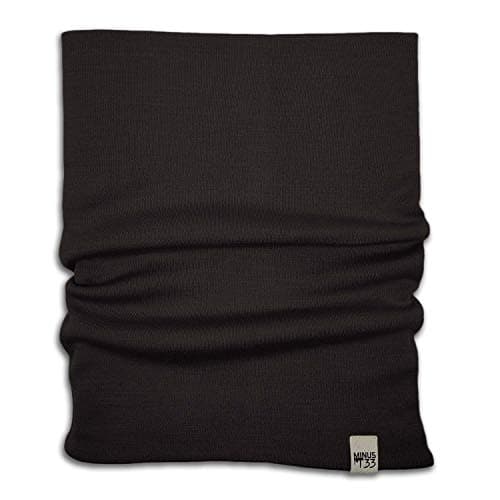
The Best Neck Gaiters and Balaclavas for Winter Camping, by Published Fabric Weight
A neck gaiter is the cheapest large upgrade in cold-weather camping, because the gap between your collar and your hat is where most of your heat leaves. The number that decides which one you want is fabric weight.
The neck is the cheapest heat leak to fix in winter camping. A jacket collar stops at your collarbone, a hat stops at your ears, and the gap between them is a chimney with warm air going up it. Closing that gap costs between five and forty dollars, which makes it the highest-return purchase in cold-weather clothing — and unlike a sleeping bag or a jacket, there is essentially no way to get it badly wrong.
The short answer
Buy a neck gaiter by its published fabric weight in g/m2. For winter camping, 200 g/m2 of merino is the one-item answer: warm enough to stand around camp in, thin enough to breathe through while you walk. Go to 245 g/m2 if you mostly stand still and run cold, and down to 125 g/m2 if you mostly move and overheat. Buy a balaclava instead of a gaiter only if you want to cover your head too, which is mainly a sleeping decision.
The one number worth comparing, and who publishes it
Fabric weight in grams per square meter is the closest thing this category has to a warmth rating. It is not perfect — knit structure and whether a piece is single or double layer both matter — but between two merino tubes of the same construction, the heavier fabric is the warmer one, and the number is comparable across brands in a way that marketing words like “thermal” and “midweight” are not.
The three merino tubes here form an unusually clean ladder: 125, 200 and 245 g/m2. That ladder is the entire buying decision, and it maps onto how much you plan to move.
Product
Fabric weight
Composition
Garment weight
Coverage
Buff Lightweight Merino
125 g/m2
100% merino
1.7 oz / 47 g
Neck only
Icebreaker 200 Oasis Flexi Chute
200 g/m2
100% merino, 18.9 micron
2.32 oz / 66 g
Neck only
Minus33 Midweight
245 g/m2
100% merino, 18.5 micron
Not published
Neck only
Smartwool Merino 250 Balaclava
Not published
100% merino
Not published
Head and neck
Ergodyne N-Ferno 6821
Not published
Not published (fleece)
Not published
Head and neck
Published specifications. Blank cells mean the manufacturer does not publish that figure for the item, not that we could not find it.
The table shows something genuinely awkward about this category, and it is worth stating rather than hiding: the two items that cover the most of you are the two that publish the least about themselves. Both balaclavas here omit a fabric weight, and the Ergodyne omits the fiber composition too. The measurable half of this category and the warmest half do not overlap, so if you want to buy on numbers you are buying a tube, and if you want full coverage you are buying partly on trust.
Gaiter or balaclava: it is mostly a question about sleeping
A neck gaiter is a tube. A balaclava covers your head, ears, neck and usually your face, leaving an opening for your eyes. People tend to assume the balaclava is simply the warmer and therefore better option, but during the day they are close to interchangeable, because anything a balaclava does for the top of your head a hat already does better.
The difference shows up at night. The reason to own a balaclava for camping is that your head is the coldest part of you in a sleeping bag, and a bag hood only works while you stay inside it. A balaclava moves with you instead. If you have ever woken up at 3 a.m. with a cold scalp and a perfectly warm body, that is the problem a balaclava solves and a gaiter does not. It is also the cheapest way to extend the range of a bag you already own, which is worth knowing before you shop for a warmer sleeping bag.
During the day, a gaiter is more flexible, because you can push it down without taking off your hat, and that single gesture is how you manage temperature while hiking. That is why the recommendation above is a 200 g/m2 gaiter for most people and a balaclava as a second, sleeping-focused item rather than a replacement.
Merino or fleece
These are the only two materials worth considering next to your face, and they fail in opposite directions.
Fleece is warmer per dollar and dries faster. Merino resists odor, stays comfortable when damp, and does not get clammy. For something you breathe through for hours, odor and damp comfort are what actually matter, which is why merino dominates this list despite costing several times as much. A fleece gaiter worn hard for a long weekend starts to smell; a merino one does not, and that is the whole argument.
There is also a durability trade in the other direction, and merino loses it. Merino is a protein fiber and it abrades and pills where polyester does not, particularly against beard stubble and jacket zippers. A $5 fleece balaclava that lasts three winters is not obviously worse value than a $40 merino one that pills in two. The washing rules are different too, and getting them wrong is how merino dies early — the merino washing guide covers that.
The moisture trap
In genuinely cold weather, breathing through any gaiter or balaclava will eventually ice the fabric in front of your mouth, because your breath carries a surprising amount of water and it freezes on the way out. This is normal and not a product defect. The fix is behavioral: pull the fabric below your mouth whenever you are working hard enough to breathe heavily, and only cover your face when you are standing still or the wind genuinely requires it. Merino stays wearable once damp; fleece ices faster but thaws and dries faster. Neither one wins outright.
Fit, and the one-size problem
Every item here is one size. For tubes that is mostly fine, because a gaiter only has to be long enough to cover the gap and loose enough to pull up. For balaclavas it is a real limitation: one-size-fits-most runs tight on larger heads, and a balaclava that is too tight is unpleasant in a specific way, because it pulls across your face every time you turn your head.
Length is the spec to check on a tube and almost nobody publishes it. Buff lists 26.5 by 9.5 in, which is roughly the category standard and is long enough to reach from collarbone to nose. A short gaiter is the one real failure mode here: if it does not overlap your collar it does not close the gap, and closing the gap was the entire point.
Two completely different products are called gaiters
Worth clearing up, because it causes real mis-purchases. A neck gaiter is the fabric tube on this page. A hiking gaiter is a fabric sleeve that wraps your lower leg and the top of your boot to keep snow, scree and mud out. They share a name and nothing else. If you came here looking for the leg kind, they are covered in best gaiters for hiking.
In a winter setup you plausibly want both, and they solve adjacent problems: the leg kind keeps snow out of your boots, which is what keeps your feet dry, and dry feet are the other half of staying warm. Pair them with winter boots and microspikes and you have the parts of a winter kit that most people forget until the first trip goes badly.
What we would actually buy
For one item and one winter: the Icebreaker at 200 g/m2, because it is the weight that is wrong least often, and because it doubles as a hat. For a cold camp where you are standing around more than hiking: the Minus33 at 245 g/m2, which is also the only product here whose spec sheet answers every reasonable question. For moving fast or for shoulder season: the Buff. For sleeping warm: the Smartwool balaclava. And buy a couple of the Ergodyne regardless of what else you choose, because the one you lose is always the one you needed.
The picks in full
1. Best overall, and the only one with a full published spec sheet
Minus33 Midweight Merino Wool Neck Gaiter
Minus33
The heaviest merino tube here at a published 245 g/m2, 18.5 micron, UPF 50+, with OEKO-TEX and Woolmark certification on the page.
Minus33 publishes 100% merino wool at 245 g/m2, an 18.5 micron fiber, UPF 50+, OEKO-TEX Standard 100 and Woolmark certification, a 16 CFR Part 1610 Class 1 flammability rating, and recommended seasons of spring, fall and winter. That is more disclosure than anything else in this category gets close to.
The 245 g/m2 figure is the reason it wins. It is the heaviest fabric of the three merino tubes here, roughly twice the Buff, and in a category where most sellers publish nothing at all, it is a number you can actually plan around. For a car-camping winter trip where you are standing around a cold camp more than you are climbing, heavier is simply better.
The 18.5 micron spec is the one people skip and shouldn't. Micron is fiber diameter, and it is what decides whether merino feels soft or itchy against your throat and chin. Anything under about 19 is comfortable next to skin for most people, so 18.5 puts this safely in the range where you will actually wear it pulled up over your mouth rather than pushing it down after ten minutes. If you already own Minus33 base layers, this is the same fabric family at a heavier weight.
The drawback
It is a tube and nothing more, so it does nothing for the top of your head. At 245 g/m2 it is genuinely too warm for hard uphill work much above freezing, and Minus33 does not publish a garment weight, so you cannot compare it to the Buff or the Icebreaker on grams.
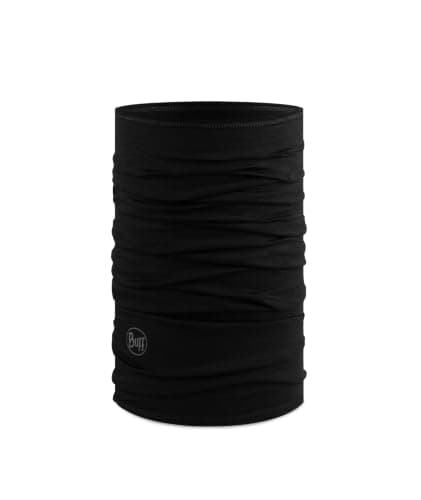
The lightest fabric here at 125 g/m2 and just 1.7 oz, which is the one you keep on while climbing instead of stuffing in a pocket.
The published figures are 100% merino wool at 125 g/m2, a 1.7 oz / 47 g weight and a 26.5 by 9.5 in tube. Those numbers appear consistently across European retailer listings; Buff itself does not serve a spec table for this item in the US, which is worth saying plainly rather than presenting retailer copy as a manufacturer sheet.
What 125 g/m2 buys you is the gaiter you do not take off. The failure mode of a warm neck gaiter is that you start climbing, you cook, you pull it down around your collar, and then it is a damp rope on your neck for the rest of the day. A 1.7 oz merino tube is thin enough to breathe through while you are working and still cut the wind, which is why this is the one to buy if you are mostly moving rather than mostly standing.
It also layers, and that is the honest way to use it in real cold. A 125 g/m2 tube under a hood, or over a heavier balaclava at camp, beats one thick item that is wrong half the time. Two thin layers trap air between them and let you dump one, which is the same logic that governs layering everywhere else.
The drawback
At 125 g/m2 it is about half the fabric of the Minus33 and it is not a deep-cold layer on its own. Buff also serves no US spec table for it, retailer listings disagree on whether the hems are seam-free, and every ASIN is a single colorway rather than a variant parent, so the exact listing can go out of stock on you.
Published specs
Fabric weight
125 g/m2
Composition
100% merino wool
Weight
1.7 oz / 47 g
Dimensions
26.5 x 9.5 in / 66 x 24.5 cm
Note
Buff does not serve a US spec table for this item; these figures are the ones repeated consistently across European retailer listings, and sources disagree on whether the hems are seam-free or semi-seamless
3. Most versatile, and the best-documented middle weight
Icebreaker Merino 200 Oasis Flexi Chute
Icebreaker
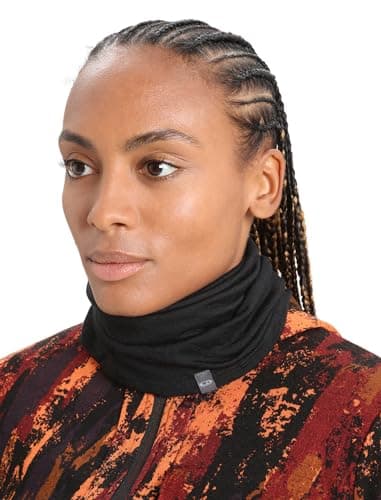
A 200 g/m2 merino jersey at 2.32 oz with a published 18.9 micron fiber and a stated warmth rating, sitting exactly between the Buff and the Minus33.
Icebreaker publishes 100% merino wool, a 200 g/m2 merino jersey fabric, an 18.9 micron fiber, a one-size weight of 66 g / 2.32 oz, and a warmth rating of 200 on its own 75 to 460+ scale. It is the only product here that puts a warmth number on the page at all.
Two hundred is the weight most people should buy if they are only buying one. It is warm enough to be a genuine cold-weather layer and thin enough to breathe through, and the Flexi Chute is cut long enough to pull up over your nose or stretch over your head as an improvised beanie. That dual use is worth more on a winter trip than it sounds, because the item you lose most often is your hat.
The thing to understand about a single jersey layer is wind. Merino handles cold air well and moving air badly, so in a stiff wind this works far better under a hood than on its own. If your winter setup is a shell with a hood you actually use, 200 g/m2 of merino inside it is close to ideal; if you are standing in open wind with no hood, the double-layer fleece route is the more honest answer.
The drawback
The most expensive tube here, and a single layer of jersey means real wind cuts through it in a way a double-layer fleece does not. Icebreaker lists this at 66 g on some storefronts and 90 g on others depending on the style code, so treat the weight as approximate.
4. Best balaclava, and the warmest thing you can put next to skin
Smartwool Merino 250 Balaclava
Smartwool
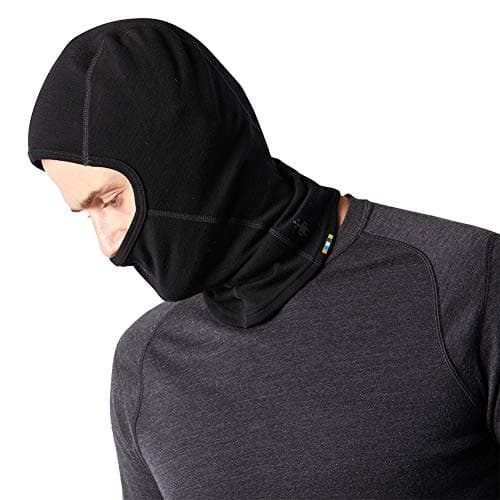
Full head and neck coverage in 100% merino interlock, which is the one fabric you can wear over your face all night without it becoming unpleasant.
The published details are 100% merino wool in Smartwool's NTS Mid 250 fabric, a single-layer interlock knit, one size fits most, style code SW0SC967. Note what is missing: there is no fabric weight in g/m2 anywhere, and the 250 is a tier name, not a measurement.
The reason to buy a merino balaclava rather than a fleece one is sleep. The coldest part of a winter night is your head, and a sleeping bag hood only helps if you stay inside it, which nobody does. Wearing a balaclava to bed solves that, but it means breathing through fabric for eight hours, and that is where fleece turns clammy and merino does not. Merino holds a large fraction of its water as vapor inside the fiber rather than as liquid on the surface, so it stays wearable damp.
It is also the right pick if your hands are the problem rather than your head. Covering your head and neck properly reduces how hard your body works to protect your core, and a warm core is what keeps blood flowing to your fingers. People who buy heavier gloves every winter and still have cold hands are often under-insulated at the neck.
The drawback
The most expensive item here and a single layer of interlock, so it is less wind-resistant than its price suggests. Smartwool publishes no g/m2 and no garment weight, and the 250 in the name is a fabric tier rather than a measured fabric weight. One-size-fits-most means it is tight on larger heads.
Published specs
Composition
100% merino wool
Fabric
NTS Mid 250
Knit
single-layer interlock
Fit
one size fits most
Style code
SW0SC967
Note
Smartwool does not publish a g/m2 figure for this item; the 250 in the name is its fabric tier rather than a measured fabric weight
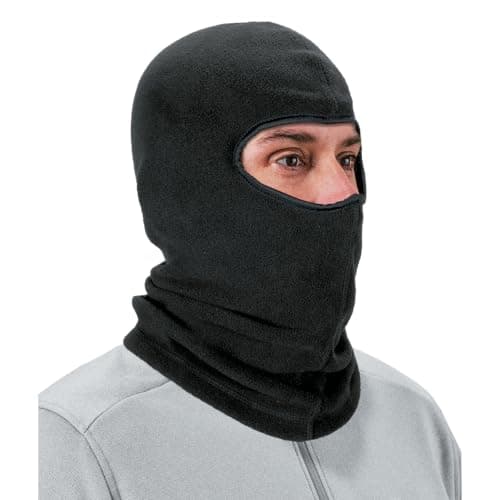
A full fleece balaclava for a few dollars, hard-hat compatible, with a reflective accent and a long tail that tucks into a jacket.
Ergodyne publishes a 1-layer thermal fleece construction, stretchable one-size-fits-most sizing, a long length that tucks into a jacket, hard hat compatibility, machine washability, a reflective accent, and a rating for cold temperature protection and low visibility. It does not publish a fiber composition or a fabric weight, which is the main caveat on an otherwise very easy recommendation.
At this price the calculation changes completely. A balaclava is the single most losable item in winter camping, and the correct number to own is more than one. Buying five of these costs less than one merino balaclava, which means there is one in the car, one in the pack, and spares for whoever forgot theirs. That is a better outcome than one excellent balaclava you are afraid to lose.
The low-visibility rating is a real and slightly unexpected benefit for campers. Winter days are short, you end up walking to the toilet block or the car in the dark constantly, and a reflective accent at head height is exactly where a headlight will catch it. It pairs with the same reasoning behind carrying a headlamp you can find in the dark.
The drawback
Ergodyne publishes the construction and features but no fiber composition and no fabric weight, so you cannot compare it on numbers to anything else here. It is polyester fleece, which means it will hold odor in a way merino does not, and it is worksite kit, so it looks like worksite kit.
Published specs
Construction
1-layer thermal fleece
Fit
stretchable, one size fits most
Coverage
long length, tucks into a jacket
Features
hard hat compatible, machine washable, reflective accent
Rated for
cold temperature protection, low visibility
Item number
16821 black
Note
Ergodyne publishes the construction and feature set but not a fiber composition or fabric weight for this item
QWhat fabric weight should a winter neck gaiter be?
Around 200 g/m2 of merino is the best single choice for winter camping: warm enough for standing around a cold camp, breathable enough to keep on while walking. The Icebreaker Flexi Chute publishes 200 g/m2. Go heavier, to the 245 g/m2 Minus33, if you run cold or mostly stay still, and lighter, to the 125 g/m2 Buff, if you overheat while hiking.
QIs a balaclava or a neck gaiter better for camping?
A gaiter for the day, a balaclava for the night. During the day they are close to interchangeable because a hat already covers what the balaclava adds, and a gaiter is easier to pull down when you overheat. The reason to own a balaclava is sleeping: your head is the coldest part of you in a sleeping bag, and a bag hood only helps while you stay inside it.
QMerino or fleece for a neck gaiter?
Merino if you will breathe through it for hours, which on a camping trip you will. It resists odor and stays comfortable when damp, where fleece turns clammy. Fleece is warmer per dollar, dries faster and abrades less, so it is the better choice for a cheap spare or for kids who will lose it. The Ergodyne fleece balaclava and the Smartwool merino one are the two ends of that trade.
QWhy does my neck gaiter freeze over my mouth?
Because your breath carries water, and below freezing that water condenses and ices in the fabric in front of your mouth. Every gaiter does this and it is not a defect. Pull the fabric below your mouth whenever you are breathing hard, and only cover your face when standing still or when the wind demands it. Merino keeps working once damp; fleece ices sooner but thaws and dries faster.
QDo neck gaiters have a warmth rating?
Almost none do, which is why fabric weight in g/m2 is the number to compare. Icebreaker is the exception here and publishes a warmth rating of 200 on its own 75 to 460+ scale, but that scale is proprietary and does not compare to other brands. Notably, both balaclavas on this page publish no fabric weight at all, so the items that cover the most of you are the hardest to compare on paper.
How we picked
Everyone else in this category will tell you they tested twenty of these. We have not tested any of them, and we would rather say so than pretend. There is no gear closet here and no test lab.
What we did instead: pulled the published specifications from each manufacturer's own spec sheet or manual, named the standard behind every rating so you can check what it actually promises, did the arithmetic that turns a spec into a decision, and pulled today's real retail price rather than quoting one from memory. Every pick states a drawback, because a list where nothing is wrong with anything is an advert.
The limits of that method, stated plainly: published specs do not capture zipper quality, seam durability, or how a tent behaves at 2am in a storm. Where that matters, we say so on the pick. The full method is here.