The Best Microspikes and Ice Cleats, Where Coils and Spikes Are Different Tools
These three products look like the same idea at three prices. They are not: coils grip packed snow, chained spikes bite hard ice, and carbide studs handle ice mixed with rock. Buying the wrong one is how people decide traction devices do not work.
One distinction to settle first, because it decides whether this is even the right page: everything here is a traction device for ice and hard-packed snow. None of it stops you sinking into soft, deep snow — that is flotation, and it needs snowshoes. A winter trip often wants both on the same day: snowshoes for an unbroken approach, spikes for the packed icy track near the trailhead.
Three designs, three surfaces
The short answer
Match the device to the surface, not to the price. Coils, like the Yaktrax Walk, bite into packed snow and skate on hard ice. Chained spikes, like Kahtoola MICROspikes, penetrate hard ice and are clumsy on bare rock. Carbide studs in a matrix, like Kahtoola EXOspikes, walk normally on mixed ice, rock and dirt but are the lesser tool on thick ice. Nobody needs all three; almost everybody buys the wrong one first.
This is the only decision on the page and it gets made badly because all three sit in the same aisle at prices that look like a quality ladder. They are not a ladder. A $90 set of MICROspikes is worse than a $22 set of Yaktrax on a packed-snow campground road, because the chains roll under your foot and the spikes have nothing hard to bite.
Work out which surface you actually walk on. For most campers it is packed snow and the occasional frozen puddle, and the honest answer is the cheapest item here. For anyone walking a frozen trail to a winter pitch, it is the MICROspikes and the weight is worth carrying.
What to look for
Specification
What to want
Why
Spike length
3/8 in for hard ice; studs are for mixed ground
a short stud rests on ice that a long spike penetrates
Spike material
heat-treated stainless for ice, tungsten carbide for rock
carbide keeps a point through grit; steel survives impact better
Chain or matrix
chain for pure ice, matrix for mixed surfaces
chains are superb on ice and awkward on everything else
Harness cold rating
a published figure, -30 F or lower
elastomer stiffens in cold and a rigid harness tears when stretched
Weight per pair
under 8 oz if it lives in a pack all season
the pair you carry beats the pair you left in the car
Sizing
size up over insulated winter boots
a winter boot is a size larger than the shoe you measured for
What decides whether a traction device works on your ground, rather than how aggressive it looks.
Compared on published numbers
Device
Traction
Spike length
Weight per pair
Cold rating
Best surface
Kahtoola MICROspikes
12 stainless spikes per foot on welded chain
3/8 in
11.0 to 13.5 oz
harness flexible to -30 F
hard ice, frozen trail
Kahtoola EXOspikes
12 tungsten carbide studs per foot in a TPU matrix
0.29 in
6.6 to 8.1 oz
not published
ice mixed with rock and dirt
Yaktrax Walk
1.2 mm zinc-coated steel coils
no spikes
2.0 to 4.0 oz
no breakage to -41 F
packed snow, campground roads
Figures as published by each manufacturer. Prices on this page carry their own as-of date.
The blank cell is honest: Kahtoola publishes the -30 F harness figure for the MICROspikes and does not state an equivalent for the EXOspikes, so we have left it out rather than assume the two share it. Yaktrax publish a breakage temperature rather than a flexibility one, which is a different claim about a different failure.
Fitting them, and the two mistakes
Fit them over the boot you will wear, in the warm, before the trip. A traction device sized to your shoe size will not stretch over an insulated winter boot, which is why Yaktrax tell you to size up for oversized footwear and why people stand at a trailhead in the cold discovering it.
The second mistake is walking in them as though they were boots. Spikes and coils both want a flat, deliberate foot placement; pushing off hard with the toe is how a harness rolls off the heel. They also do nothing for your balance, which is what trekking poles are for — on ice the pole and the spike solve different halves of the same problem.
None of these is a crampon, and the difference matters
Microspikes and cleats are for walking on frozen flat-ish ground. They are not rated for climbing, they do not have front points, and they will not hold on a steep icy slope where a fall runs out badly. If the ground is steep enough that a slip would not stop, the answer is mountaineering equipment and the training to use it, not a longer spike. This site covers camping, and the honest boundary is that everything on this page belongs on a trail you could walk in summer.
What goes with them
Traction keeps your feet under you; it does nothing about the water. Frozen trail turns to slush in the afternoon, and the combination that actually keeps a winter camper comfortable is a waterproof insulated boot, a gaiter to stop the slush entering over the top, and somewhere to dry everything overnight. Those three are in best winter hiking boots, best gaiters for hiking and best boot dryers.
Store them dry and separately. Steel coils and chains rust where they sit damp against fabric, and a set thrown wet into a pack pocket in March is a set with a seized coil in December. The stuff sack they ship in exists for that reason.
Which to buy
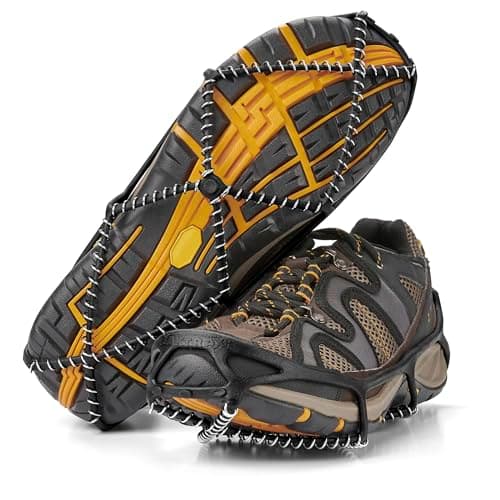
Buy the Yaktrax Walk if your winter is campground roads, car parks and the walk to the toilet block. Two to four ounces, a price that does not need thinking about, and coils that work on exactly the packed snow most people actually slip on. This is the one most campers should stop reading at.
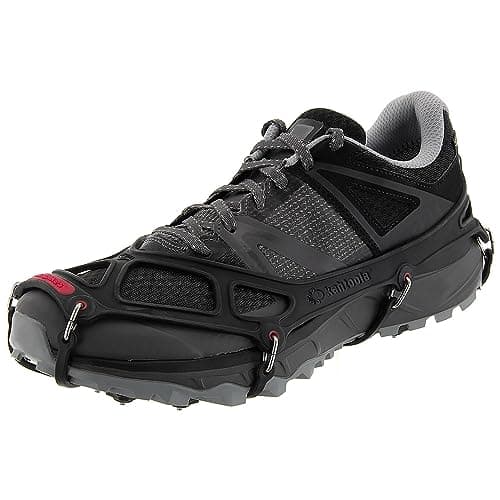
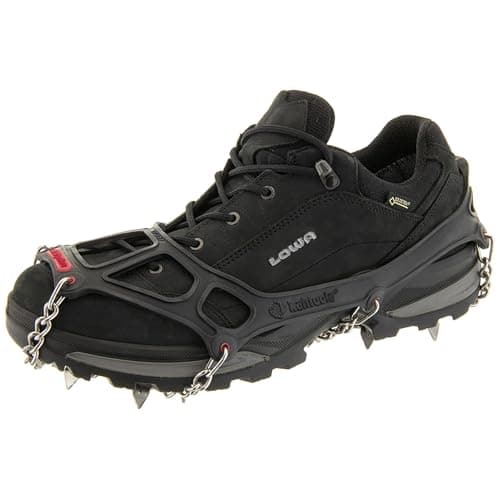
Buy the Kahtoola MICROspikes if you walk frozen trail. Twelve 3/8 in stainless spikes per foot is the only thing here that penetrates hard ice, and the -30 F harness means you can fit them on the morning it matters. Accept the weight and the noise on rock.
Buy the Kahtoola EXOspikes if your trail alternates between frozen and bare. The TPU matrix walks normally on rock where chains do not, carbide keeps its point through grit, and at under eight ounces a pair they are light enough to live in the pack all season. They are the compromise, and on pure ice the compromise shows.
The picks in full
1. Best overall, and the one for genuine ice
Kahtoola MICROspikes
Kahtoola
Twelve 3/8 in heat-treated stainless spikes per foot on welded chains, with a harness that stays flexible to -30 F.
Kahtoola publishes 12 spikes per foot at 3/8 in in heat-treated 400-series stainless steel, welded stainless chains, a thermoplastic elastomer harness with reinforced eyelets that stays flexible down to -30 F, per-pair weights of 11.0 oz in small through 13.5 oz in extra large, a 5 by 3 by 2 in packed size and a two-year warranty.
Three eighths of an inch is the number that separates this from everything else on the page. That is a real spike that penetrates hard ice rather than resting on it, which is what you want on a frozen trail where a slip has consequences. The coils on the Yaktrax cannot do that job and do not pretend to.
The harness rating is the quietly important specification. Elastomer stiffens as it gets colder, and a harness that has gone rigid is one that tears when you stretch it over a boot at dawn. A published -30 F figure means you can fit them with cold hands on the morning you actually need them, which is the only time anybody fits them.
The drawback
At 11 to 13.5 oz per pair they are the heaviest thing here, the chains are noisy and clumsy on bare rock, and they are roughly four times the price of the Yaktrax. They are also the wrong tool for a packed-snow campground road.
Published specs
Spikes
12 per foot, 3/8 in, heat-treated 400-series stainless
Chains
welded stainless steel
Harness
thermoplastic elastomer with reinforced eyelets, stays flexible to -30 F
Twelve 0.29 in tungsten carbide studs per foot in a TPU matrix rather than chains, at 6.6 to 8.1 oz per pair.
Kahtoola publishes 12 tungsten carbide spikes per foot at 0.29 in, anchored in aluminum and thermoplastic polyurethane lugs, carried on a TPU traction matrix instead of steel chains, on a thermoplastic elastomer harness, at per-pair weights from 6.6 oz in extra small to 8.1 oz in extra large.
The matrix is the whole design argument. Chains are superb on ice and miserable on everything else: they roll underfoot on rock, they catch on roots, and they transmit every stone straight into your arch. A TPU matrix with studs set into it walks almost normally on bare ground, which matters enormously on the real shoulder-season trail that is frozen in the shade and dry in the sun.
Tungsten carbide is the other half of it. It is far harder than steel and keeps a point through contact with rock and grit, which is exactly the abuse that rounds off a steel spike. Buy these if your winter walking is mixed surfaces, and buy the MICROspikes if it is ice.
The drawback
A 0.29 in carbide stud is well under the MICROspikes' 3/8 in steel spike, so on thick hard ice this is the lesser tool. Carbide is also brittle compared with heat-treated stainless if you kick a rock hard enough.
Zinc-coated 1.2 mm steel coils on polyelastomer webbing, 2 to 4 oz per pair, tested safe from breakage to -41 F.
Yaktrax publishes 1.2 mm abrasion-resistant steel coils with a zinc coating against rust, polyelastomer webbing, a figure of 2.0 to 4.0 oz per pair, four sizes from extra small to large, 70 percent recycled content in the coils and 20 percent in the webbing, and testing safe from breakage in temperatures as low as -41 F.
Coils work by biting into a compressible surface. On packed snow that is genuinely effective and it is all most campers need: the thing that actually puts people on the ground in winter is not an alpine ice sheet, it is the polished strip between the car and the toilet block. For that, four ounces in a jacket pocket is the right answer.
Be clear about the limit, because Yaktrax do not market it loudly. On hard ice a coil skates. If your winter involves frozen trail rather than packed snow, the money saved here is not a saving. Note too that Yaktrax recommend sizing up for oversized footwear, which includes most insulated winter boots.
The drawback
Coils grip packed snow and do almost nothing on hard ice, which is the mistake people make with them. There is no spike here at all, and they wear out faster than either Kahtoola.
Published specs
Traction
1.2 mm abrasion-resistant steel coils, zinc coated
QWhat is the difference between microspikes and ice cleats?
The traction element. Ice cleats such as the Yaktrax Walk use steel coils that bite into a compressible surface, which works on packed snow and skates on hard ice. Microspikes use actual spikes on chains - Kahtoola publishes 12 per foot at 3/8 in - which penetrate hard ice. They are different tools for different surfaces rather than two price points for the same job.
QDo I need microspikes for winter camping?
Only if you walk on hard ice. The surface that actually puts campers on the ground is packed snow between the car and the pitch, and 2 to 4 oz of steel coils handles that for a fraction of the price. If your approach is a frozen trail where a slip has consequences, then yes - and buy a real 3/8 in spike rather than coils.
QWhat size microspikes should I buy over winter boots?
Size up. Yaktrax explicitly recommend buying one size larger than your normal shoe size for oversized footwear, and an insulated winter boot is oversized footwear. Fit them over the actual boot you will wear, indoors, before the trip rather than at the trailhead in the cold.
QAre microspikes the same as crampons?
No, and the difference is a safety boundary rather than a marketing one. Microspikes are for walking on frozen flat-ish ground; they have no front points and are not rated for climbing. On a slope steep enough that a slip would not stop, the answer is mountaineering equipment and the training to use it, not a longer spike.
QWill steel traction devices rust?
Yaktrax coat the Walk's coils with zinc to resist it, and Kahtoola use stainless steel, but any of them left damp in a pack pocket will suffer. Dry them before storage and keep them in their own sack - a seized coil in December is usually a set that was put away wet in March.
How we picked
Everyone else in this category will tell you they tested twenty of these. We have not tested any of them, and we would rather say so than pretend. There is no gear closet here and no test lab.
What we did instead: pulled the published specifications from each manufacturer's own spec sheet or manual, named the standard behind every rating so you can check what it actually promises, did the arithmetic that turns a spec into a decision, and pulled today's real retail price rather than quoting one from memory. Every pick states a drawback, because a list where nothing is wrong with anything is an advert.
The limits of that method, stated plainly: published specs do not capture zipper quality, seam durability, or how a tent behaves at 2am in a storm. Where that matters, we say so on the pick. The full method is here.