The Best Boot Dryers for Camping, Rated in Watts and Hours
Wet boots are the thing that ends a cold trip early, and they do not dry overnight in a tent. The specification that matters is not drying speed, it is what the thing plugs into.
Pick on what it plugs into, then on speed. On an unpowered pitch the only option here is the 12 V DryGuy Travel Dry DX, which runs off a car socket at 13 W. On a powered pitch or at home, the PEET Original dries silently overnight at 36 W, and the 240 W DryGuy Force Dry DX is the fast one that takes gloves as well as boots. Every one of them is capped below 105 F, which is the point: real heat destroys boots.
Boot dryers are sold on drying time and bought, correctly, on power source. A three-hour cycle is irrelevant if the appliance needs a wall you do not have, and this is the mistake that leaves campers putting wet boots on at 7 am. Decide whether you are drying boots at a campsite or after you get home, because those are two different purchases.
If you are drying at a campsite, the realistic options are a 12 V unit off the car, a mains unit on a powered pitch, or the free methods below. If you are drying at home between trips, buy on speed and capacity and ignore the voltage question entirely.
What to look for
Specification
What to want
Why
Power source
12 V DC if you camp unpowered
the single thing that decides whether you can use it at all
Wattage
low for overnight, high for a fast turnaround
watts buy speed and cost you either battery or silence
Maximum temperature
under about 105 F, published
heat delaminates glue and damages waterproof membranes
Dry time
read it as a range, not a promise
every published figure assumes damp rather than soaked
Capacity
boots plus gloves if there are four of you
one pair per cycle does not clear a family weekend
Fan or convection
convection for silence, fan for speed
a fan is the only moving part and the only thing to wear out
What decides whether a boot dryer suits your trips, rather than how quickly it claims to work.
Compared on published numbers
Dryer
Power source
Draw
Max temperature
Dry time
Capacity
Warranty
DryGuy Travel Dry DX
120 V AC or 12 V DC vehicle
13 W (one retailer lists 24 W)
99 F / 37 C
2 to 5 hours
one pair
1 year
PEET Original
120 V AC
36 W, 0.3 A
not published
3 to 8 hours
one pair
25 years
DryGuy Force Dry DX
120 V AC
240 W
105 F / 40.5 C
not published as hours
boots plus gloves
1 year
Figures as published by each manufacturer or its retail listing. Prices on this page carry their own as-of date.
The blanks are real gaps rather than oversights. PEET publishes a wattage and a dry-time range but no maximum temperature, and DryGuy publishes a temperature and a timer for the Force Dry DX but not an hours figure, so retailer estimates of “about an hour” to “1 to 2 hours” are not the maker's claim and are not quoted here as one.
What 13 watts means off a car battery
This is the arithmetic that makes the 12 V option sensible rather than theoretical. Thirteen watts for four hours is about 52 watt-hours, which is a small fraction of the roughly 500 usable watt-hours in a car starter battery — but it is four hours of draw with the engine off, which is exactly the situation the site warns about on best power inverters for camping.
The clean version is to run it off a battery you are allowed to flatten. A 256 Wh power station covers a full 4-hour cycle roughly four times over; a car starter battery covers it once and then you are hoping. If you own a power station already, the 12 V dryer is close to free to run; if you do not, run it while driving to the next site.
The free methods work, and you should know them anyway
Stuff the boots with newspaper or a dry spare sock overnight and change it once — the paper pulls water out of the lining by capillary action and costs nothing. Pull the insoles out, always, because a boot dries from the inside and an insole left in traps the wettest layer against the footbed. Loosen the laces fully and open the tongue. And never put boots near a fire or on a heater: the glue that holds a sole on softens well below the temperature that feels hot to a hand, which is why a boot dryer caps itself at 99 to 105 F. The full routine is in how to dry clothes and boots at camp.
Why wet boots matter more in winter
A damp boot conducts heat away from your foot far faster than a dry one, so the practical result of not drying boots is cold feet on day two regardless of how good the boot is. It is the same mechanism that makes a damp sleeping bag cold, and it is why winter campers treat drying as part of the evening routine rather than an afterthought.
The other half is the sock. A dry wool sock in a damp boot is damp within minutes, so drying boots and carrying a spare pair of wool socks are the same tactic rather than alternatives. If the boots themselves are the problem, start at best winter hiking boots and keep the slush out with gaiters.
Which to buy
Buy the DryGuy Travel Dry DX if you dry boots at a campsite. It is the only unit here that runs off a 12 V vehicle socket, 13 W is nothing to supply, 1.3 lb packs with the rest of the kit, and the 99 F ceiling cannot hurt a membrane. This is the camping answer and the one most readers of this page want.
Buy the PEET Original if you dry boots at home or on a powered pitch and would rather it were silent. Thirty-six watts of convection with no moving parts and a 25-year warranty is the buy-once option, and the price of that is needing a whole night.
Buy the DryGuy Force Dry DX if there are four of you and a wall. Two hundred and forty watts with a 3-hour timer, drying boots and gloves in the same cycle, is the only configuration here that clears a family's wet weekend overnight. It is mains-only and the size of a small suitcase, which is the trade.
The picks in full
1. Best for camping, because it runs off the car
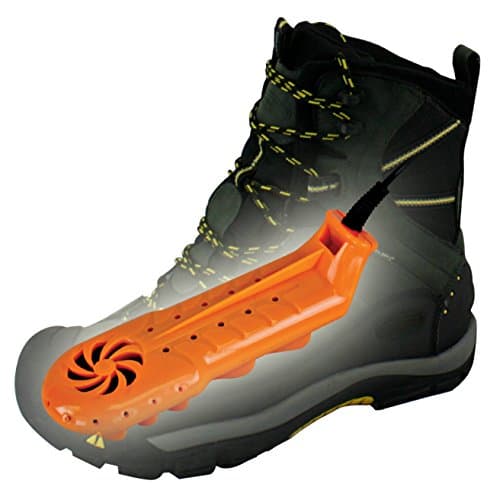
DryGuy Travel Dry DX
DryGuy
13 W from either a household outlet or a 12 V vehicle socket, drying in 2 to 5 hours at a maximum of 99 F, at 1.3 lb.
DryGuy publishes operation from a 120 V AC household outlet or a 12 V DC vehicle outlet, a 13 W draw (one retailer lists 24 W), a convection and forced-air hybrid system, a maximum temperature of 99 F / 37 C, a dry time of 2 to 5 hours, a 6.5 by 2.5 by 2.25 in body, a 1.3 lb weight and a one-year warranty.
The 12 V socket is the entire reason this wins on a camping site. Every other boot dryer assumes a wall, and a wall is the one thing a campsite does not have unless you booked a powered pitch. Thirteen watts off the car is also trivial: it is roughly a tenth of what a phone charger pulls at peak, so an hour of engine idling or a modest power station covers a full cycle without thinking about it.
Ninety-nine degrees is the other number worth noticing, and it is a feature rather than a limit. Boot leather and modern waterproof membranes are both damaged by real heat, which is why the fix people reach for — boots by the fire — ruins boots. A dryer that physically cannot exceed 99 F cannot cook a membrane.
The drawback
Thirteen watts is a gentle trickle and 2 to 5 hours assumes damp rather than soaked. One retailer lists it at 24 W rather than 13, so the draw is not consistently published. It handles one pair and no gloves.
2. Best overnight, and the one with a 25-year warranty
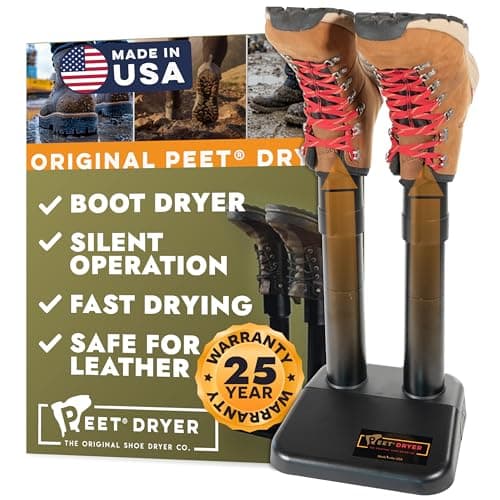
PEET Original Boot Dryer
PEET
36 W of silent convection with no fan at all, drying in 3 to 8 hours, backed by a 25-year warranty.
PEET publishes 36 W at 120 V drawing 0.3 A, a silent convection system with no fan and no forced heat, a dry time of 3 to 8 hours depending on how saturated the boots are, a one-pair capacity and a 25-year warranty.
The warranty is not a throwaway detail. Twenty-five years on a $50 appliance tells you what the design is: a low-wattage heating element with no moving parts, which is why there is nothing in it to fail. Every fan-driven dryer on the market is a motor waiting to wear out; this is a warm tube.
Silent matters more than it sounds for the obvious use case. A boot dryer that runs overnight next to where people sleep has to be inaudible, and a convection unit is. The cost is time: 3 hours for damp boots and the full 8 or more for boots that actually got soaked, so this is a thing you switch on at bedtime, not an hour before you leave.
The drawback
No fan means it is the slowest thing here and genuinely needs a night, and it is mains-only so it is no use on an unpowered pitch. It takes one pair and nothing else.
Published specs
Power
36 W at 120 V, 0.3 A
System
silent convection, no fan and no forced heat
Dry time
3 to 8 hours depending on how saturated the boots are
3. Fastest, and the only one that does gloves at the same time
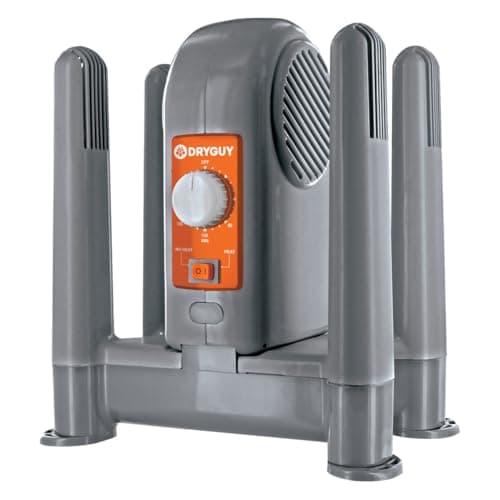
DryGuy Force Dry DX
DryGuy
240 W of forced air at up to 105 F with a 3-hour timer, drying boots and gloves simultaneously.
DryGuy publishes 120 V AC operation at 240 W, a maximum temperature of 105 F / 40.5 C, an integrated timer of up to 3 hours, capacity for boots plus gloves at the same time, a 15 by 12 by 7.5 in body, model number 02129 and a one-year warranty.
Two hundred and forty watts of forced air is what buys the speed, and for a family it is the right trade. Four people on a wet winter weekend produce four pairs of boots and eight gloves, and a dryer that does a boot pair and a glove pair per cycle on a three-hour timer clears that overnight. A single-pair convection unit does not.
The timer is the detail that makes it usable rather than merely powerful. Prewarming boots to a set time is pleasant; leaving 240 W running unattended all night is not, and the integrated timer removes the choice. Note the mains requirement honestly: this belongs at home, in a cabin, or on a powered pitch, and 240 W is more than most portable batteries want to supply for three hours.
The drawback
240 W is nearly seven times the PEET and nineteen times the Travel Dry, it is mains-only, and at 15 in wide it is a piece of furniture rather than kit. The fan is audible.
Only if it matches your power. The DryGuy Travel Dry DX runs from a 12 V vehicle outlet at 13 W, which a car socket or a small power station supplies easily, so it works on an unpowered pitch. Mains-only units like the PEET Original or the 240 W Force Dry DX need a powered pitch, a cabin or home.
QHow long does a boot dryer take?
Between two and eight hours depending on the design and how wet the boots are. DryGuy publishes 2 to 5 hours for the forced-air Travel Dry DX; PEET publishes 3 to 8 hours for its fan-free convection unit. Every published figure assumes damp boots rather than soaked ones, so treat them as a range rather than a promise.
QWill a boot dryer damage my boots?
Not these, and that is deliberate. The glue holding a sole on and the waterproof membrane in the lining are both damaged by real heat, which is why DryGuy caps the Travel Dry DX at 99 F and the Force Dry DX at 105 F. What does damage boots is the improvised version - boots next to a fire, on a radiator or in front of a heater.
QDo you need a boot dryer or is newspaper enough?
Newspaper genuinely works and costs nothing: stuff the boots, change the paper once, and pull the insoles out so the wettest layer is not trapped against the footbed. A dryer earns its place when you need the boots dry by morning rather than eventually, and in winter when a damp boot means cold feet all of day two.
QHow much power does a boot dryer use?
Far less than people assume for the low-wattage units. The DryGuy Travel Dry DX draws 13 W, so a four-hour cycle is about 52 watt-hours - a small fraction of a 256 Wh power station. The 240 W Force Dry DX is a different proposition: three hours of that is roughly 720 watt-hours, which is mains territory rather than battery territory.
How we picked
Everyone else in this category will tell you they tested twenty of these. We have not tested any of them, and we would rather say so than pretend. There is no gear closet here and no test lab.
What we did instead: pulled the published specifications from each manufacturer's own spec sheet or manual, named the standard behind every rating so you can check what it actually promises, did the arithmetic that turns a spec into a decision, and pulled today's real retail price rather than quoting one from memory. Every pick states a drawback, because a list where nothing is wrong with anything is an advert.
The limits of that method, stated plainly: published specs do not capture zipper quality, seam durability, or how a tent behaves at 2am in a storm. Where that matters, we say so on the pick. The full method is here.