Trail & Tarp earns a commission from qualifying purchases made through links on this page, at no extra cost to you. Full disclosure.
Quick picks
#
Product
Best for
Price
1
Best all-round hiking sock
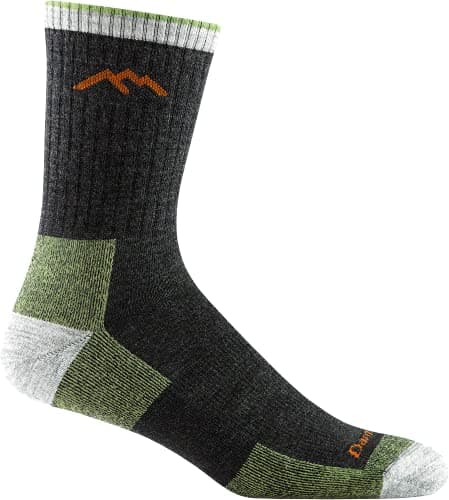
Darn Tough Hiker Micro Crew Midweight Sock
61% merino wool with 36% nylon and 3% Lycra, midweight cushion, micro crew height at about 8.5 in, knit in Vermont with an unconditional lifetime guarantee.
Boots, day hikes, and anyone who would rather buy socks once
Cotton absorbs moisture and holds it against the skin, and wet skin blisters far more easily than dry skin because it is softer and grips the sock instead of sliding. Blisters are a friction injury, and damp cotton is a friction machine. Every sock on this page is merino or engineered synthetic for that single reason. The cheapest useful thing you can do for your feet costs nothing: stop wearing cotton socks in boots.
Merino works because the fiber absorbs moisture into its structure rather than holding it on the surface, so it feels dry at up to about a third of its own weight in water. Engineered synthetics such as COOLMAX work the opposite way, moving moisture along the fiber to the outside where it evaporates. Both end at the same place: a foot that stays drier, and skin that does not soften.
Sock
Fiber
Cushion
Height
Notable
Darn Tough Hiker Micro Crew
61% merino / 36% nylon / 3% Lycra
Midweight
Micro crew, about 8.5 in
Unconditional lifetime guarantee
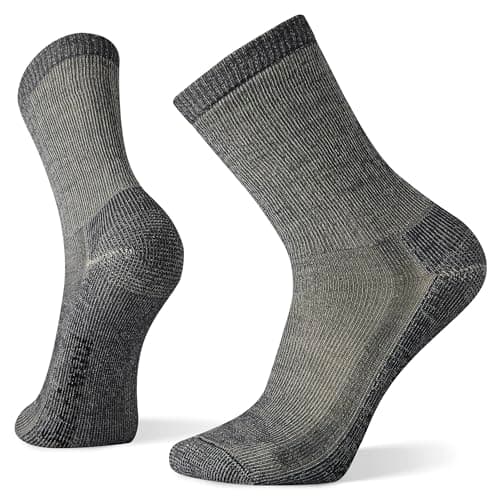
Smartwool Hike Classic Full Cushion
ZQ merino with recycled nylon
Full cushion
Crew
Fills volume in a roomy boot
Injinji Trail Midweight Mini-Crew
58% nylon / 39% COOLMAX / 3% Lycra
Midweight
Mini-crew, double cuff
Five-toe sleeve construction
All figures as published by the manufacturers.
Cushion level: match it to the boot, not the weather
Cushion is padding thickness, and it is a fit specification as much as a warmth one. A stiff boot needs more cushion because there is less give in the sole and more pressure at the edges. A flexible shoe needs less, and too much cushion in a snug shoe creates pressure that was not there before.
Ultralight or no cushion. Hot weather, trail shoes, or as a liner sock under a thicker pair.
Midweight. The default for boots in three-season conditions. This is where both midweight picks above sit.
Full or heavy cushion. Stiff boots, cold weather, long descents, or a boot that is a touch roomy.
Whatever you choose, try boots on with the socks you will hike in. A full-cushion sock takes up meaningful volume, and a boot fitted with a thin sock will be tight with a thick one. That is one of the most common causes of a boot that “shrank”.
Height is a blister specification
The sock must be taller than the boot cuff. If the cuff of a mid-height boot sits directly on bare skin or on the very edge of a sock, it rubs there all day and that is exactly where the blister appears. Mid boots want crew socks; low shoes are fine with micro or mini crew. This is a free fix, and it prevents more blisters than any tape. The full prevention sequence is in how to break in hiking boots.
How many pairs, and what to do at camp
Three pairs covers almost any trip: one on, one drying, one dry in reserve. The third pair is not a luxury — it is the pair that never gets worn during the day and only comes out at bedtime, and it is one of the highest-value items in the whole sleep system. Damp socks in a sleeping bag will keep you cold all night, which is the mechanism in why you get cold in a sleeping bag.
Wool socks also do not need washing every day, which matters when you are carrying them. Merino resists odor because the fiber is inhospitable to the bacteria that cause it, so a pair can be aired overnight and worn again. Synthetics cannot, which is the practical cost of the Injinji.
Washing them so they last
Warm gentle wash, no fabric softener, and no high heat in the dryer. Softener coats the fibers and destroys the moisture management that is the entire point of the sock. High heat shrinks wool and melts the elastane that holds the shape.
Turn them inside out to wash, which gets the abrasive grit out of the pile where it does the damage. A sock that fails at the heel usually failed because of sand, not because of miles.
What we did not do
We have not worn these. There is no standard for sock cushion levels or for the moisture performance claims made across this category, so this page compares what the manufacturers publish — fiber composition, cushion level, height and construction — and explains what each of those means for a foot. Every figure is linked to its source. See how we research, and how to layer for camping for where socks fit in the whole system.
The picks in full
1. Best all-round hiking sock
Darn Tough Hiker Micro Crew Midweight Sock
Darn Tough
61% merino wool with 36% nylon and 3% Lycra, midweight cushion, micro crew height at about 8.5 in, knit in Vermont with an unconditional lifetime guarantee.
Darn Tough publishes a composition of 61% merino wool, 36% nylon and 3% Lycra spandex, midweight cushion with padding underfoot, a micro crew height of about 8.5 in from heel to cuff, knitting in Vermont, and an unconditional lifetime guarantee.
The 36% nylon is the specification that matters and the one people misread as cost-cutting. Pure merino is lovely and it wears through at the heel in a season. Nylon is the abrasion-resistant structural fiber; the Lycra is what keeps the sock in shape so it does not bunch. A sock that is 61% wool is a wool sock built to survive.
The lifetime guarantee is unusual enough to be worth taking seriously as a specification rather than marketing. A company that replaces worn socks indefinitely has to build them to not wear out, and that constraint shows in the density of the knit. It also changes the arithmetic: three pairs of these against a drawer of replaced cheap socks is not the comparison it first appears to be.
The drawback
Midweight cushion is warm for high summer, and a micro crew is slightly short if your boot cuff is tall.
Smartwool Hike Classic Edition Full Cushion Crew Sock
Smartwool
ZQ-certified merino with recycled nylon, full cushion throughout, in a crew height that clears the boot cuff.
Smartwool publishes ZQ-certified merino wool with recycled nylon, full cushion throughout, an over-the-ankle mid-calf crew fit intended to prevent chafing from boots, machine wash warm on a gentle cycle, and manufacture in the USA.
Full cushion means padding through the whole foot rather than just underfoot, and it does two things. It absorbs impact on descents, which is where feet actually get hurt, and it fills volume in a boot that is slightly too roomy — a genuinely useful trick when a boot fits in length but not in fit.
The crew height is the other reason to choose this over a micro crew. If your boots are mid or high cut, the sock has to be taller than the cuff or the cuff rubs directly on skin at the exact point that blisters. Match sock height to boot height and a whole category of problem disappears — the boots in the hiking boot roundup are all mid cut, so crew is the right pairing.
The drawback
Full cushion is genuinely thick: it takes up real volume in a boot and is too warm for a hot day.
A five-toe sleeve design in 58% nylon, 39% COOLMAX EcoMade polyester and 3% Lycra, in a double-cuffed mini-crew with an arch band.
Injinji publishes a fiber content of 58% nylon, 39% COOLMAX EcoMade polyester and 3% Lycra spandex, a five-toe sleeve construction, a double-cuffed mini-crew height, an arch support band with a breathable mesh top, and care instructions of cold delicate wash and line dry.
Toe socks solve one specific problem completely: skin-on-skin friction between toes. If your blisters are always in the same interdigital spot and no amount of tape or boot adjustment fixes them, this is the answer, and it is a much cheaper experiment than another pair of boots.
The synthetic composition is a deliberate choice rather than a compromise here. COOLMAX is engineered to move moisture along the fiber surface, which matters more between toes than anywhere else on the foot, and a merino toe sock would be bulkier in exactly the place there is no room. The trade is that synthetics smell after a day and merino does not.
The drawback
Synthetic rather than merino, so it holds odor more; and getting five toes into five sleeves is a genuine faff, especially in the dark.
Merino wool blended with nylon for durability is the default: the Darn Tough Hiker Micro Crew publishes 61% merino, 36% nylon and 3% Lycra with a lifetime guarantee. Choose full cushion for stiff boots or cold weather, and toe socks if your blisters are always between toes.
QWhy should you not wear cotton socks for hiking?
Cotton absorbs moisture and holds it against the skin. Wet skin is softer and grips the sock rather than sliding against it, which is exactly how blisters form. Merino absorbs moisture into the fiber and synthetics move it to the outside; both keep skin drier.
QHow tall should hiking socks be?
Taller than your boot cuff. If the cuff of a mid-height boot rubs directly on skin or on the edge of a sock, that is where the blister appears. Mid boots want crew socks; low trail shoes are fine with micro or mini crew.
QHow many pairs of hiking socks do I need?
Three. One on, one drying, one dry in reserve that never gets worn during the day and only comes out at bedtime. Merino resists odor well enough that a pair can be aired overnight and worn again; synthetics cannot.
How we picked
Everyone else in this category will tell you they tested twenty of these. We have not tested any of them, and we would rather say so than pretend. There is no gear closet here and no test lab.
What we did instead: pulled the published specifications from each manufacturer's own spec sheet or manual, named the standard behind every rating so you can check what it actually promises, did the arithmetic that turns a spec into a decision, and pulled today's real retail price rather than quoting one from memory. Every pick states a drawback, because a list where nothing is wrong with anything is an advert.
The limits of that method, stated plainly: published specs do not capture zipper quality, seam durability, or how a tent behaves at 2am in a storm. Where that matters, we say so on the pick. The full method is here.