The Best Gaiters for Hiking, and Whether You Need Them at All
Gaiters are the most situational item in this category. For three specific conditions they are transformative, and the rest of the time they are hot nylon around your ankles.
One quick disambiguation first, because it causes real mis-purchases: the gaiters on this page are the leg kind — the sleeve that wraps your lower leg and boot top to keep snow, scree and mud out. If you came looking for the fabric tube that covers your neck and face, that is a neck gaiter, and it is a completely different product that happens to share the name.
The three conditions that justify gaiters
The short answer
Buy gaiters for snow deeper than your boot, for scree and sand that pours in over the collar, or for wet overgrown trail that soaks your socks through the boot opening. Outside those three, they mostly make your legs hot. The height you need follows directly from which one you have.
This is worth stating plainly because gaiters get sold as general hiking equipment and they are not. A dry, maintained trail in summer gives you nothing to keep out, and a waterproof layer wrapped around your lower leg in that situation is purely a heat penalty.
Condition
What gets in
Height you need
Snow above boot height
snow packing into the boot collar, then melting
knee-high
Scree, sand, volcanic grit
sharp debris over the collar, every step downhill
mid-calf is usually enough
Wet brush, dew, mud
water wicking from wet vegetation into the sock
mid-calf to knee
Dry maintained trail in summer
nothing
none; leave them home
What each condition puts in your boot, and how tall the gaiter has to be to stop it.
Compared on published numbers
Gaiter
Height
Weight per pair
Leg fabric
Foot fabric
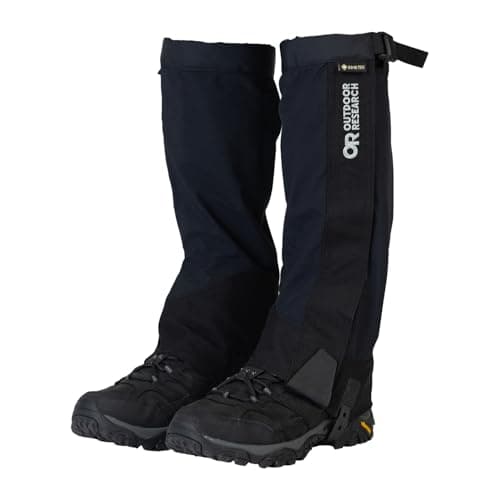
Outdoor Research Crocodile
knee high
10.2 oz / 289 g
GORE-TEX 3L, 70D nylon
Cordura 2L, 1000D nylon
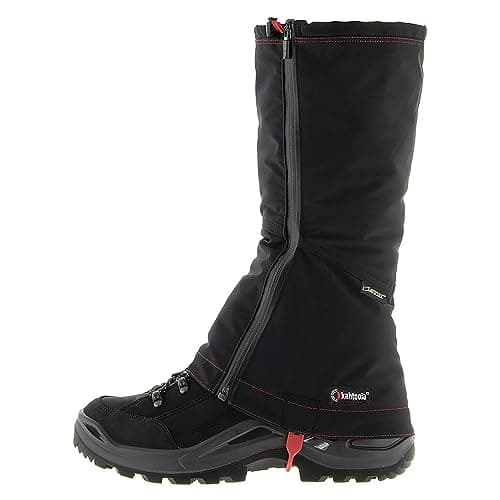
Kahtoola LEVAgaiter Tall GTX
tall
4.48 oz
3-layer GORE-TEX, ePE membrane
not published
Figures as published by each manufacturer.
Two picks, because these are the two ends of the useful range and the middle of this market is trail-running gaiters that are not waterproof and do a different job. Those are worth owning too, and they are the cheap end — a low breathable trail gaiter keeps grit out of a trail shoe for a couple of ounces and does not pretend to be waterproof.
Waterproof gaiters do not make your boots waterproof
This is the most common misunderstanding. A gaiter covers the opening at the top of the boot. It does not seal to the boot, and water crossing above the sole, or a boot that has wet out through its own membrane, is unaffected by anything you wrap around your shin.
What gaiters genuinely stop is water running down your leg into the boot, which in sustained rain or wet brush is most of how boots fill. Paired with rain pants worn outside the gaiter, that path is closed — and the order matters, because pants tucked inside a gaiter funnel water straight in. The boot side of this is in hiking boots vs trail shoes.
The under-strap is the part that fails
Every gaiter has a strap or cord running under the boot, and it is a wear item: it drags on rock with every step and it is the first thing to break, usually far from the car. Check whether the model you buy uses a replaceable strap, carry a spare or a length of cord, and look at the lace hook at the front — the Crocodile's is double-riveted for the same reason. Repair options belong in the same kit as your other field fixes — camp gear repair kit essentials.
Fit is against the boot, not the leg
Gaiter sizing is driven by boot size rather than calf circumference, because the bottom opening has to sit close around the boot without riding up. A gaiter that is loose at the ankle lets in exactly what it exists to exclude.
Two practical notes. Wide or plastic mountaineering boots need the wide version, which Outdoor Research sells separately. And if you wear hiking pants with an ankle zip or a wide cuff, check the two work together before the trip rather than at the trailhead.
What the specifications do not tell you
Nobody publishes a breathability figure for gaiters, which is the property that decides whether they are bearable in summer. GORE-TEX construction implies some, but a three-layer laminate wrapped around a lower leg is always going to be warmer than bare fabric.
Kahtoola does not publish a denier for the LEVAgaiter leg or foot fabric on the page we read, so we cannot compare its abrasion resistance with the Crocodile's 1000D Cordura foot in any meaningful way. Given the 5.7 oz weight difference, assume the trade is real.
Which to buy
Buy the Outdoor Research Crocodile if you hike in snow, on scree, or off-trail through scrub, and you want a pair that lasts a decade. The 1000D foot is what you are paying for.
Buy the Kahtoola LEVAgaiter Tall GTX if you are a three-season hiker who wants waterproofing that stays in the pack without being noticed. Four and a half ounces is the version you will actually have with you.
Buy neither if you hike maintained trails in dry weather. Spend the money on socks instead, which improve every single hike rather than three of them a year.
The picks in full
1. Best overall
Outdoor Research Crocodile Gaiters
Outdoor Research
Knee-high GORE-TEX with a 1000D Cordura foot panel at 10.2 oz per pair, closed with a cam buckle and a 2 in hook-and-loop front.
Outdoor Research publishes a knee-high cut, a 10.2 oz / 289 g weight per pair, a three-layer GORE-TEX 70D nylon leg panel, a two-layer 1000D Cordura foot panel, a webbing and cam buckle top closure, a 2 in hook-and-loop front closure and a double-riveted boot lace hook.
The 1000D Cordura foot panel is the specification that matters. The foot is where gaiters die: crampon points, rock, and your own opposite boot cut through light fabric within a season. A thousand denier there is the difference between gaiters that last years and gaiters that last a trip.
Knee height is not a comfort feature, it is a depth rating. Gaiters only work up to their own height, so in deep snow the tall ones are the only ones doing anything.
The drawback
10.2 oz and knee-high. In summer they are hot, and on a maintained trail in dry weather they are a lot of fabric doing very little.
Published specs
Height
knee high
Weight
10.2 oz / 289 g per pair
Leg fabric
GORE-TEX 3L, 70D nylon
Foot fabric
Cordura 2L, 1000D nylon
Closure
webbing and cam buckle top, 2 in hook and loop front
Full 3-layer GORE-TEX waterproofing at 4.48 oz per pair, less than half the weight of the Crocodile.
Kahtoola publishes a tall cut, a 4.48 oz per pair weight and three-layer GORE-TEX construction with an ePE waterproof membrane, describing it as among the lightest fully waterproof gaiters available.
Four and a half ounces is the number that changes behavior. Gaiters only help if you actually carry them, and a 10 oz pair gets left at home on a marginal forecast while a 4.5 oz pair stays in the pack all season.
The ePE membrane is worth noting as a materials change: it is GORE-TEX's PFC-free expanded polyethylene membrane, replacing the PTFE ones the industry has used for decades.
The drawback
No heavy Cordura foot panel, so abrasion resistance is nothing like the Crocodile's. Kahtoola does not publish a leg fabric denier on the page we read.
Published specs
Height
tall
Weight
4.48 oz per pair
Fabric
3-layer GORE-TEX with ePE waterproof membrane
Note
among the lightest fully waterproof gaiters published
Only for three conditions: snow deeper than your boot, scree or sand that pours in over the collar, and wet overgrown trail that soaks socks through the boot opening. On dry maintained trails in summer they add heat and keep nothing out.
QDo gaiters keep your feet dry?
They stop water running down your leg into the boot, which in rain and wet brush is how most boots fill. They do not seal to the boot, so a water crossing above the sole or a boot whose own membrane has wet out will still soak you. Wear rain pants outside the gaiter, never tucked inside.
QHow tall should hiking gaiters be?
As tall as the thing you are keeping out. Snow above boot height needs knee-high, because a gaiter only works up to its own height. Scree and sand are usually handled by mid-calf, and grit in a trail shoe needs only a low running gaiter.
QWhat size gaiters do I need?
Size to your boot, not your calf. The lower opening has to sit close around the boot or debris gets in at the ankle, which defeats the point. Wide or plastic mountaineering boots need a wide version, which Outdoor Research sells as a separate size in the Crocodile line.
How we picked
Everyone else in this category will tell you they tested twenty of these. We have not tested any of them, and we would rather say so than pretend. There is no gear closet here and no test lab.
What we did instead: pulled the published specifications from each manufacturer's own spec sheet or manual, named the standard behind every rating so you can check what it actually promises, did the arithmetic that turns a spec into a decision, and pulled today's real retail price rather than quoting one from memory. Every pick states a drawback, because a list where nothing is wrong with anything is an advert.
The limits of that method, stated plainly: published specs do not capture zipper quality, seam durability, or how a tent behaves at 2am in a storm. Where that matters, we say so on the pick. The full method is here.