The Best Winter Boots for Camping, and Why the Temperature Rating Is Not a Standard
Sleeping bags have a tested standard behind their numbers. Winter boots do not: every maker rates its own, and some publish no rating at all. Insulation weight and whether the liner comes out tell you more.
Sleeping bags are tested to ISO 23537 on a heated manikin, so a 20 F bag from one brand is comparable to a 20 F bag from another. Winter boots have no equivalent. Kamik rates the Nation Plus at -40 F, Columbia rates the Bugaboot III at -25 F, and Merrell publishes no rating for the Coldpack 3 at all — and none of those numbers came from the same test. Compare insulation weight in grams instead, and treat every temperature figure as a marketing claim about a stationary foot.
This is the single most useful thing to understand in the category, and it explains why people buy a -40 F boot and still get cold feet. Those ratings assume things nobody states: a dry liner, a dry sock, a foot with good circulation, and usually some walking. Standing still on frozen ground for an hour defeats almost any boot.
The figures that are comparable are insulation weight in grams and whether the liner is removable. Two hundred grams is the common three-season-winter figure, 400 to 600 g is deep cold, and a removable liner is worth more in multi-day camping than another hundred grams of fill because it is the only way to start day two dry. The same logic that governs sleeping bag temperature ratings applies here, except without the standard.
Pac boots and insulated hikers are different tools
Pac boot
Insulated hiker
Example here
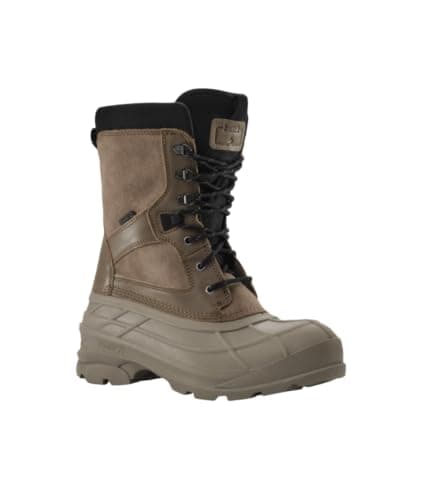
Kamik Nation Plus
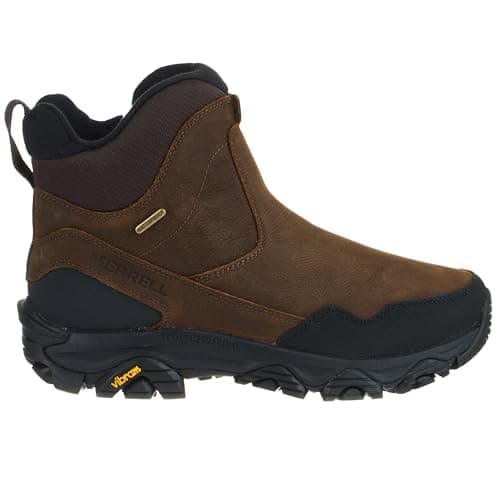
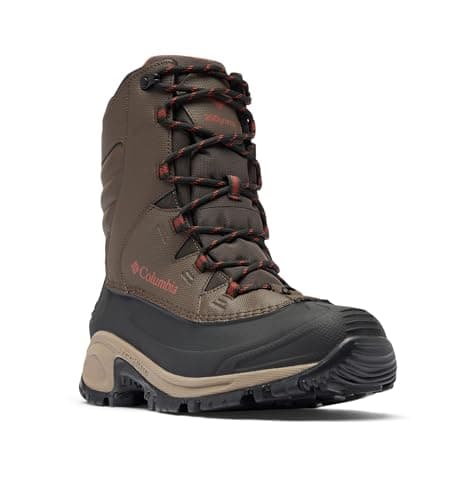
Merrell Coldpack 3, Columbia Bugaboot III
Liner
removable, dries overnight
bonded in, dries slowly or not at all
Shell
waterproof rubber, no membrane to wet out
leather or synthetic over a membrane
Weight
heavy, around 3.6 lb per pair
lighter, roughly 2.5 lb per pair
Flex
poor; walks like a wellington
flexes like a hiking boot
Best at
standing around camp in deep cold
covering ground in cold
Our summary. Most winter campers want the hiker; people who stand still in real cold want the pac boot.
If you camp in winter and mostly potter around a site, cook, and walk short distances, the pac boot is correct and the weight does not matter because you are not going far. If there is a hike at either end of the trip, the insulated hiker is correct and you accept that the insulation cannot be taken out to dry.
Compared on published numbers
Boot
Rating
Insulation
Liner
Waterproofing
Weight
Outsole
Kamik Nation Plus
-40 F
not published as grams
removable
waterproof rubber shell
3.6 lb per pair
not published
Merrell Coldpack 3 Thermo Tall Zip
not published
200 g plus fleece lining
bonded in
breathable membrane, waterproof zip
1 lb 4.8 oz per boot
Vibram Arctic Grip
Columbia Bugaboot III
-25 F / -32 C
200 g plus Omni-Heat reflective lining
bonded in
seam-sealed waterproof leather
24.5 oz per half pair at size 9
not published
Figures as published by each manufacturer or its retail listing, and deliberately not reconciled - see the note below.
Notice that no row is complete and no two rows are measured the same way. Kamik gives a temperature and no gram weight; Merrell gives a gram weight and no temperature; Columbia gives both but across a confusing family of variants. Weights are quoted per pair, per boot and per half pair by three different makers. This table is the honest state of the category rather than a tidy comparison, and anyone presenting it as tidy has filled in gaps.
Fit, socks and the mistake that causes cold feet
A winter boot needs room for a thicker sock and for your toes to move, because circulation is most of what keeps a foot warm. A boot fitted snugly over a thin sock in a shop in October is a boot that compresses a wool sock in January and leaves you with cold toes regardless of its rating. Fit winter boots over the sock you will actually wear and leave room to wiggle.
One sock, not two. Two pairs compress each other and each other's loft, and the result is less insulation and more friction. A single proper wool sock is both warmer and less likely to blister — the argument in full is in best hiking socks.
Size up for traction devices too, if you plan to use them. A device sized to your shoe will not stretch over an insulated boot, which is covered in best microspikes and ice cleats.
Dry the boots or the rating is irrelevant
Insulation works by trapping air, and water displaces air. A boot that is damp inside has lost most of its insulating value whatever the label says, which is why the removable liner on a pac boot is worth more than it looks and why every winter camper needs a drying plan. Pull the insoles, loosen the laces fully, and either take the liner into your sleeping bag or use a low-wattage dryer — never a fire or a heater, which softens the glue holding the sole on. The methods are in best boot dryers and how to dry clothes and boots at camp.
Which to buy
Buy the Merrell Coldpack 3 Thermo Tall Zip if you walk in winter. Two hundred grams of insulation with a Vibram Arctic Grip outsole at under 600 g per boot is the configuration that covers ground, the side zip is a real convenience with cold hands, and the wet-ice compound is the most useful outsole here. Accept that Merrell publishes no temperature rating.
Buy the Kamik Nation Plus if you stand still in deep cold. A -40 F pac boot with a removable liner you can dry overnight is the right tool for a static winter camp, and the waterproof rubber shell has nothing to wet out. It is heavy and it walks badly, which is the trade.
Buy the Columbia Bugaboot III if this is a first winter boot for campground use. A published -25 F with 200 g and a seam-sealed leather upper covers normal cold at the lowest price here — just read the variant name on the listing carefully, because the Plus III and XTM are different boots with different numbers.
The picks in full
1. Warmest, and the one with a liner you can dry
Kamik Nation Plus
Kamik
A -40 F rated pac boot on a waterproof synthetic rubber shell with a removable insulated liner, at 3.6 lb per pair.
Kamik publishes a -40 F rating, a waterproof synthetic rubber shell, a removable insulated liner, a suede upper with listings also citing 600D nylon panels, a height of about 11 to 11.5 in and a weight of 3.6 lb per pair.
The removable liner is the feature that matters most for camping and it is what makes this a pac boot rather than an insulated hiker. A liner that comes out can be pulled at night and dried in your sleeping bag or next to a stove, which means you start day two with dry insulation. A boot with the insulation bonded in cannot do that, and damp insulation is cold insulation.
The rubber shell is the other half. It is genuinely waterproof rather than waterproof-until-the-membrane-wets-out, which is the right call for slush, and it is why this style has survived unchanged for decades. The cost is weight and a sole that does not flex, so if the plan involves real miles this is the wrong boot.
The drawback
Three and a half pounds per pair is heavy and the flex is poor, so this is a camp boot rather than a hiking boot. Retailers disagree about whether the liner is 3M Thinsulate or Kamik's own HEAT-MX, and about whether the upper is suede or 600D nylon.
Published specs
Temperature rating
-40 F
Shell
waterproof synthetic rubber
Liner
removable; retailers name it as either 3M Thinsulate or Kamik HEAT-MX
200 g of synthetic insulation with a fleece lining, a waterproof membrane and side zip, and a Vibram Arctic Grip outsole, at 1 lb 4.8 oz per boot.
Merrell publishes 200 g of synthetic insulation plus a fleece lining, a breathable waterproof membrane, a waterproof heavy-duty side zipper, a Vibram Arctic Grip outsole, a 6 in shaft height and a weight of 1 lb 4.8 oz (590 g) per boot. It publishes no temperature rating.
Arctic Grip is the specification that separates this from a generic insulated boot. It is a rubber compound designed for wet ice specifically, which is the surface that defeats ordinary lug patterns — and wet ice is what a winter campsite path becomes in the afternoon. It is not a substitute for traction devices on real ice, but it is a meaningful improvement over nothing.
At 590 g per boot this is roughly a third lighter than the Kamik and it flexes like a hiking boot, which is the whole point. The side zip is a genuine convenience in cold weather: getting a stiff winter boot on with numb fingers is slow, and a zip removes most of that.
The drawback
Merrell publishes no temperature rating at all for it, so you are buying on insulation weight alone. The insulation is not removable, and it is the most expensive boot here. Sources disagree on whether the upper is leather or synthetic.
Published specs
Insulation
200 g synthetic plus a fleece lining
Temperature rating
not published
Waterproofing
breathable waterproof membrane; waterproof heavy-duty side zipper
A published -25 F rating with 200 g of insulation and an Omni-Heat reflective lining, on a seam-sealed waterproof leather upper.
Columbia publishes a -25 F / -32 C rating, 200 g of insulation with an Omni-Heat reflective lining, a seam-sealed waterproof leather upper and a weight of 24.5 oz per half pair at size 9, for the plain Bugaboot III.
Read the variant name carefully before you buy, because this is where the money gets wasted. There is a Bugaboot III, a Bugaboot Plus III, a Plus III Titanium and an XTM, and they carry different insulation weights and different ratings — one source describes a Plus III Titanium at 600 g and -65 F. Retailer listings use the names interchangeably. Check the insulation figure on the listing you are actually buying.
Omni-Heat is a reflective lining rather than insulation, and it is worth understanding as exactly that: a layer of metallic dots that reflects radiant heat back at your foot, working alongside the 200 g of fill rather than instead of it. It is a real mechanism and a modest one.
The drawback
Columbia's naming is a trap: the plain Bugaboot III, the Plus III and the XTM carry different insulation and ratings, and retailer listings mix them up freely. The figures here are for the plain III. Independent immersion testing has also found water entering over the top of the tongue gusset.
Published specs
Temperature rating
-25 F / -32 C
Insulation
200 g, with an Omni-Heat reflective lining
Upper
waterproof leather, seam sealed
Weight
24.5 oz per half pair at size 9
Note
figures are for the plain Bugaboot III; the Plus III and XTM variants carry different insulation and ratings
QAre winter boot temperature ratings standardized?
No, and this is the key thing to know. Sleeping bags are tested to ISO 23537 on a heated manikin so the numbers are comparable between brands; boots have no equivalent. Kamik rates the Nation Plus at -40 F, Columbia the Bugaboot III at -25 F, and Merrell publishes no rating for the Coldpack 3 at all. Compare insulation weight in grams instead.
QHow much insulation do winter camping boots need?
Two hundred grams covers normal winter cold and is what both the Merrell Coldpack 3 and the plain Columbia Bugaboot III publish. Deep cold or long periods standing still want 400 to 600 g. A removable liner is often worth more than extra fill on a multi-day trip, because it is the only way to start the second day with dry insulation.
QWhat is the difference between a pac boot and an insulated hiking boot?
The liner and the shell. A pac boot like the Kamik Nation Plus has a waterproof rubber shell and a removable insulated liner you can pull out and dry overnight; it is warm, heavy and walks poorly. An insulated hiker has the insulation bonded in behind a membrane; it is lighter and flexes properly but cannot be dried the same way.
QShould you wear two pairs of socks in winter boots?
No. Two pairs compress each other's loft, which reduces insulation and adds friction and blisters. One proper wool sock is warmer. What does matter is fitting the boot over the sock you will actually wear, with room for your toes to move, because circulation is most of what keeps a foot warm.
QDo winter boots work on ice?
Better or worse depending on the outsole, but none of them is a traction device. The Merrell's Vibram Arctic Grip is a compound designed for wet ice specifically and is a genuine improvement over an ordinary lug pattern. On real ice you still want microspikes or cleats over the boot, and you should size those up to fit over an insulated boot.
How we picked
Everyone else in this category will tell you they tested twenty of these. We have not tested any of them, and we would rather say so than pretend. There is no gear closet here and no test lab.
What we did instead: pulled the published specifications from each manufacturer's own spec sheet or manual, named the standard behind every rating so you can check what it actually promises, did the arithmetic that turns a spec into a decision, and pulled today's real retail price rather than quoting one from memory. Every pick states a drawback, because a list where nothing is wrong with anything is an advert.
The limits of that method, stated plainly: published specs do not capture zipper quality, seam durability, or how a tent behaves at 2am in a storm. Where that matters, we say so on the pick. The full method is here.