The Best Snowshoes for Winter Camping, Sized by Load Rather Than Shoe Size
Snowshoes are sized by how much weight they have to hold up, not by how big your feet are. Get that one number right and almost any decent pair works; get it wrong and the best snowshoe on the market sinks.
A snowshoe does exactly one thing: it spreads your weight over enough area that you walk on top of soft snow instead of sinking to your knee with every step. That is called flotation, and it is the only problem snowshoes solve. They are not an ice-traction device, they are not a boot, and they do not help on a packed trail. Buying them for the wrong one of those jobs is the most common way people end up deciding snowshoes are overrated.
The short answer
Size a snowshoe by total loaded weight — your body, plus your pack, plus your clothing — against the maker's published load rating. Shoe size is irrelevant. For most adults heading to a winter campsite on rolling ground, a 22 in shoe rated to about 180 lb is the default. Add heel lifts only if you climb sustained hills, and buy a shorter shoe for a lighter person rather than assuming one size fits the family.
Load rating is the only size that matters
Every snowshoe worth buying publishes a load rating, and it is the single number to compare. It is not a safety limit like a climbing rating — nothing breaks if you exceed it. It is a flotation estimate: above that weight, in soft snow, you sink far enough that you are post-holing in expensive footwear.
The number people get wrong is what goes into it. A load rating covers everything the snow has to hold up, so it is your body weight plus the pack plus the boots and layers. Winter kit is heavy and bulky in a way summer kit is not: a four-season tent, a cold-rated bag, a pad or two and extra insulation add up fast, and that is before water. A 170 lb person is realistically a 200 to 210 lb load on a winter overnight, which pushes them out of the 180 lb band entirely.
Snowshoe
Length
Published load
Weight per pair
Heel lift
Traction
MSR Evo Trail
22 in
up to 180 lb; 250 lb with tails
3 lb 9 oz
none
steel rails and brake bars molded into the deck
MSR Evo Ascent
22 in
up to 180 lb; 250 lb with tails
3 lb 15 oz
Televators
steel crampons, rails and teeth
Retrospec Drifter
21 / 25 / 30 in
80-120 / 110-160 / 160-210 lb by size
4.2 lb (2.1 lb per shoe)
heel lifters, angle not published
not published
Figures as published by each manufacturer. Blank-equivalent cells mean the maker does not publish that figure, not that we could not find it.
Two things jump out of that table. The first is that the two MSRs have identical flotation — same length, same width, same 180 lb rating — so the roughly hundred-dollar gap between them buys heel lifts and crampons, not the ability to carry more. The second is that the cheapest pair is also the heaviest, at 4.2 lb against the Evo Trail's 3 lb 9 oz. There is no version of this category where the budget option is also the light option.
Length, and why bigger is not better
Length and load move together, because length is how a snowshoe buys area. That makes it tempting to size up for margin, and it is usually the wrong call. A longer shoe is harder to turn, catches on its neighbor when you walk normally, and is genuinely awkward in trees, on sidehills and on the narrow packed tracks that most campsites are reached along.
The working rule is to size for the snow you will actually be on. Dense, wet, settled or already-tracked snow supports you far better than fresh cold powder, so if your winter camping is campground and forest-track rather than untracked backcountry, the shorter shoe at the top of its load band beats the longer shoe in the middle of its.
What a heel lift actually does
This is the feature that splits the two MSRs and it is worth understanding before paying for it. On a steep climb your heel sits far below your toes, so your calf and Achilles hold a stretched position for every step of the ascent. A heel lift — MSR calls theirs a Televator — is a small bar you flip up so your heel rests on it, leveling your foot relative to the slope.
It does not make you faster and it does nothing on the flat. What it does is stop your calves being the thing that ends the day. If your winter trips are valley floors and rolling forest, you will flip it up roughly never and the Trail is the better buy. If they involve a sustained pull up to a plateau or a ridge, the Ascent pays for itself in one trip.
Snowshoes are not microspikes, and the two do not substitute
These get confused constantly because both go under a boot in winter. They solve opposite problems. Snowshoes give you flotation on soft, deep snow and are clumsy and pointless on hard ground. Microspikes and ice cleats give you traction on ice and hard-packed snow and do nothing at all for sinking. A winter trip often needs both on the same day: snowshoes for the unbroken approach, spikes for the packed icy track near the trailhead. If your problem is slipping rather than sinking, you want microspikes and ice cleats instead, and they cost a fraction as much.
Flotation tails, and the 180-to-250 lb question
Both MSRs take optional 6 in tails that clip to the back of the deck and raise the rating from 180 lb to 250 lb. They are sold separately, which matters for how you budget: if you already know you will be over 180 lb loaded, the real price of either MSR is the shoe plus the tails.
The upside is that it is the right way round. A modular tail means you carry the extra flotation only on the trips that need it, so the same pair works for a day walk and a two-night winter overnight with a heavy pack. Compare that with buying a 30 in shoe outright and living with the length all year.
Poles are not optional with snowshoes
Snowshoeing changes your balance more than people expect — a wide deck underfoot, deep soft snow, and a gait that is wider than walking. Poles do most of the work of keeping that upright, and they are also how you test snow depth and push yourself back up after a fall in powder, which will happen. If you do not already carry a pair, add trekking poles to the same order rather than the next one. Snow baskets matter more than the pole itself here.
For one pair and one winter: the MSR Evo Trail, with the tails if you will be over 180 lb loaded. It is the right length for the way most people reach a winter campsite, the steel is molded in rather than bolted on, and nothing about it is fashionable enough to be redesigned out from under you. Pay the extra for the Evo Ascent only if you genuinely climb — the flotation is identical, so heel lifts are the whole of what the money buys. And size a lighter person down rather than handing them an adult shoe: the 21 in Retrospec at 80 to 120 lb is the only published answer here for someone that weight, and at this price it is a reasonable way to find out whether the family likes snowshoeing at all before buying three pairs of MSRs.
The picks in full
1. Best overall, and the one most winter campers should buy
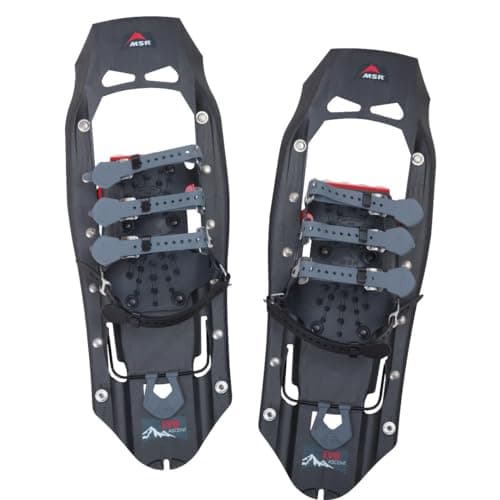
MSR Evo Trail Snowshoes (22 in)
MSR
A 22 by 8 in footprint at 3 lb 9 oz a pair, rated to 180 lb and to 250 lb with the optional tails, on steel rails molded into the deck.
MSR publishes a 22 in length, an 8 in width, a 3 lb 9 oz weight per pair, a load rating of up to 180 lb and up to 250 lb with the optional tails, an injection-molded UniBody deck, and steel traction rails and brake bars molded directly into that deck. The 6 in flotation tails are sold separately.
The molded-in steel is the part worth paying for. On most snowshoes the traction is hardware bolted to a frame, and bolted hardware is what works loose and rattles. Rails formed into the deck itself have nothing to loosen, which is why this design has survived essentially unchanged for years while everything around it was restyled.
A 22 in shoe is also the right default for the job this site cares about. Longer shoes float better but are clumsy in trees and on sidehills, and a winter campsite is usually reached on a track rather than across open powder. If you are heavier than about 180 lb once your pack is on, that is what the tails exist for — see the section below, because it changes which shoe you should buy.
The drawback
No heel lift, so a long sustained climb puts all of it through your calves. The tails that take it from 180 to 250 lb are a separate purchase, not in the box. MSR does not consistently publish a binding name for this model either, so you cannot compare that on paper.
Published specs
Length
22 in
Width
8 in
Weight
3 lb 9 oz per pair
Load
up to 180 lb; up to 250 lb with the optional tails
Deck
injection-molded UniBody
Traction
steel traction rails and brake bars molded into the deck
Tails
optional 6 in flotation tails, sold separately
Note
no heel lift on this model -- that is the Evo Ascent. MSR's binding name is not consistently published for it either: current listings say DuoFit and older ones Paraglide, so no binding name is claimed here
2. Best for steep ground, and the only one here with heel lifts
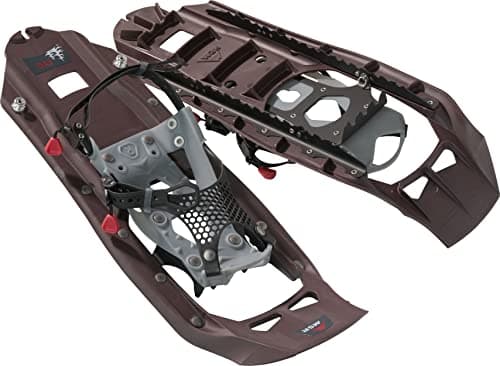
MSR Evo Ascent Snowshoes (22 in)
MSR
The same 22 in footprint and the same 180 lb rating as the Trail, plus Televator heel lifts and steel crampons for climbing.
Cascade Designs publishes a 22 in / 56 cm length, an 8 in / 20 cm width, a weight of 3 lb 15 oz per pair (retailer listings say 4 lb 1 oz), the same up-to-180 lb load and up-to-250 lb with tails as the Trail, steel crampons with steel rails and teeth, a PosiLock AT binding, and Televator heel lifts.
Televators are the entire reason this model exists, and they are easy to underrate until you have used them. A heel lift is a small bar you flip up under your heel on a climb, so your foot sits level on an angled slope instead of permanently flexed. The effect is on your calves and Achilles rather than on your speed: without one, a long climb in snowshoes is a calf workout that ends the day early.
Note what you are not buying. The load rating is identical to the Trail, so this is not the model to pick because you are carrying more. Buy it if your winter walking involves sustained uphill; buy the Trail if it involves getting across a flat valley to a pitch.
The drawback
Around a hundred dollars more than the Trail for exactly the same flotation, so you are paying for the heel lifts and crampons rather than for carrying more weight. It is heavier, and Cascade Designs and its own retailers disagree about the pair weight by 2 oz.
Published specs
Length
22 in / 56 cm
Width
8 in / 20 cm
Weight
3 lb 15 oz per pair published by Cascade Designs; retailers list 4 lb 1 oz
Load
up to 180 lb; up to 250 lb with the optional tails
3. Best budget, and the only one here sized for a light load
Retrospec Drifter Snowshoes
Retrospec
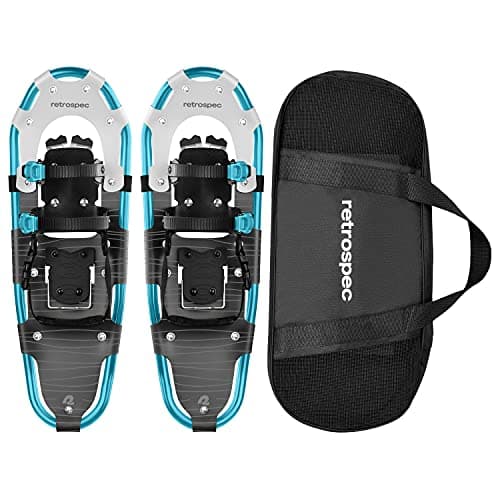
Three published lengths covering load bands from 80 lb up to 210 lb, aluminum frames and a carry bag included, at under a third the price of the MSRs.
Retrospec publishes 21 in, 25 in and 30 in lengths with load bands of 80 to 120 lb, 110 to 160 lb and 160 to 210 lb respectively, a 2.1 lb weight per shoe, aluminum alloy frames, polyethylene decks, double-ratchet bindings and an included mesh vented carry bag.
The per-size load bands are the reason this earns a place rather than just being the cheap option. Both MSRs come in one size with one rating, which quietly assumes an adult of adult weight. If you are outfitting a 90 lb twelve-year-old, a 22 in shoe rated to 180 lb is the wrong tool: too much shoe, awkward to walk in, and no better on snow. The 21 in Drifter at 80 to 120 lb is the honest answer, and it is the only published one here.
Be clear-eyed about what is missing. Retrospec describes heel lifters but publishes no angle for them, and publishes nothing about crampons or traction on the standard Drifter at all — its separate Drifter Plus is the model whose listing names steel toe crampons. On flat snow that gap does not matter much. On anything icy it does, which is where a traction device is the better purchase anyway.
The drawback
At 2.1 lb per shoe it is 4.2 lb a pair against the Evo Trail's 3 lb 9 oz, so the cheapest option is also the heaviest. Retrospec publishes no crampon or traction detail for the standard Drifter, and no heel-lift angle. Its own bundle page contradicts its product page on the 25 in load band.
Published specs
Sizes
21 in, 25 in and 30 in
Load by size
80 to 120 lb (21 in), 110 to 160 lb (25 in), 160 to 210 lb (30 in)
Weight
2.1 lb per shoe
Frame
aluminum alloy
Deck
polyethylene
Bindings
double-ratchet
Included
mesh vented carry bag
Note
Retrospec's own bundle page lists the 25 in at 120 to 200 lb, which contradicts the 110 to 160 lb on its main product page; the figures above are the main product page's
Size by total loaded weight, not shoe size. Add your body weight, your pack and your winter clothing together and match that to the maker's published load rating. MSR rates both 22 in Evo models to 180 lb, extending to 250 lb with optional tails; Retrospec publishes 80 to 120 lb for its 21 in, 110 to 160 lb for the 25 in and 160 to 210 lb for the 30 in. A 170 lb person on a winter overnight is realistically a 200 lb load once the pack is on.
QDo I need snowshoes or microspikes?
They solve opposite problems and do not substitute. Snowshoes stop you sinking into soft deep snow; microspikes and ice cleats stop you slipping on ice and hard-packed snow. A winter trip often needs both on the same day - snowshoes for the unbroken approach, spikes for the packed icy section near the trailhead. If your problem is slipping rather than sinking, spikes are the far cheaper purchase.
QAre heel lifts on snowshoes worth it?
Only if you climb sustained hills. A heel lift flips up under your heel so your foot sits level on an angled slope instead of permanently flexed, which saves your calves and Achilles rather than making you faster. It does nothing on flat ground. The MSR Evo Ascent has them and the Evo Trail does not, and the two have identical 180 lb flotation - so the price gap buys heel lifts and crampons, not load capacity.
QCan you wear snowshoes with normal winter boots?
Yes, and that is the normal way to use them. Snowshoe bindings are designed to take an ordinary insulated winter boot rather than a special boot, which is why the boot matters more than the snowshoe for whether your feet stay warm and dry. What a binding does need is a boot with enough of a sole and a defined heel for the straps to hold onto.
QWhat are snowshoe flotation tails?
Short add-on sections that clip to the back of the deck to increase surface area when you are carrying more weight. MSR publishes 6 in tails for both Evo models that raise the rating from 180 lb to 250 lb, and they are sold separately rather than included. The advantage is modularity: you carry the extra flotation only on trips that need it, instead of buying a longer snowshoe and living with the length all year.
How we picked
Everyone else in this category will tell you they tested twenty of these. We have not tested any of them, and we would rather say so than pretend. There is no gear closet here and no test lab.
What we did instead: pulled the published specifications from each manufacturer's own spec sheet or manual, named the standard behind every rating so you can check what it actually promises, did the arithmetic that turns a spec into a decision, and pulled today's real retail price rather than quoting one from memory. Every pick states a drawback, because a list where nothing is wrong with anything is an advert.
The limits of that method, stated plainly: published specs do not capture zipper quality, seam durability, or how a tent behaves at 2am in a storm. Where that matters, we say so on the pick. The full method is here.