Camp clothing solves a different problem from hiking clothing
The short answer
Walking, your body produces a lot of heat and the clothing problem is getting moisture out. Sitting at camp, your body produces very little and the problem is keeping heat in. An insulated jacket carried specifically for the hours after you stop is the single most effective piece of camp comfort there is.
Most people underdress for this, because they judge how cold it is while still warm from walking and only find out an hour later. Camp temperature also falls fastest exactly when you arrive, in the hour or two either side of sunset.
The layer sits on top of everything else rather than replacing it. How the system fits together, and why a damp base layer under a warm jacket still leaves you cold, is in how to layer for camping.
Compared on published numbers
Jacket
Insulation
Weight
Shell
Packs into itself
Patagonia Nano Puff
60 g PrimaLoft Gold Eco synthetic
12.8 oz mens medium
100 percent recycled polyester
yes, about 8 x 6 x 3.5 in
Columbia Powder Lite
Thermarator recycled polyester, weight not published
not published
not published
not published
Patagonia Better Sweater
10 oz recycled polyester fleece
22.5 oz mens / 15.9 oz womens
fleece throughout
no
Figures as published by each manufacturer. Columbia does not publish weights for the Powder Lite.
The gaps in that table are real and worth naming rather than filling. Columbia publishes material technology and fit, not grams. That is common across the mass-market end of the category, and it means the only honest comparison available is between the two Patagonia garments.
Synthetic or down for camping
Down is warmer per ounce and packs smaller. It also collapses when wet, dries slowly, and is ruined by exactly the things that happen to a camp jacket: sitting on damp ground, cooking over a stove, being worn in drizzle while you put a tarp up.
Every jacket here is synthetic for that reason. If you are counting grams on an alpine trip and can keep a jacket dry, down is the better tool; for camping it is the wrong trade. The same argument in a sleeping bag is worked through in down vs synthetic sleeping bags.
Sparks and synthetic fabric
Both puffy jackets and fleece are polyester, and polyester melts rather than chars. An ember from a campfire will put a permanent hole in a Nano Puff, and once the shell is holed the insulation starts escaping. Sit upwind, keep a jacket you care about out of the smoke, and treat a wool or cotton layer as the fire-side garment if you spend evenings close to one. The fire habits that reduce spark throw are in campfire safety basics.
What an insulated jacket does not do
It is not a rain jacket. A puffy in sustained rain wets out, and a wet synthetic jacket is a heavy jacket that is barely warmer than no jacket. The layer that keeps water out is a separate garment, and the options are in best rain jackets for camping.
It is also not a substitute for a warm sleeping system. Wearing a puffy inside a sleeping bag compresses the bag's own loft from the inside and can make you colder, not warmer. The warmth you are missing at night is almost always underneath you rather than around you — why you get cold in a sleeping bag explains what is actually happening.
Fit, and the two details that matter
Buy it roomy enough to go over a fleece and a base layer without compressing them. Insulation works by holding still air, and a jacket tight enough to flatten the layers underneath is doing the opposite of its job.
Then check two things: whether the hem drops below your waistband when you sit down, and whether the cuffs stay put when you reach up. Those are the two places heat leaves a camp jacket, and they are also the two things a size chart will not tell you.
Washing it, and why it matters more than you think
Body oils and dirt collapse both synthetic insulation and fleece pile over time, so a jacket that seems to have got colder has usually just got dirty. Wash a puffy on a gentle cycle with a technical wash rather than detergent, and tumble it low to restore loft.
Buy the Patagonia Nano Puff if it will be carried in a pack, because 12.8 oz packing into its own pocket is what makes a jacket get taken. Buy the Columbia Powder Lite for car camping where weight does not matter and the budget does. Buy the Better Sweater if your evenings are cool rather than cold and you want a layer that breathes while you are still moving.
Ideally, own a fleece and a puffy rather than choosing. They do different jobs and they layer over each other, which is a warmer combination than either alone.
The picks in full
1. Best overall
Patagonia Nano Puff Jacket
Patagonia
60 g PrimaLoft Gold synthetic insulation at 12.8 oz, packing into its own chest pocket at about 8 by 6 by 3.5 in.
Patagonia publishes 60 g PrimaLoft Gold Insulation Eco made from 100 percent postconsumer recycled polyester, a weight of 12.8 oz in a mens medium, a shell and lining of 100 percent recycled polyester, and a packed size of about 8 by 6 by 3.5 in inside its own internal chest pocket.
Synthetic fill is the specification that makes this a camping jacket rather than a mountaineering one. It holds most of its warmth when damp, which matters because a camp jacket gets rained on, sat on wet ground in, and worn while cooking. Down would be warmer per ounce and useless after the first of those.
The drawback
60 g of insulation is a light layer. In genuinely cold conditions it is a mid-layer under a shell rather than an outer jacket on its own.
No product photo: we don't take our own
Published specs
Insulation
60 g PrimaLoft Gold Insulation Eco, 100 percent postconsumer recycled
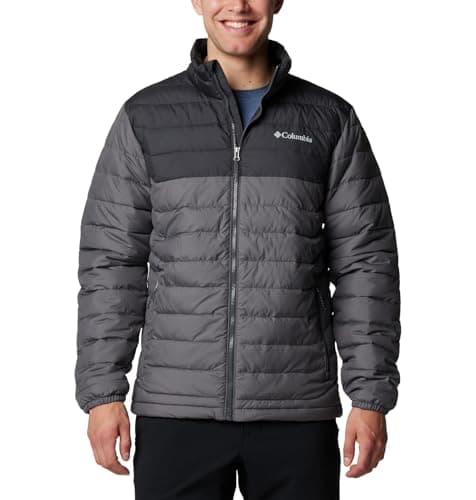
Recycled-polyester Thermarator insulation behind an Omni-Heat thermal reflective lining, in an active fit.
Columbia publishes Thermarator insulation made from 100 percent recycled polyester, an Omni-Heat thermal reflective breathable lining, a claim that the synthetic fibers retain heat when wet, and an active fit. Columbia does not publish a garment weight or a gram weight for the insulation on the product page we read.
The reflective lining is the interesting part and the easiest to over-read. A metallized dot pattern reflects radiant body heat back at you, which is a real effect and a smaller one than the loft of the insulation itself. Buy this for the insulation and treat the lining as a bonus.
The drawback
Columbia does not publish a weight or an insulation weight for this jacket, so it cannot be compared numerically against the Patagonia. It is also a bulkier garment that does not pack down as small.
10 oz, 100 percent recycled polyester fleece at 22.5 oz for a mens jacket, Fair Trade Certified sewn.
Patagonia publishes a 10 oz, 100 percent recycled polyester fleece fabric, weights of 22.5 oz / 638 g for the mens jacket and 15.9 oz for the womens, a low-impact dyeing process, Fair Trade Certified sewing, a zippered chest pocket and two zippered handwarmers, and flat-seam construction.
Fleece earns its place for one specific reason: it breathes far better than a puffy, so it works while you are still moving around camp rather than only once you have stopped. It is also the layer that survives being worn every day for a week without smelling.
The drawback
22.5 oz is nearly twice the Nano Puff for less warmth in still air, and fleece does not compress, so it takes real space in a pack.
A synthetic insulated jacket for the hours after you stop moving. Camp is where your body stops producing heat, and a jacket carried specifically for that is the single most effective piece of camp comfort. It goes over your existing layers rather than replacing them.
QShould a camping jacket be down or synthetic?
Synthetic. A camp jacket gets sat on damp ground, worn while cooking and rained on, and down collapses when wet. Down is warmer per ounce and the right choice only if you can reliably keep it dry.
QIs a fleece or a puffy jacket better for camping?
They do different jobs. Fleece breathes well and works while you are still moving around camp; a puffy is warmer per ounce in still air and packs far smaller. Owning both and layering them is warmer than either alone.
QCan I wear my puffy jacket inside my sleeping bag?
It usually does not help. A jacket inside a bag compresses the bag's own insulation from the inside. If you are cold at night the problem is almost always the insulation underneath you, which body weight has crushed flat, rather than what you are wearing.
How we picked
Everyone else in this category will tell you they tested twenty of these. We have not tested any of them, and we would rather say so than pretend. There is no gear closet here and no test lab.
What we did instead: pulled the published specifications from each manufacturer's own spec sheet or manual, named the standard behind every rating so you can check what it actually promises, did the arithmetic that turns a spec into a decision, and pulled today's real retail price rather than quoting one from memory. Every pick states a drawback, because a list where nothing is wrong with anything is an advert.
The limits of that method, stated plainly: published specs do not capture zipper quality, seam durability, or how a tent behaves at 2am in a storm. Where that matters, we say so on the pick. The full method is here.