The Best Camping Blankets, Judged on Where They Sit in the Sleep System
A camping blanket is the only piece of gear that does three jobs: something to sit on, something to wrap up in by the fire, and an extra layer over a bag that is not quite warm enough.
A camping blanket is a layer, not a bed. Used over a sleeping bag it adds real warmth; used instead of one it is a cold night. The useful specification is fill weight in gsm or ounces, not the word “insulated” on the label. Rumpl publishes 240 gsm of fill for the Original Puffy; Therm-a-Rest publishes 10.5 oz of eraLoft for the Argo. Blankets that publish neither are usually a fleece with a weather-resistant face.
The three jobs, in the order most people actually use them: something to sit on that is not wet grass; something to wrap around you in a camp chair once the sun goes down and the temperature drops fifteen degrees; and an extra layer over a sleeping bag on a night colder than you planned for.
Blanket
Size
Weight
Packed
Fill
Rumpl Original Puffy, 1-person
52 x 75 in
2.2 lb
7 x 16 in
240 gsm recycled synthetic
Therm-a-Rest Argo
78 x 72 in, two-person
1 lb 10 oz
14.5 x 5.25 in
10.5 oz eraLoft
Kelty Bestie
75.59 x 42.13 in
1.54 lb
6.75 x 11.5 in
CloudLoft synthetic
All figures as published by the manufacturers.
Synthetic, and why nobody sells a down camping blanket
Every blanket here is synthetic-filled, and that is not a cost decision. A camping blanket gets sat on, spilled on, dragged over grass and taken near a fire. Down in that service life would be wet, clumped and dead within a season, and washing it back to health is a two-hour job with a tumble dryer.
Synthetic fill keeps most of its loft damp, survives a machine wash, and does not need specialist detergent. The trade — more weight and bulk for the same warmth — is one nobody notices in a car boot. The same reasoning in the sleeping bag category is set out in down vs synthetic sleeping bags.
A blanket is not a cheap sleeping bag
The most common mistake with these is buying one instead of a proper bag for a child or a guest. A blanket has no hood, no draft collar, no zip and no way to close around a body, so it loses warm air from every edge all night. If somebody needs to sleep out, they need a bag rated for the conditions — see the sleeping bag roundup — and a blanket over the top of it if it is cold.
Size: measure the person, not the bed
Blanket sizing is not standardized and the names are unhelpful. What matters is whether it wraps an adult with an overlap. A 42 in shoulder width, as on the Kelty, wraps one adult. A 52 in width, as on the Rumpl, wraps one adult comfortably with a fold. A 72 in width, as on the Argo, covers two people lying down and is awkward for one person sitting up.
For a family, two one-person blankets beat one large one, for the same reason two sleeping bags beat one double: people move, and shared bedding means shared draughts. The exception is the sleep-system use, where a two-person blanket over two adjacent bags is exactly right.
Washing and storage
All three are machine washable, and all three should be washed on cold and dried on low or hung. The failure mode is heat: high dryer heat melts the fine synthetic fibers into clumps that never separate again, and the blanket loses loft permanently.
Store them loose, not compressed in their stuff sack. Synthetic fill takes a permanent set when it is crushed for months, which is the same rule that applies to sleeping bags in how to wash a sleeping bag. A blanket left stuffed all winter comes out thinner every year.
What we did not do
We have not slept under any of these, and there is no warmth rating standard for blankets to compare them against — unlike sleeping bags, which have ISO 23537, or pads, which have ASTM F3340. That is why this page compares fill weight, size and fabric rather than pretending a temperature number exists. Every figure is the manufacturer's published specification with a link. See how we research.
The picks in full
1. Best all-round camping blanket
Rumpl Original Puffy Blanket, 1-Person
Rumpl
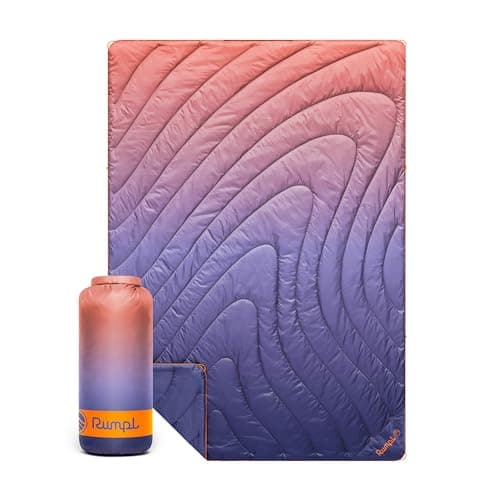
52 by 75 in of 240 gsm synthetic fill in a 30D recycled ripstop shell, at 2.2 lb, packing to 7 by 16 in and machine washable.
Rumpl publishes a 1-person size of 52 by 75 in, a 2.2 lb weight, a 7 by 16 in packed size, a 30D recycled ripstop polyester shell and liner, 240 gsm recycled synthetic hollow fiber insulation, a PFAS-free DWR finish, and machine washability on cold.
The specification that makes this the default is 240 gsm. That is a real insulation weight — comparable to a light synthetic jacket — rather than the token fill in most “outdoor blankets”. Combined with 52 by 75 in, it is big enough to actually wrap an adult rather than covering their knees.
The DWR finish is the underrated part. A blanket at a campsite spends its life on damp grass, on a wet chair, and near a fire; a shell that beads water and brushes clean is the difference between a blanket that stays in service and one that lives in the car boot smelling of woodsmoke. Rumpl publishes a warmth claim of about 45 F and above, which is honest and worth reading as what it is: a blanket, not a sleeping bag.
The drawback
2.2 lb and a 7 by 16 in packed size is a lot of duffel space, and the maker only claims warmth down to about 45 F.
78 by 72 in of two-person coverage with 10.5 oz of eraLoft fill and snap loops designed to attach to a sleep system, at 1 lb 10 oz.
Therm-a-Rest publishes a 78 by 72 in two-person size, a 1 lb 10 oz weight, a 14.5 by 5.25 in packed size into its own pocket, eraLoft hollow-fiber synthetic insulation with a 10.5 oz fill weight, a 30D polyester shell with DWR, and snap loops to join it to a sleep system.
The snap loops are the reason this one earns its place. Insulation only works when it is lofted, and a blanket that slides off in the night is doing nothing at 4am. Attaching it to a pad or bag keeps it where it is useful, which is what turns a blanket from a comfort item into a genuine warmth adjustment.
And the direction matters: over the bag, never inside it. A blanket inside a sleeping bag compresses the bag's own fill and can leave you colder. Over the top it adds loft where loft still works. That mechanism is the same one described in why you get cold in a sleeping bag.
The drawback
A two-person blanket is unwieldy for one, and at 14.5 by 5.25 in packed it goes in the car rather than a pack.
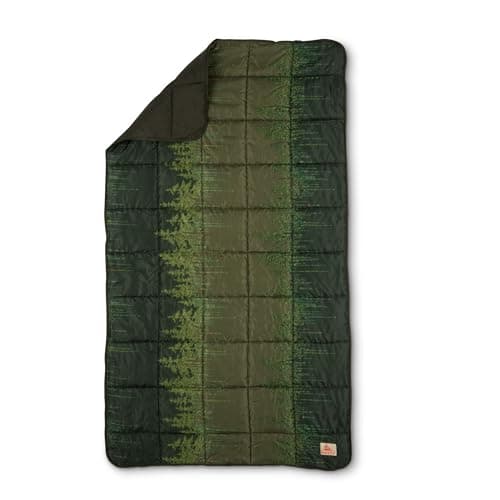
1.54 lb of CloudLoft synthetic at 75.59 in long, in soft 75D taffeta and pongee with a PFC-free DWR, packing to 6.75 by 11.5 in.
Kelty publishes a 75.59 in length, a 42.13 in shoulder width, a 1.54 lb weight, CloudLoft synthetic insulation, a 75D printed polyester taffeta shell with a 75D polyester pongee liner, a 6.75 by 11.5 in stuff sack, and C0 PFC-free DWR fabrics.
The heavier 75D fabrics are a deliberate trade in the opposite direction from the ultralight end of the market: less packable, much nicer to sit on and against. For a blanket whose main job is being wrapped around somebody in a camp chair, that is the right call.
It is also the one to buy for a child. Two thirds the weight of the Rumpl, a smaller stuff sack, soft on both sides, and cheap enough that it being dragged through dirt does not matter. The rest of the child-warmth argument is in how to keep kids warm camping.
The drawback
42.13 in across the shoulder is a one-person blanket and no more, and there is no attachment system to hold it in place at night.
Not on its own. A blanket has no hood, draft collar or zip, so it loses warm air from every edge. It works as a layer over a sleeping bag, where it adds real loft, and as something to wrap up in around the fire.
QShould a blanket go over or inside a sleeping bag?
Over the top. Inside, it compresses the bag's own insulation and can leave you colder. Over the top it adds loft where the loft still works, which is why some camping blankets have snap loops to attach to a sleep system.
QWhy are camping blankets always synthetic rather than down?
Because of how they are used. Blankets get sat on, spilled on and used near fires, and wet down loses its loft and needs specialist washing. Synthetic fill keeps most of its warmth damp and survives a normal machine wash.
QHow do I wash a camping blanket?
Cold machine wash, then hang dry or tumble on low. High dryer heat melts fine synthetic fibers into clumps that never separate. Store it loose rather than compressed in its stuff sack, because synthetic fill takes a permanent set when crushed for months.
How we picked
Everyone else in this category will tell you they tested twenty of these. We have not tested any of them, and we would rather say so than pretend. There is no gear closet here and no test lab.
What we did instead: pulled the published specifications from each manufacturer's own spec sheet or manual, named the standard behind every rating so you can check what it actually promises, did the arithmetic that turns a spec into a decision, and pulled today's real retail price rather than quoting one from memory. Every pick states a drawback, because a list where nothing is wrong with anything is an advert.
The limits of that method, stated plainly: published specs do not capture zipper quality, seam durability, or how a tent behaves at 2am in a storm. Where that matters, we say so on the pick. The full method is here.