The Best Camping Chairs, Compared on Weight Capacity and Seat Height
Camp chairs are bought on price and regretted on seat height. Here are the four specs that decide whether you will still be sitting in it after two hours.
Seat height first, weight capacity second, packed size third, weight last. A chair with a seat 18 to 20 in off the ground is comfortable for hours and easy to stand up from; the 12 to 14 in seats common on cheap chairs are a squat you have to climb out of. Capacity ratings are also a proxy for build quality: 250 lb is light-duty, 300 to 350 lb is normal, 800 lb is a steel frame.
Chair
Capacity
Seat height
Weight
Packed
GCI Freestyle Rocker
250 lb
19.7 in
11.8 lb
4.9 in wide folded
ALPS King Kong
800 lb
18 in
13 lb
7 x 41 in
Coleman Cooler Quad
325 lb
18.1 in
8.2 lb
6 x 6.5 x 38.2 in
Helinox Chair One
320 lb
not published
2 lb 2 oz
14 x 4.5 x 4.5 in
All figures as published by the manufacturers.
Seat height is the spec nobody checks
It is the difference between a chair you sit in all evening and one you get up from every twenty minutes. Around 18 to 20 in is standard dining-chair height. Below about 15 in your knees are above your hips, which is fine for twenty minutes and unpleasant for two hours, and it is considerably harder to stand up from.
This matters most for anyone with knee or back trouble, and for anyone who is going to sit by a fire until midnight, which is most people who go camping.
Buy for the ground you sit on
Chairs with small feet sink into soft grass and sand, tipping you backwards. Wide feet or add-on ball feet fix it. Rocking chairs need firm, level ground to rock properly, so a rocker is a great campground chair and a poor beach chair.
Four chairs, not one
Families need one chair per person, which changes the calculation completely. Four mid-priced chairs cost as much as one very good one, and one very good chair means three people sitting on a picnic bench. Buy the best chair you can afford times four, and that usually lands on a good-value quad chair rather than a premium single.
The exception is space: four folded quad chairs take a lot of trunk. If your car is small, two full-size chairs plus two packable ones is a reasonable compromise, and the packables also come out for anything where the car does not reach the pitch.
What we did not test
We have not sat in these chairs for a season, so we cannot tell you which fabric sags or which hinge loosens. The specs above are all published by the manufacturers, and where a chair's capacity is unusually high we treat it as evidence about construction rather than as a claim we have verified. Our method is at how we research.
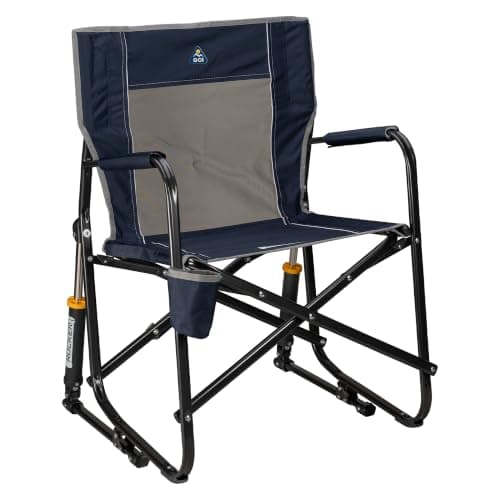
A 19.7 in seat height with a spring rocking action, rated to 250 lb at 11.8 lb.
GCI publishes a 250 lb capacity, a 19.7 in seat height, an open size of 24 by 25 by 34.8 in, a folded width of 4.9 in and an 11.8 lb weight on a powder-coated steel frame.
The seat height is why it is first here. Most cheap camp chairs sit you at 12 to 14 in, which is a squat rather than a sit; nearly 20 in is dining-chair height, and getting out of it does not require a strategy.
The drawback
250 lb is the lowest capacity here, and the rocker mechanism needs firm, level ground to work properly. On soft grass it digs in.
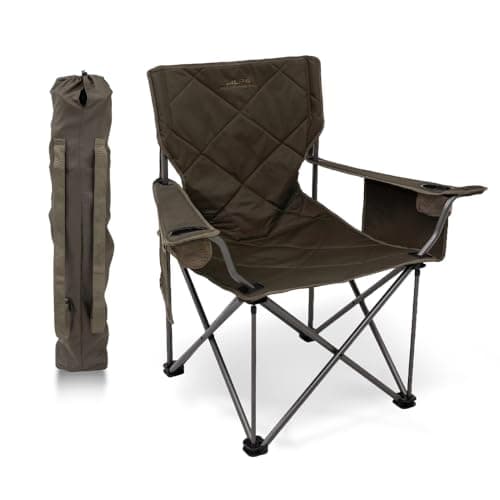
An 800 lb capacity on a powder-coated steel frame with a 24 in wide seat.
ALPS publishes an 800 lb capacity, 38 by 38 by 20 in open, a folded size of 7 by 41 in, an 18 in seat height, a 24 in seat width, 600D polyester fabric and a 13 lb weight.
Eight hundred pounds is not a number most people need, but capacity ratings are also a proxy for how a chair is built. This one has the widest seat here, which matters at least as much as the rating.
The drawback
13 lb and a 41 in long folded package. It is the least portable chair here and it will not fit neatly beside a big cooler.
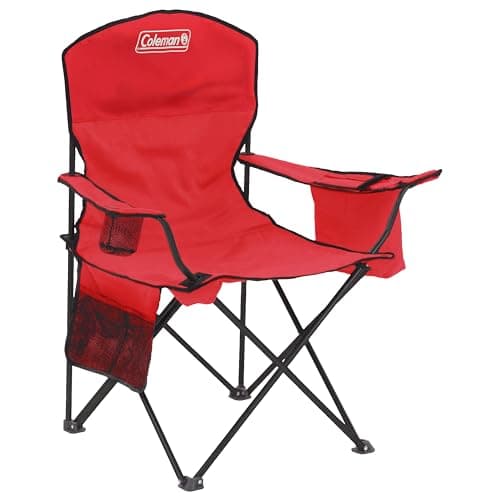
325 lb capacity and a built-in 4-can cooler in the armrest, at 8.2 lb.
Coleman publishes a 325 lb capacity, an 18.1 in seat height, 8.2 lb, an open size of 24 by 37 by 40.5 in, and a soft cooler pocket in the armrest holding four cans.
The reason it makes the list is arithmetic: a family needs four chairs, and four of these cost less than one of most alternatives. The armrest cooler also does something genuinely useful, which is keeping the main cooler closed.
The drawback
The 18.1 in seat height is good, but the fabric and frame are the lightest here. It is a chair you replace, not a chair you keep.
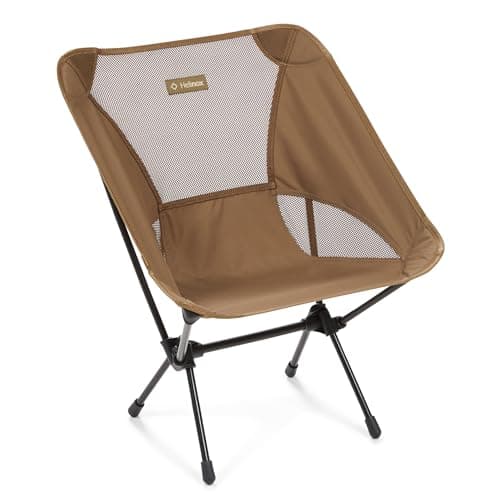
2 lb 2 oz packed into 14 by 4.5 by 4.5 in, rated to 320 lb, with a five-year warranty.
Helinox publishes a packed weight of 2 lb 2 oz, an assembled weight of 1 lb 15 oz, a 320 lb capacity, a packed size of 14 by 4.5 by 4.5 in, an assembled height of 25.5 in and a five-year warranty.
The packed size is the entire argument: it takes about as much room as a loaf of bread, which is what makes it the chair you can actually bring when the trunk is already full.
The drawback
It is low and it takes 30 seconds to assemble each time. On soft ground the small feet sink unless you fit ball feet.
One with a seat height around 18 to 20 in and a supportive back, which makes standing up far easier than the 12 to 14 in seats common on cheap chairs. The GCI Freestyle Rocker publishes 19.7 in and the ALPS King Kong 18 in.
QHow much weight can a camping chair hold?
Published capacities on this page range from 250 lb for the GCI Freestyle Rocker to 800 lb for the ALPS King Kong, with 300 to 350 lb typical. Treat the rating as a guide to how the chair is built, not just as a limit.
QAre expensive camping chairs worth it?
For a family the arithmetic usually says no, because you need one per person and four mid-priced chairs beat one premium chair and three people on a bench. Spend up where it buys something specific: seat height, seat width, or a packed size that fits a small car.
QWhat size camping chair do I need?
Check seat width and seat height rather than the overall dimensions. A 24 in seat width like the ALPS King Kong's is generous; many chairs are closer to 20 in. Seat height around 18 to 20 in suits most adults.
How we picked
Everyone else in this category will tell you they tested twenty of these. We have not tested any of them, and we would rather say so than pretend. There is no gear closet here and no test lab.
What we did instead: pulled the published specifications from each manufacturer's own spec sheet or manual, named the standard behind every rating so you can check what it actually promises, did the arithmetic that turns a spec into a decision, and pulled today's real retail price rather than quoting one from memory. Every pick states a drawback, because a list where nothing is wrong with anything is an advert.
The limits of that method, stated plainly: published specs do not capture zipper quality, seam durability, or how a tent behaves at 2am in a storm. Where that matters, we say so on the pick. The full method is here.