The Best Camping Gear for Couples, and What Two People Should Not Share
Camping as a pair is the one configuration where buying two of everything is wrong and buying one of everything is also wrong. The split is fairly predictable.
Share the shelter, the kitchen, the cooler and the light. Do not share the sleeping bag unless you already sleep close, the headlamp, or the sleeping pad if either of you is a restless sleeper. Sharing the wrong three items is what makes couples argue at 10pm.
Item
Share or separate
Why
Tent
share, one size up from two
two people plus gear needs a 3 or 4 person floor
Stove and cookware
share
one pot feeds two; two stoves is pointless
Cooler
share
one well-packed box beats two half-full ones
Lantern
share
it lights a space, not a person
Headlamp
separate, always
two people, one light means one stands in the dark
Sleeping bag
depends entirely on how you sleep
a double is warmer together, colder apart
Sleeping pad
separate if either of you moves a lot
one wide pad transmits every movement
Camp chair
separate
nobody shares a chair
Our summary of where sharing saves money and where it costs sleep.
What to look for
Two doors, not one. The single best tent feature for a pair. Nobody climbs over anybody at 2am, and each of you gets a vestibule for boots.
Floor length against the taller person. A 7 ft floor is 84 in, which leaves a 6 ft camper six inches. Touching the wall transfers condensation into a bag.
Pad width and thickness over R-value alone. Two adults on a 25 in pad is tight; thickness is what stops either of you feeling the ground.
A two-burner stove. One burner for two people means eating in shifts.
The zip-together question, answered honestly
Two rectangular bags zipped into a double are warmer than two singles if you sleep close, because you share body heat with no wall between you. They are colder if you do not, because the gaps at the shoulders and feet vent constantly and there is no draft collar. Couples who sleep back-to-back at opposite edges are better off with two separate bags and a shared mattress. Test it at home before the trip, not at a campsite in October.
The kitchen for two
Two people need less kitchen than most lists suggest: a two-burner stove, one 2 to 3 quart pot, one pan, two mugs, two bowls, two sets of cutlery, a sharp knife and a board. That is it for most trips.
Two people rarely sleep at the same temperature, and the gap is often substantial. If you buy one specification for both of you, buy for whoever gets cold, because the warmer sleeper can always vent a bag or throw a leg out and the colder one has no equivalent move.
In practice that means the warmer pad and the lower-rated bag, then let the warm sleeper unzip. It is cheaper than buying two different setups and it removes the most common source of a bad night for couples: one person lying awake cold while the other is fine and asleep.
The same logic applies to the tent. If one of you is claustrophobic or gets up at night, size and door count should be chosen for that person rather than averaged between you.
What two people can skip
A lot, compared with a family list. No room dividers, no extra shelter, no wagon for hauling, usually no second cooler, and a much smaller first aid kit. The biggest saving is the tent: the jump from a 6-person cabin to a 4-person dome is real money and real trunk space.
If you are outfitting from nothing, work from the car camping checklist and cross off the family-specific lines. And if one of you eventually wants to carry all of it, car camping vs backpacking is the next decision.
The picks in full
1. Best tent for two
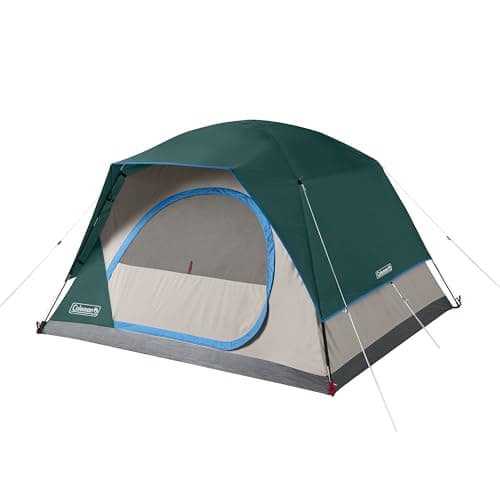
Coleman Skydome 4-Person Tent
Coleman
A 4-person tent is the right size for two adults once boots, packs and a queen airbed are in it.
The persistent mistake couples make is buying a two-person tent. Capacity is a floor-area calculation at roughly 20 to 22 in of shoulder width per sleeper with no allowance for gear, so a two-person tent fits two pads and nothing else.
Buy one size up from your headcount. For two people that means a 3- or 4-person tent, which turns a shelter you tolerate into one you can sit out a wet afternoon in — the arithmetic is in what size tent do I need.
The drawback
A 4-person tent is heavier and pricier than the 2-person you think you need, and it is more tent than a single camper should carry.
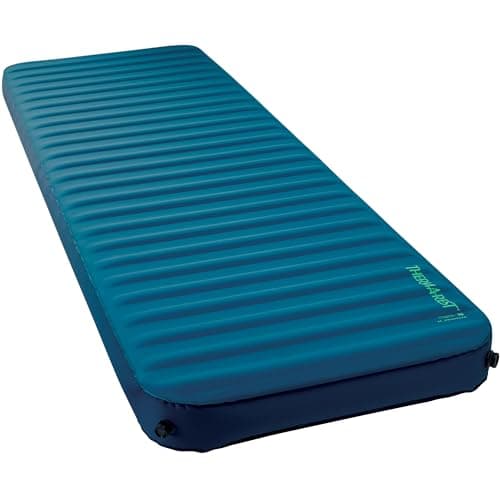
Therm-a-Rest publishes an R-value of 7.0, a 4.25 in thickness, a 77 by 25 in large size and a 4 lb 6 oz weight, self-inflating.
The thickness is the reason to buy a self-inflating mattress as a couple: at 4.25 in neither of you bottoms out, which is what makes shared sleeping surfaces fail. The R 7.0 also means neither of you is the cold one — see R-value explained.
The drawback
4 lb 6 oz and bulky, and a single wide pad means one person's movement moves the other. Two separate pads are more stable.
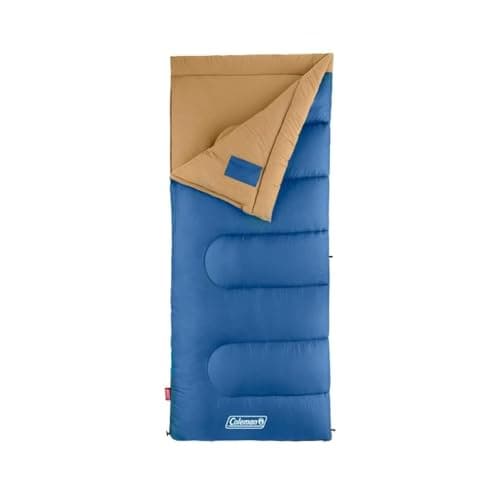
A 75 by 33 in rectangle at a 20 F maker's rating that unzips flat and pairs with a second.
Coleman publishes a 20 F maker's rating, a 75 by 33 in size, a 5.3 lb weight and polyester ColeTherm fill, fitting campers up to 5 ft 11 in.
Two identical rectangles with opposing zips make a double. Whether that is actually a good idea is argued honestly in double sleeping bag vs two singles — the short version is that it is warmer if you sleep close and colder if you do not.
The drawback
5.3 lb each, and zipping two together creates cold gaps at the shoulders and feet that a single bag does not have.
A 3 or 4 person tent. Tent capacity is a floor-area figure at about 20 to 22 in per sleeper with no allowance for gear, so a two-person tent fits two pads and nothing else. Buying one size up from your headcount is what gives you room for boots, packs and sitting up.
QShould couples get a double sleeping bag or two singles?
It depends on how you sleep. A double is warmer if you sleep close, because you share heat with no wall between you, and colder if you do not, because the shoulder and foot gaps vent and there is no draft collar. Two rectangular bags with opposing zips give you both options.
QCan two people share one sleeping pad?
Yes, and a thick self-inflating mattress is the best way to do it: at 4.25 in neither person bottoms out. The catch is movement transfer, so if either of you is a restless sleeper, two separate pads are more comfortable even though they drift apart.
QWhat camping gear should couples not share?
Headlamps, chairs, and sleeping pads if either of you moves a lot. Two people sharing one headlamp means somebody is always standing in the dark, and it is the cheapest item on the list to duplicate.
How we picked
Everyone else in this category will tell you they tested twenty of these. We have not tested any of them, and we would rather say so than pretend. There is no gear closet here and no test lab.
What we did instead: pulled the published specifications from each manufacturer's own spec sheet or manual, named the standard behind every rating so you can check what it actually promises, did the arithmetic that turns a spec into a decision, and pulled today's real retail price rather than quoting one from memory. Every pick states a drawback, because a list where nothing is wrong with anything is an advert.
The limits of that method, stated plainly: published specs do not capture zipper quality, seam durability, or how a tent behaves at 2am in a storm. Where that matters, we say so on the pick. The full method is here.