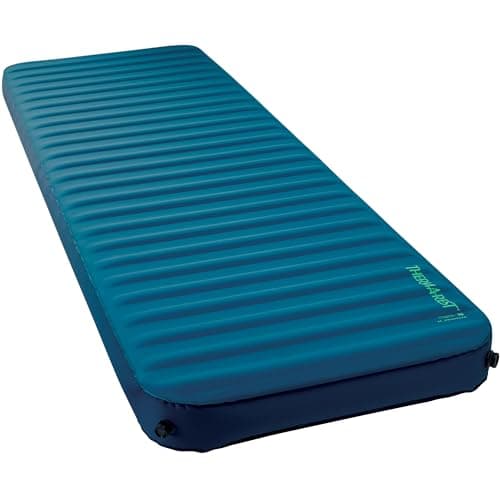
Therm-a-Rest MondoKing 3D
Therm-a-Rest
R 7.0 and 4.25 in thick, self-inflating. The pad in System 2, and the component to buy first.
$289.95 · Check price on Amazon
#ad how this is funded · price as of October 23, 2026
A sleep system is a pad, a bag and a pillow chosen together. Almost everyone buys them in the wrong order, spends the money on the bag, and then wonders why they were cold.

Trail & Tarp earns a commission from qualifying purchases made through links on this page, at no extra cost to you. Full disclosure.
The short answer
Buy the pad first and to the ground temperature, using R-value: 2 for summer, 3 to 4 for three seasons, 5 or more for frost. Buy the bag second and to the air temperature, using its ISO comfort rating rather than the number on the label. Buy the pillow third, because it is the cheapest component and the one that most changes whether you actually sleep. Spending bag money to fix a pad problem is the single commonest mistake in camping, and it never works.
The reason this order is not obvious is that a sleeping bag looks like the warm thing. It is not: a sleeping bag is an air-trapping layer, and underneath you its insulation is crushed flat by your own weight, so it traps nothing. All the warmth between you and the ground comes from the pad. Cold ground conducts heat out of you far faster than cold air does, which is why people in expensive bags on cheap pads are cold and confused.
So a sleep system is three purchases that have to agree with each other. A 0 F bag on an R 2 pad is an uncomfortable night. An R 8 pad under a summer bag is wasted money. The point of this page is to put the three together in combinations where the numbers actually line up.
| Component | The number to buy on | What it does | Spend order |
|---|---|---|---|
| Sleeping pad | R-value (ASTM) | all of the insulation beneath you, plus getting your hip off a root | first |
| Sleeping bag | ISO comfort rating | traps air around you - above and beside you only | second |
| Pillow | packed size and loft | neck angle, which is most of whether you sleep at all | third |
One more thing belongs in the system and is not a purchase: what you wear. A dry base layer and dry socks are worth several degrees and cost nothing if you already own them, and damp clothes worn to bed undo an entire tier of bag. That argument is in how to layer for camping.
For ground above about 50 F and air in the 50s and 60s. This is the kit for a first season of car camping in July.
| Component | Pick | Published figure |
|---|---|---|
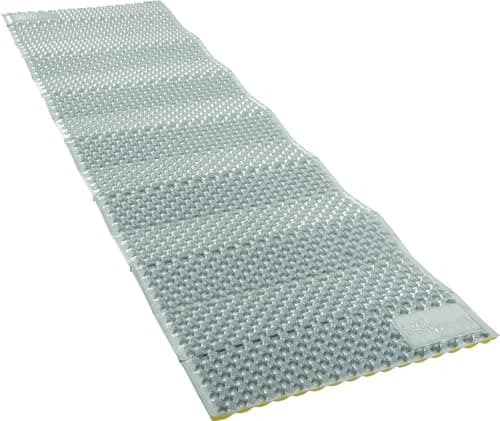
| Pad | Therm-a-Rest Z Lite Sol | R 2.0, 72 x 20 x 0.75 in, 14 oz, closed-cell foam |
| Bag | Coleman Brazos 20F | maker's rating 20 F, 75 x 33 in, 5.3 lb, polyester fill |
| Pillow | Trekology Aluft 2.0 | inflatable, 16 x 12 x 4 in, 3.9 oz, packs to 5 x 2 in |
Two honest caveats about this system. First, R 2.0 is summer insulation - the Z Lite Sol is on this list because closed-cell foam cannot puncture and costs very little, not because it is warm. Second, the Brazos is rated by Coleman rather than tested to ISO, and a maker's rating is typically a survival number rather than a comfort number. Treat "20 F" as a 40s-night bag and you will be right.
What this system does well is cost nothing to be wrong about. A foam pad has no valve to fail, the bag is machine washable, and if camping turns out not to be for you the total outlay is small. The step up from here is in best budget sleeping bags.
For spring through autumn, ground down to near freezing, air in the 30s and 40s. This is the configuration that covers most of a camping year in most of the country.
| Component | Pick | Published figure |
|---|---|---|
| Pad | Therm-a-Rest MondoKing 3D | R 7.0, 4.25 in thick, 77 x 25 in, 4 lb 6 oz, self-inflating |
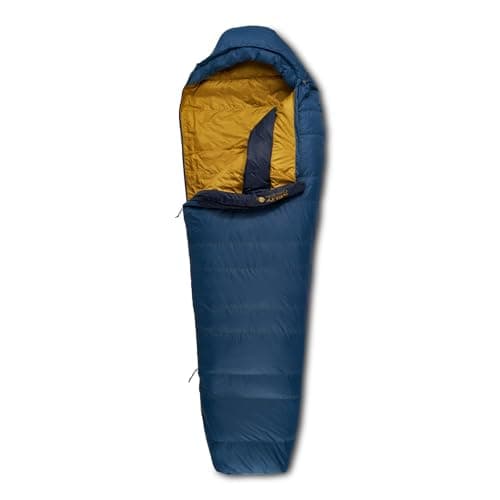
| Bag | Kelty Cosmic Down 20 | ISO comfort 31 F, ISO limit 21 F, 550-fill DriDown, 2 lb 7 oz |
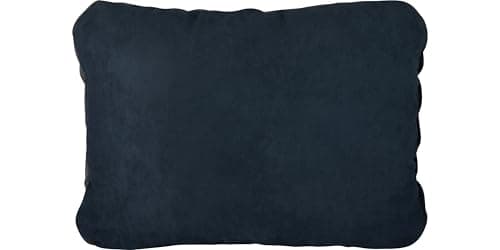
| Pillow | Therm-a-Rest Compressible Pillow Cinch | foam fill, 18 x 13 x 6 in regular, 10 oz, cinch-adjustable loft |
This is the system to copy. The Cosmic Down publishes an ISO comfort rating of 31 F, which means a cold sleeper should be comfortable at 31 F, and an ISO limit of 21 F, which means a warm sleeper will survive but not enjoy 21 F. Those are tested numbers rather than marketing ones, and the gap between them is exactly why sleeping bag temperature ratings are worth understanding before you spend anything.
R 7.0 under it is more than three seasons strictly require, and that is deliberate: the pad is the component you least want to under-buy, 4.25 inches of thickness is what gets a side sleeper's hip off the ground, and self-inflating means it is at usable firmness while you pitch the tent. The cinch pillow is the quiet hero - adjustable loft is what lets one pillow suit a back sleeper and a side sleeper.
For couples car camping, where two single pads drifting apart is the actual problem rather than temperature.
| Component | Pick | Published figure |
|---|---|---|
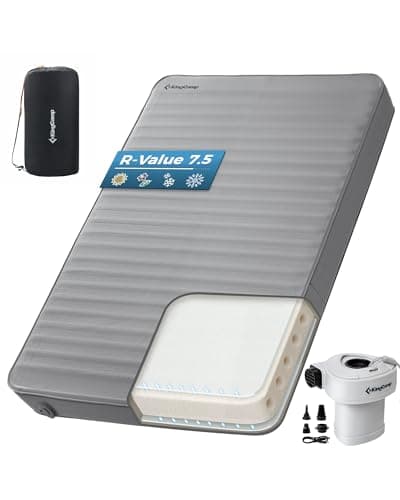
| Pad | KingCamp Premium Double | R 7.5, 79 x 50.4 x 3.0 in, 9.7 lb, self-inflating |
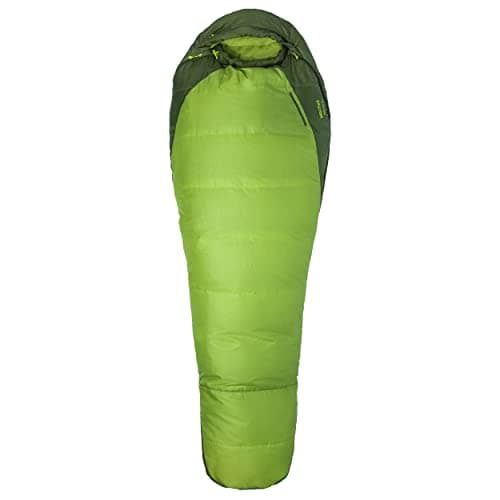
| Bags | two Marmot Trestles Elite Eco 20, zipped or side by side | ISO comfort 32.2 F, ISO limit 21.6 F, synthetic, 3 lb 8.4 oz each |
| Pillows | two Therm-a-Rest Compressible Pillow Cinch | foam fill, 10 oz each, cinch-adjustable loft |
The pad is the point here. Two single pads leave an uninsulated strip down the middle exactly where two people's shoulders meet, and no warmer bag fixes that because the heat is leaving downwards. One double pad at R 7.5 removes the gap. The trade is motion transfer - a single air chamber means you feel each other turn - which is covered properly in best double sleeping pads.
Synthetic fill rather than down is deliberate for two people. Two bodies put roughly twice the moisture into a tent overnight, synthetic insulates when damp and down does not, and the Trestles publishes real ISO numbers. The down-versus-synthetic argument in full is in down vs synthetic sleeping bags.
If you are cold tonight and cannot buy anything
Put something under you, not over you. A spare blanket, a folded tarp, a closed-cell foam pad on top of an air pad, even the empty backpack under your hips - all of it adds R-value where you are losing heat. Then eat something, put on dry socks and a dry hat, and go to the loo before you get in the bag rather than at 2am. Those five moves are free and they are worth more on the night than any single purchase. The full list is in why you get cold in a sleeping bag.
After three or four trips you will know which component is letting you down, and it is almost never the one you expect.
| Symptom | The component at fault | What to do |
|---|---|---|
| Cold back and hips, warm shoulders | pad - R-value too low | higher R-value pad, or a foam pad on top of what you have |
| Cold shoulders and face, warm underneath | bag - comfort rating too high for the night | warmer bag, or a liner for a few degrees at the margin |
| Warm but awake, neck aching | pillow | adjustable loft; this is the cheapest fix on the list |
| Hip pressure, waking to roll over | pad thickness, not warmth | 3 in or more; see the side-sleeper pads |
| Damp bag by morning two | moisture, not insulation | ventilate the tent; synthetic fill if this repeats |
| Cold strip down the middle, two people | two pads instead of one | a double pad |
The second row is where most money gets wasted in the wrong direction. People with cold shoulders buy a thicker pad, and people with cold hips buy a warmer bag, and in both cases nothing improves. The symptom tells you which component to change, and the published R-value and ISO comfort figures tell you by how much.
Never inflate a pad by mouth. The moisture in your breath goes inside the pad and stays there, and over seasons it grows mould in a core you cannot open. Use the pump sack or a small rechargeable pump.
Store bags uncompressed. A sleeping bag left in its stuff sack for a winter loses loft permanently, and loft is the insulation. Hang it or keep it in the large cotton sack it shipped in; the washing and drying routine is in how to wash a sleeping bag.
Do not over-inflate. A rock-hard pad is less comfortable and conducts more heat, because you are compressing the air and the insulating structure together. Fill it until it holds your weight without bottoming out, then let a little back out.
If you are assembling a first kit from scratch, System 2 above is the honest recommendation and the component pages behind it are best sleeping pads for car camping, best sleeping bags for camping and best camping pillows.
If the trips are getting colder, read sleeping pad R-value explained before you shop, because the pad is where the limit of a system really sits. And if you are carrying the kit rather than driving it, the whole calculation changes on weight - start at best backpacking sleeping pads.
Therm-a-Rest
R 7.0 and 4.25 in thick, self-inflating. The pad in System 2, and the component to buy first.
#ad how this is funded · price as of October 23, 2026
Kelty
ISO comfort 31 F, ISO limit 21 F, 550-fill DriDown at 2 lb 7 oz. Real tested numbers.
#ad how this is funded · price as of October 23, 2026
Therm-a-Rest
Cinch-adjustable loft, 10 oz. The cheapest component and the one that decides whether you sleep.
#ad how this is funded · price as of October 23, 2026
Therm-a-Rest
R 2.0 closed-cell foam at 14 oz. Summer System 1, and the thing to stack under an air pad when cold.
#ad how this is funded · price as of October 23, 2026
KingCamp
R 7.5 across 79 x 50.4 in. The pad for System 3, where two singles leave a cold gap.
#ad how this is funded · price as of October 23, 2026
Marmot
ISO comfort 32.2 F, synthetic fill. Two of these for System 3, because two people make moisture.
#ad how this is funded · price as of October 23, 2026
A sleeping pad, a sleeping bag and a pillow chosen to work together: the pad matched to the ground temperature by R-value, the bag matched to the air temperature by its ISO comfort rating, and the pillow sized so your neck is straight. They are three different specifications and none of them substitutes for another.
The pad. A sleeping bag's insulation is crushed flat underneath you by your own weight, so it traps almost nothing there - all of the warmth between you and the ground comes from the pad, and cold ground pulls heat out of you far faster than cold air does. Buying a warmer bag to fix a cold-ground problem is the commonest mistake in camping.
Match each to its own job rather than to each other: R 2 for summer ground, R 3 to 4 for three seasons, R 5 or more for frost, and a bag whose ISO comfort rating is at or below the night's low. For most of the camping year, an R 7 self-inflating pad with a bag rated to an ISO comfort of about 31 F covers it comfortably.
By where you are cold. Cold back and hips with warm shoulders is a pad problem - the R-value is too low. Cold shoulders and face with a warm underside is a bag problem. Warm but awake with an aching neck is the pillow. Hip pressure that wakes you to roll over is pad thickness rather than warmth, which is a different fix again.
It solves a specific problem: two single pads slide apart overnight and leave an uninsulated strip down the middle, exactly where two people's shoulders meet, and no warmer bag fixes it because the heat is going into the ground. One double pad removes the gap; the cost is that a single air chamber transfers motion, so you feel each other turn.
Every figure on this page comes from a published source. We have not tested this gear, so the numbers are the manufacturer's or the standard body's, not ours. How we research.