The Best Double Sleeping Pads, Compared on R-Value and Nothing Else First
Two single pads drift apart and leave a cold crack down the middle. One double pad fixes that and introduces a different problem: when one of you turns, both of you know.
Two single pads slide apart during the night and leave a gap down the middle where there is no insulation and nothing holding the bag off the ground - which is exactly where two people's shoulders meet. One double pad removes the gap. What it introduces is motion transfer: a single air chamber means every time one person rolls, the other feels it. That is the entire trade, and it is a preference rather than a specification.
The cold-crack problem is worse than it sounds because of where it falls. The middle of a two-person sleeping area is where you naturally end up, so the uninsulated strip is under the parts of you that are trying to share warmth. People diagnose that as a bag problem and buy a warmer bag, and it does not work, because the heat is going down into the ground rather than out into the air.
Motion transfer is the price. All three pads here are a single connected chamber or a pair of chambers that behave like one, so there is no version of this that isolates two sleepers. If one of you is a restless sleeper, two singles plus a connector strap may genuinely be the better answer - see double sleeping bag vs two singles for the same argument applied to bags.
What to look for
Specification
What to want
Why
R-value
3 to 4 for three seasons, 5+ for winter, published not implied
it is the only number that predicts whether you will be cold
Width
47 to 52 in
narrower than 47 and two adults overhang the edges
Length
at least 74 in
a pad that ends at your ankles means cold feet on the floor
Thickness
3 in minimum, more for side sleepers
thickness is what keeps a hip off a root
Edge profile
vertical sidewalls if you can afford them
tapered edges put the outside sleeper on a slope
Packed size and weight
match it to the vehicle, not the ambition
a 10 lb pad is a car pad, and that is fine if it stays in a car
What decides whether a double pad suits your trips, rather than how plush it looks in a photograph.
R-value first is deliberate. Width and thickness are comfort; R-value is whether the night works at all. Every pad here publishes a real ASTM-comparable figure, which is why they are the three on this page.
Compared on published numbers
Pad
R-value
Thickness
Inflated size
Weight
Packed
Exped MegaMat Duo 10 (LW+)
8.1
10 cm (3.9 in)
197 x 132 cm (77.6 x 52 in)
4,630 g (10 lb 3 oz)
70 x 30 cm
KingCamp Premium Double
7.5
3.0 in (7.5 cm)
79 x 50.4 in (201 x 128 cm)
9.7 lb (4.4 kg)
31.9 x 10.2 in
Klymit Double V
1.6
3 in (8 cm)
74 x 47 in (188 x 119 cm)
40 oz (1,134 g)
9 x 5 in
Figures as published by each manufacturer. Prices on this page carry their own as-of date.
Read that table as two products and an outlier. The Exped and the KingCamp are both self-inflating foam pads in the same insulation class - 8.1 against 7.5 is a difference you will not feel - separated by thickness, edge profile and a large amount of money. The Klymit is a different thing entirely: a quarter of the weight, a twentieth of the packed volume, and a fifth of the warmth.
What those R-values mean in nights
R-value
Realistic ground
Which pad here
1 to 2
summer only, ground above about 50 F
Klymit Double V (1.6)
3 to 4
three-season, spring through autumn
none here - this is the single-pad range
5 to 6
cold shoulder season, light frost
both foam pads exceed this
7 and up
winter, frozen ground
KingCamp (7.5), Exped (8.1)
The bands this site uses throughout; the full reasoning is in the R-value explainer.
The gap in the middle of that table is real and worth noticing. There is no three-season double pad on this page, because the market splits into uninsulated summer air pads and heavily insulated car-camping foam pads with very little between them. If you want a three-season double, the foam pads are your option and you are buying more warmth than you need rather than less.
A double pad usually needs a double bag, or a quilt
Two mummy bags on one double pad slide around on it and each cinches warm air to one person, which wastes most of the benefit of sleeping next to somebody. The setups that actually work on a double pad are a rectangular double bag, two bags zipped together, or a wide quilt over the top of both of you. The trade-offs are in double sleeping bag vs two singles and best camping quilts.
Inflating and deflating something this big
A self-inflating double pad does most of the work itself, but "self-inflating" never means fully inflated - the foam pulls in air until it is at ambient pressure, and the last firmness has to be added. Exped includes a mini pump for exactly that; KingCamp includes an inflatable outer bag that doubles as a pump sack.
Do not do it by mouth. The moisture in your breath goes inside the pad and stays there, which over seasons grows mould in a foam core you cannot open. If your pad does not come with a pump, a rechargeable one is a few ounces - see best air pumps for camping, where pressure in kPa rather than airflow is the figure that matters for a pad.
Packing down is the other half. A 10 lb foam pad does not go back into its sack unless the valves are both fully open and you roll from the far end, kneeling as you go. Rushing it is how valves get stressed, and a valve is the one component on these pads that is awkward to repair in the field.
Which to buy
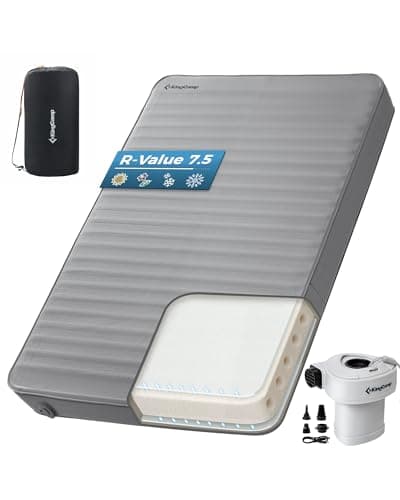
Buy the KingCamp Premium Double Camping Mattress if you car camp with a partner across spring, summer and autumn. A published R-value of 7.5 at 79 by 50.4 in is more insulation than a three-season tent will ever need, it self-inflates, and it costs a fraction of the Exped. This is the one most people should stop reading at.
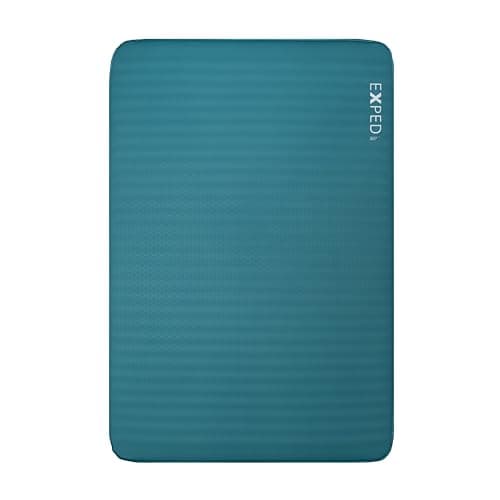
Buy the Exped MegaMat Duo 10 if comfort is the point of the trip or if you camp in genuine cold. The vertical sidewalls mean the person on the outside gets the same 10 cm as the person in the middle, which no other pad here offers, and R 8.1 is winter insulation. Check your tent floor against 132 cm before ordering.
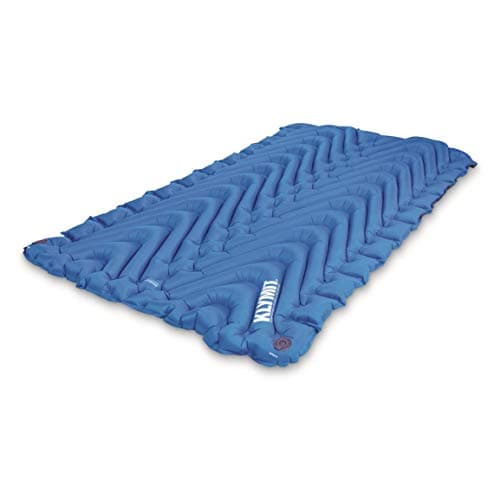
Buy the Klymit Double V if the trips are warm and the pad has to pack small - a festival, a canoe, a car with no space, a summer-only kit. Nine by five inches and 40 oz for a 74 by 47 in pad is a genuinely remarkable ratio, and R 1.6 is the honest price of it. Do not take it into a cold shoulder-season night expecting the bag to compensate; read sleeping pad R-value explained first and plan the months.
The picks in full
1. Best overall
KingCamp Premium Double Camping Mattress
KingCamp
A published R-value of 7.5 across 79 by 50.4 in of self-inflating foam, for well under half the Exped's price.
KingCamp publishes an R-value of 7.5, an inflated size of 79 by 50.4 by 3.0 in (201 by 128 by 7.5 cm), a rolled size of 31.9 by 10.2 in (81 by 26 cm), a 9.7 lb (4.4 kg) weight, self-inflating construction, a 30D stretch fabric TPU top and sidewall, a 190T polyester pongee TPU base, two universal air nozzles, and an inflatable outer bag plus a storage bag in the box.
Seven and a half is the number that makes this the pick. An R-value of 7.5 is genuine winter insulation - more than the Therm-a-Rest MondoKing 3D this site already recommends as a single - and it costs about 40 percent of what the Exped does. For two people sleeping in a tent in spring or autumn, that is the whole argument.
Fifty and a half inches of width is also close to the internal width of a two-person sleeping area, which means it fills the floor rather than leaving two cold strips at the sides. Self-inflating helps here too: a foam core that draws its own air gets to usable firmness while you set up the rest of the tent, and it is far less temperamental than a pure air pad to top off in the cold.
The drawback
Three inches of thickness against the Exped's 3.9, and 9.7 lb rolled to 31.9 by 10.2 in - this is a pad that lives in a car boot, not in a pack. Two valves means two things to leave open.
R 8.1 across 10 cm of self-inflating foam with vertical sidewalls, so the full thickness carries right to the edge.
Exped publishes an R-value of 8.1, a 10 cm (3.9 in) thickness, a Long Wide Plus size of 197 by 132 cm (77.6 by 52 in), a weight of 4,630 g (10 lb 3 oz), a packed size of 70 by 30 cm, self-inflating construction with vertical sidewalls, a stretch tricot top surface, and a Smart pack sack with a mini pump included.
The vertical sidewalls are what you are paying for, and they are not a marketing flourish. Most pads taper at the edges, so the person on the outside rolls down a slope all night and the full thickness only exists in the middle. Exped's construction carries 10 cm right to the perimeter, which on a double pad is the difference between two good sleeping positions and one.
R 8.1 is the same figure as the MegaMat 10 single this site already recommends, so the comparison is honest: you are buying the same insulation in a two-person width. If you are cold on this pad, the problem is the bag, and the place to start is why you get cold in a sleeping bag.
The drawback
4,630 g - over ten pounds - packing to 70 by 30 cm, and the most expensive item on this page several times over. At 132 cm wide it will not fit the floor of every two-person tent.
74 by 47 in for 40 oz, packing to 9 by 5 in - and a published R-value of 1.6, which is an honest summer number.
Klymit publishes an R-value of 1.6, a size of 74 by 47 by 3 in (188 by 119 by 8 cm), a 40 oz (1,134 g) weight, a packed size of 9 by 5 in (23 by 13 cm), 75D polyester fabric, inflatable uninsulated construction, a patch kit and a lifetime warranty.
Nine inches by five is the reason this exists. A double pad that packs to the size of a loaf of bread can go in a duffel, a canoe or a car with no room left in it, and at 40 oz it is a quarter of the Exped's weight. For two people sleeping out in July, none of the insulation the others carry is doing anything useful.
The honest caution is that 1.6 is a July number and this page is not going to pretend otherwise. The site's own R-value explainer puts the three-season floor around 3 to 4 and winter at 5 or more, so this is a shoulder-season mistake waiting to happen. Buy it knowing which months it is for.
The drawback
R 1.6 is almost no insulation. On ground below about 50 F you will be cold no matter what bag you use, and no amount of extra bag fixes a pad problem. Seventy-five denier polyester is also the thinnest fabric here.
QIs a double sleeping pad better than two singles?
It removes the cold gap. Two single pads slide apart overnight and leave an uninsulated strip down the middle, which is exactly where two people's shoulders meet - and no warmer sleeping bag fixes that, because the heat is going into the ground. The cost is motion transfer: a double pad is one air chamber, so when one person rolls the other feels it.
QWhat R-value do you need for a double sleeping pad?
Three to four for three-season use and five or more for winter. Of the pads here, the KingCamp publishes 7.5 and the Exped 8.1 - both comfortably winter-capable - while the Klymit Double V publishes 1.6, which is a summer-only figure. R-value is the only specification that predicts whether you will be cold.
QHow wide is a double sleeping pad?
Forty-seven to fifty-two inches on the pads here: 47 in for the Klymit Double V, 50.4 in for the KingCamp and 52 in for the Exped MegaMat Duo in Long Wide Plus. Check that width against your tent floor before ordering, because 52 in will not lie flat in every two-person tent.
QDo you need a double sleeping bag with a double pad?
You need something that is not two separate mummy bags. Two mummies slide around on a double pad and each one cinches warm air to its own occupant, which wastes the benefit of sleeping next to somebody. A rectangular double bag, two bags zipped together, or a wide quilt over both of you all work.
QShould you inflate a sleeping pad by mouth?
No. The moisture in your breath ends up inside the pad and stays there, which over several seasons grows mould inside a foam core you cannot open to clean. Use the pump or pump sack that comes with it - Exped includes a mini pump and KingCamp an inflatable outer bag - or a small rechargeable pump.
How we picked
Everyone else in this category will tell you they tested twenty of these. We have not tested any of them, and we would rather say so than pretend. There is no gear closet here and no test lab.
What we did instead: pulled the published specifications from each manufacturer's own spec sheet or manual, named the standard behind every rating so you can check what it actually promises, did the arithmetic that turns a spec into a decision, and pulled today's real retail price rather than quoting one from memory. Every pick states a drawback, because a list where nothing is wrong with anything is an advert.
The limits of that method, stated plainly: published specs do not capture zipper quality, seam durability, or how a tent behaves at 2am in a storm. Where that matters, we say so on the pick. The full method is here.