The Best Budget Sleeping Bags, and How to Read Their Ratings
Cheap bags and expensive bags both print a temperature on the label. Only some of those numbers came from a standardized test, and that is the whole story.
An ISO 23537 rating comes from a standardized manikin test and publishes two numbers: a comfort rating and a lower limit. A single number with no standard named beside it is the manufacturer's own claim, and across the budget category it typically runs 15 to 20 degrees optimistic. Read the label for ISO or EN before you read the temperature.
This is not an accusation of dishonesty. ISO testing costs money per model, and a bag selling for less than a tank of gas cannot absorb it. But it means a 20 F Coleman and a 20 F Marmot are not describing the same thing: Marmot publishes an ISO limit of 20.3 F, which tells you the honest comfortable temperature is well above that.
The practical rule is simple. If a bag publishes ISO figures, plan around the comfort number. If it publishes one manufacturer number, add 15 to 20 degrees and plan around that.
The four compared
Bag
Rating as published
Standard
Fill
Weight
Kelty Cosmic Down 20
comfort 31 F / limit 21 F
ISO
550-fill down
2 lb 7 oz
Marmot Trestles Elite Eco 20
limit 20.3 F
ISO
HL-ElixR Eco synthetic
3 lb 8.4 oz
Coleman Brazos 20F
20 F
maker's own
ColeTherm polyester
5.3 lb
TETON Celsius XXL
0 F
maker's own
SuperLoft Elite
7 lb
Figures as published by each manufacturer. ISO ratings are measured under ISO 23537-1.
Notice what weight tracks. The two ISO-tested bags weigh 2 lb 7 oz and 3 lb 8.4 oz for broadly similar tested performance. The untested bags weigh 5.3 lb and 7 lb. Cheap warmth is heavy warmth, and for car camping that is an entirely acceptable trade.
Where budget bags actually cut cost
No ISO testing. The largest single saving, and the one that costs you information rather than performance.
Heavier, cheaper fill. Low-fill-power down or basic polyester staple fiber. It works; it is bulkier and heavier per degree.
A rectangular cut. More room to move, more air volume to heat. Warmer per ounce goes to mummy shapes.
No draft collar. The insulated tube around the neck is often the first feature dropped, and it is where warm air escapes on a cold night.
A lighter shell. Usually fine. This is the corner worth having cut.
Spend the difference on the pad, not the bag
Body weight crushes the insulation underneath you flat, so whatever the bag is rated to, warmth on the ground side comes from the pad. If your budget is fixed, an inexpensive bag on a good pad beats a good bag on an inexpensive pad every time, and it is not close. The mechanism is in why you get cold in a sleeping bag.
Two cheap ways to add warmth to a cheap bag
A liner adds a measurable amount of warmth for very little money and keeps body oils out of the fill, which is what actually shortens a budget bag's life. Whether one is worth it for you is worked through in do you need a sleeping bag liner.
A blanket over the top of the bag adds loft where loft still works; inside the bag it compresses the fill and makes things worse. And a large breathable storage sack is the cheapest way to make a budget bag last, because storing it compressed is what kills loft, not use.
Which to buy
Buy the Kelty Cosmic Down 20 if you want tested numbers and low weight. Buy the Marmot Trestles Elite Eco 20 if it will get damp. Buy the Coleman Brazos for summer campgrounds and do not take it below 40 F. Buy the TETON Celsius XXL if you are tall or you camp cold in a car.
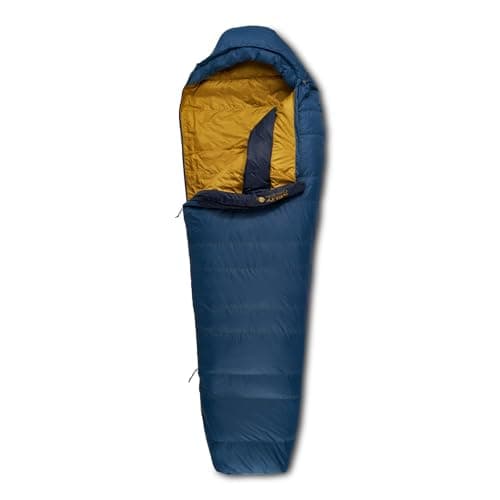
ISO comfort 31 F and limit 21 F on 550-fill down, at 2 lb 7 oz. Tested numbers where most bags at this price have none.
Kelty publishes an ISO comfort rating of 31 F, an ISO limit of 21 F, 550-fill-power down, 2 lb 7 oz in the regular with 16.4 oz of fill, a recycled 50D polyester taffeta shell and a recycled 20D nylon taffeta lining.
The reason this leads is the word ISO. Two numbers from a standardized manikin test are worth far more than one number from a marketing department, and at this price almost nothing else publishes them.
The drawback
550 fill power is low for down, so it is bulkier than a premium bag at the same warmth, and down is ruined by a spilled drink in a way synthetic is not.
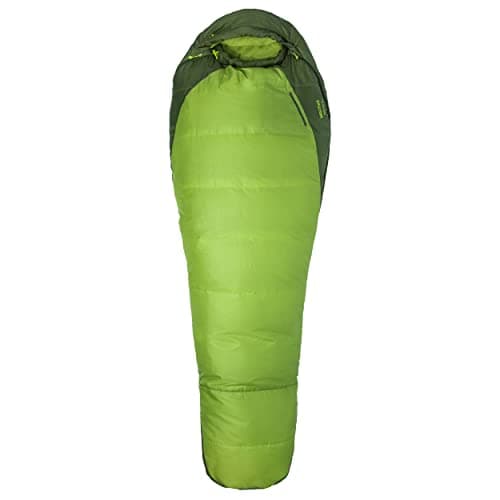
An ISO limit of 20.3 F on synthetic HL-ElixR Eco fill at 3 lb 8.4 oz, in fully recycled PFC-free materials.
Marmot publishes an ISO limit of 20.3 F / -6.5 C, a regular weight of 3 lb 8.4 oz, HL-ElixR Eco Micro synthetic insulation, 100 percent PFC-free recycled shell, lining and fill, and a wave-construction top with a blanket-construction bottom.
Synthetic keeps most of its loft when damp and washes with ordinary detergent, which is why it is the right budget choice for anyone camping near water or lending the bag out. The comparison is in down vs synthetic sleeping bags.
The drawback
A pound heavier than the Kelty for effectively the same tested rating, and it packs noticeably larger. Synthetic always costs weight and volume.
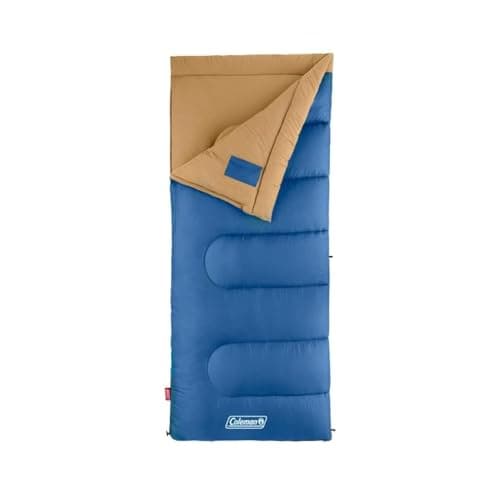
A 20 F maker's rating on ColeTherm polyester fill in a 75 by 33 in rectangular bag at 5.3 lb.
Coleman publishes a 20 F rating, a 75 by 33 in size, a 5.3 lb weight, polyester ColeTherm fill and a fits-to height of 5 ft 11 in.
Treat 20 F as meaning comfortable somewhere around 40 F, which makes it a perfectly good summer bag and not a spring one. That is not a criticism of Coleman specifically; it is what an untested manufacturer figure means across the whole budget category.
The drawback
The 20 F figure is Coleman's own rather than an ISO result, and should be read as a survival number rather than a comfort one. It also fits only to 5 ft 11 in.
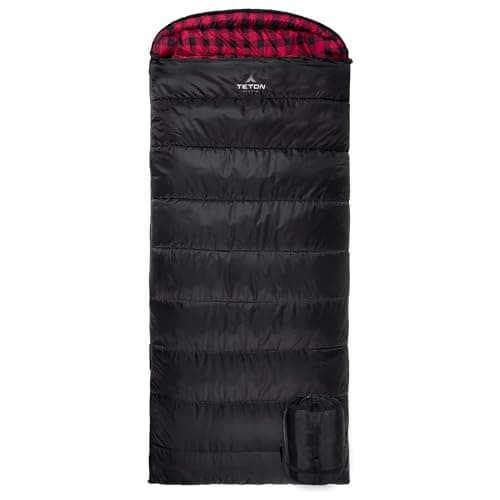
A 90 by 39 in bag with a 0 F maker's rating on SuperLoft Elite fill, at 7 lb.
TETON publishes a 0 F rating, a 90 by 39 in size, 7 lb of total weight, SuperLoft Elite hollow fiber fill and a 17.5 by 12.5 in packed size.
Ninety inches is 7 ft 6 in of bag, and that is the specification worth paying for here. A tall camper in a bag that fits is warmer than a tall camper in a warmer bag that does not, because a compressed foot end has no loft left in it.
The drawback
7 lb and a 17.5 by 12.5 in packed size. That is a car-camping-only bag, and the 0 F number is TETON's own rather than an ISO result.
For summer campground use, yes. The issue is that budget bags rarely publish ISO 23537 ratings, so the number on the label is the maker's own and typically runs 15 to 20 degrees optimistic. Plan around that and an inexpensive bag is fine.
QWhat does an ISO rating on a sleeping bag mean?
It means the bag was tested on a standardized heated manikin under ISO 23537-1, producing a comfort rating and a lower limit. Two numbers with a standard named beside them are worth far more than one number with no standard.
QShould a budget sleeping bag be down or synthetic?
Synthetic if it will get damp, get lent out or get washed often, because synthetic keeps most of its loft when wet. Down if weight and pack size matter and you can keep it dry. At budget prices down means low fill power, so it is bulkier than premium down.
QIs it better to spend money on a sleeping bag or a sleeping pad?
The pad. Body weight crushes the bag's insulation flat underneath you, so warmth on the ground side comes from the pad's R-value. A cheap bag on a good pad outperforms a good bag on a cheap pad.
How we picked
Everyone else in this category will tell you they tested twenty of these. We have not tested any of them, and we would rather say so than pretend. There is no gear closet here and no test lab.
What we did instead: pulled the published specifications from each manufacturer's own spec sheet or manual, named the standard behind every rating so you can check what it actually promises, did the arithmetic that turns a spec into a decision, and pulled today's real retail price rather than quoting one from memory. Every pick states a drawback, because a list where nothing is wrong with anything is an advert.
The limits of that method, stated plainly: published specs do not capture zipper quality, seam durability, or how a tent behaves at 2am in a storm. Where that matters, we say so on the pick. The full method is here.