The Best Portable Fire Pits for Camping, and Where You Are Allowed to Use One
A portable fire pit is the difference between a fire ban meaning no fire and a fire ban meaning no ground fire. That distinction is the whole reason to own one.
Many fire restrictions distinguish between an open ground fire and a contained, off-the-ground appliance with a shutoff or a lid. Stage 1 restrictions frequently permit the second while banning the first, which is how a portable fire pit turns a no-fire weekend into a fire weekend. It is also why the exact wording of the restriction matters more than the product.
Read this carefully, because the distinction is not uniform. Some restrictions exempt only propane and other liquid or gas appliances with an instant shutoff, which a wood-burning pit is not. Others exempt any fire fully contained above the ground. Under a total ban, nothing is permitted. The land manager's current order is the only authority, it changes week to week in summer, and a product page claiming a pit is “fire-ban safe” is marketing rather than law.
The second reason to own one is the one you notice every trip: it leaves no scar. No ring of blackened rocks, no burn mark on the grass, no half-burned trash for the next party. That is the Leave No Trace argument, and at dispersed sites it is the strong one — see dispersed camping for beginners.
Compared on published numbers
Fire pit
Size
Weight
Fuel
How it burns clean
Notable
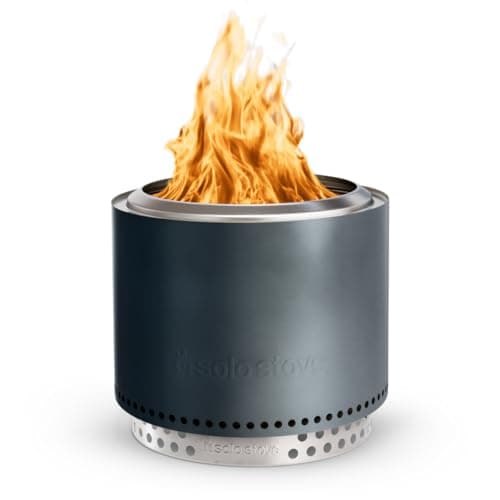
Solo Stove Bonfire 2.0
19.5 in dia x 14 in
23.3 lb
wood
passive double wall, 360 airflow
removable ash pan
BioLite FirePit+
27 x 13 x 15.8 in
19.8 lb
wood or charcoal
51 fan-fed air jets, 3 settings
12,800 mAh battery, 30 h fan on low
Figures as published by each manufacturer.
Two products, two philosophies, and the choice between them is almost entirely about whether you want to cook. The Solo Stove is a better fire; the BioLite is a better appliance.
We are not padding this list with a third pick. The category is full of unbranded stainless bowls with no published wall construction, and recommending one on looks would mean inventing the thing that matters. If neither of these is right, the honest alternative is a collapsing steel pit bought locally — and the specification to check is whether it has a double wall at all.
Smokeless is a description of physics, not a promise
Both of these work the same way in principle: burn the wood, then burn the smoke. Smoke is unburned fuel, and if you can get it hot enough with enough oxygen, it combusts instead of drifting into your eyes.
What that means in practice is that a secondary-burn pit is only clean once it is hot, and only stays clean while it is fed properly. Three things break it every time:
Wet or green wood. Water has to boil off before anything burns hot. Damp wood smokes in any pit ever made.
Overfilling. Logs stacked above the top vent ring block the secondary air. Keep the fuel below the vents.
Startup and burndown. The first ten minutes and the last twenty are smoky. That is unavoidable.
Buy dry hardwood, keep it dry, and split it small. A tarp over the woodpile does more for smoke than either of these products does.
What goes underneath is not optional
The base of a burning fire pit gets hot enough to kill grass, scorch a wooden deck and melt a synthetic ground sheet, and the Solo Stove's own stand exists because of it. On a campsite, put it on dirt, gravel or an existing fire ring pad — never on a tent footprint, a picnic table, or a camping rug. And keep it the same distance from the tent you would keep an open fire, because a spark does not care that the fire is contained. The rest of the fire discipline is in campfire safety basics.
Weight is the spec that decides where it lives
Both of these are roughly 20 lb, which sounds portable and is not. “Portable” in this category means it fits in a car, not that you carry it anywhere. Neither is a backpacking item, and nothing that burns wood cleanly at this size ever will be.
Practically, that means the fire pit lives in the trunk alongside the storage bins and comes out at the site, and the loading order matters if the car is already full — how to pack a car for camping covers that. A carry bag is worth having purely to keep soot off everything else.
Cooking on one
The BioLite takes charcoal and has a controllable fan, which makes it a genuine grill with the right grate. The Solo Stove burns wood only, and wood is a poor cooking fuel until it has burned down to coals — which takes far longer than people expect and is the reason campfire cooking so often produces burned-outside, raw-inside food.
If eating is the point of the evening, cook on a stove and light the fire for the fire. That is not a compromise; it is what most experienced campers do. The stove options are in best camp stoves, and the cast-iron case is in best dutch ovens for camping.
What the specifications do not tell you
Nobody publishes a heat output figure for a wood-burning pit, because it depends entirely on what you put in it. BioLite does not publish a BTU rating for the FirePit+ and neither does Solo Stove for the Bonfire, so any number you see compared between them is somebody's estimate rather than a manufacturer figure. We are not going to supply one.
Nobody publishes a useful burn-time figure either, for the same reason. BioLite's 30-hour figure is the fan battery, not the fire. Read it as “the fan will outlast several evenings”, which is the useful version of that claim.
Which to buy
Buy the Solo Stove Bonfire 2.0 if you want the best version of sitting around a fire and you will cook on something else. Buy the BioLite FirePit+ if you want one object that is a fire in the evening and a charcoal grill at dinner, and you do not mind charging it.
And before either: check the current fire restriction for the specific unit you are visiting, the week you are going. That single check decides whether this is the best purchase on the list or 20 lb of stainless steel riding in your trunk for nothing.
The picks in full
1. Best overall
Solo Stove Bonfire 2.0
Solo Stove
19.5 in of 304 stainless steel with a double-wall secondary burn and a removable ash pan, at 23.3 lb.
Published as 19.5 in in diameter, 14 in tall and 23.3 lb in 304 stainless steel, burning wood, with a double-wall body, 360-degree airflow and a removable base plate and ash pan.
The double wall is the entire product. Air is drawn in at the base, heated as it rises between the two walls, and injected back in through the top vents, where it burns the smoke that an open fire simply releases. “Smokeless” overstates it — it smokes while it is getting up to temperature and it smokes if you feed it damp wood — but once hot, the difference against a fire ring is not subtle.
The removable ash pan in the 2.0 is the practical upgrade over the original. Emptying a fire pit used to mean tipping 20 lb of stainless upside down; now it is lifting out a tray.
The drawback
23.3 lb and 19.5 in across. This is a car-camping object, it needs a flat non-flammable base, and the stainless discolors permanently after the first hot burn.
51 fan-fed air jets on a 12,800 mAh battery, burning wood or charcoal, with 30 hours of fan on low.
BioLite publishes dimensions of 27 by 13 by 15.8 in, a weight of 19.8 lb, a 12,800 mAh battery with USB-A output, 51 air jets, three fan settings, and fan run times of 30 hours on low, 14 on medium and 7 on high. It burns firewood or charcoal.
Forced air is a different approach to the same problem. Instead of relying on heat to drive the secondary burn, a fan pushes it, which means you get a clean burn sooner and you can turn the fire up and down like a dial. That control is why this is the one to buy if you intend to cook: charcoal plus a controllable fan is a grill.
The battery also charges a phone, which is a genuine feature at a site with no power — though not a reason to skip a proper power bank.
The drawback
There is a battery in your fire pit. It is 19.8 lb and 27 in long, the fan is what makes it work, and a flat battery turns it into an ordinary smoky box.
QAre portable fire pits allowed during a fire ban?
Sometimes, and only the land manager's current order decides it. Many Stage 1 restrictions permit a contained, off-the-ground appliance while banning open ground fires, but some exempt only propane appliances with an instant shutoff, and a total ban permits nothing. Check the order for the specific unit the week you go.
QAre smokeless fire pits actually smokeless?
No, but the reduction is real. They burn the smoke by injecting preheated air back into the fire, which only works once the pit is hot. Expect smoke during the first ten minutes, during burndown, and any time you put damp or green wood in.
QCan you carry a portable fire pit backpacking?
No. The Solo Stove Bonfire 2.0 is 23.3 lb and the BioLite FirePit+ is 19.8 lb. Portable here means it fits in a car, not that you carry it. Backpacking fire options are a stove, not a pit.
QWhat do you put under a portable fire pit?
Dirt, gravel or an existing fire ring pad. The base gets hot enough to kill grass, scorch decking and melt a synthetic groundsheet, which is why Solo Stove sells a stand. Never set one on a tent footprint, a camping rug or a picnic table.
How we picked
Everyone else in this category will tell you they tested twenty of these. We have not tested any of them, and we would rather say so than pretend. There is no gear closet here and no test lab.
What we did instead: pulled the published specifications from each manufacturer's own spec sheet or manual, named the standard behind every rating so you can check what it actually promises, did the arithmetic that turns a spec into a decision, and pulled today's real retail price rather than quoting one from memory. Every pick states a drawback, because a list where nothing is wrong with anything is an advert.
The limits of that method, stated plainly: published specs do not capture zipper quality, seam durability, or how a tent behaves at 2am in a storm. Where that matters, we say so on the pick. The full method is here.