A fire needs four things in order and most people buy only the first. An ignition source makes heat. Tinder catches that heat and burns for a minute or more. Kindling is pencil-to-thumb-thick wood that the tinder lights. Fuel is the split logs that the kindling lights. Skip a stage and the fire dies, however good your firestarter is.
The failure is nearly always between tinder and kindling. A spark lights a wisp of something, it burns for ten seconds, and the damp sticks above it never catch. A commercial tinder cube burning for five minutes covers that gap, and so does a fistful of dry birch bark or a cotton ball loaded with petroleum jelly.
Compared on published numbers
Product
Type
Key published figure
Weight
Works wet
Light My Fire FireSteel 2.0 Scout
ferro rod ignition
about 3,000 strikes at 5,400 F
27 g
yes, wipe and strike
UST WetFire
tinder
up to 5 min per cube at over 1,300 F
0.16 oz per cube
yes, floats and burns longer wet
Stormproof matches
ignition
typically 10 to 15 sec burn, relights after immersion
varies
yes, by design
Butane lighter
ignition
no published figures
about 20 g
no, fails cold and wet
Manufacturer figures for the two products above. The last two rows are category characteristics, not specific models.
Why a lighter is still the right primary tool
Nothing here is an argument against carrying a lighter. A disposable butane lighter is the fastest, simplest, cheapest ignition source in the world and it will start ninety-five percent of your campfires with no skill at all.
The argument is for a backup that fails differently. A lighter fails cold, wet, at altitude, and when it runs out, and it gives no warning about any of that. A ferro rod fails only when you run out of rod, which takes years. Carry both, keep them in different places, and the realistic worst case becomes an inconvenience.
Make your own tinder for almost nothing
Cotton balls worked through with petroleum jelly burn for four to five minutes, cost essentially nothing, and store indefinitely in a small screw-top jar or a zip bag. Dryer lint packed into a cardboard egg carton cup with melted wax does the same job. Neither is as tidy as a commercial cube and both work as well. Make a dozen at home and the wet-weather fire problem is solved for a season.
Using a ferro rod so it actually lights something
Build the whole fire first. Tinder in place, kindling stacked over it, fuel within reach. Then strike. Sparks last a fraction of a second and you will not have time to assemble anything afterwards.
Scrape the rod, do not chop at it. Hold the striker at about 45 degrees and pull the rod back under it, keeping the striker still. Moving the rod rather than the striker stops you scattering your own tinder pile.
Get the rod close. An inch above the tinder, not six. Sparks cool fast.
Scrape off a small pile of shavings first, then throw a spark into it. A pile of ferro shavings catches far more reliably than a single spark does.
Fire rules come before technique
Fire restrictions change weekly in summer and are frequently total, including bans on charcoal and sometimes on gas stoves. A firestarter is worth nothing if the answer that week is no fire at all, and campground hosts and ranger district pages are the authority rather than a phone app.
Where fires are allowed, use the existing ring, keep it small, and put it out properly with water rather than dirt — the routine is in campfire safety basics. For dispersed sites, the additional rules are in dispersed camping for beginners.
What to keep the kit in
A single small waterproof container with a rod, a lighter, stormproof matches and half a dozen tinder cubes, kept in the same pocket of the same bag every trip. The reason to consolidate is that firestarting kit is the most commonly scattered category in camping, and a fire is exactly the thing you need when you are cold and it is getting dark.
Buy the Light My Fire FireSteel 2.0 Scout as a backup ignition source that will outlast the rest of your kit. Buy a pack of UST WetFire if you camp anywhere wet and have ever failed to get a fire going. Keep a lighter as the primary, and make your own tinder at home if you camp often enough to care about the cost.
The picks in full
1. Best ignition source
Light My Fire Swedish FireSteel 2.0 Scout
Light My Fire
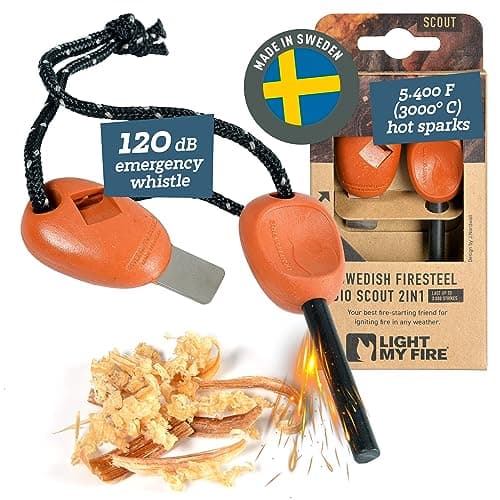
About 3,000 strikes throwing sparks at a published 5,400 F, in a 27 g rod with a whistle in the striker.
Light My Fire publishes about 3,000 strikes, a spark temperature of 2,980 C / 5,400 F, a 27 g weight, dimensions of 77 by 24 by 14 mm, a magnesium alloy rod with a stainless steel striker, and an emergency whistle built into the striker handle.
The reason to carry one over a lighter is that nothing about it can fail in weather. A butane lighter stops working in cold and at altitude because the fuel will not vaporize, and a soaked lighter is done. A ferro rod is a piece of metal: wipe it and strike it.
The drawback
A ferro rod only makes sparks. Without dry tinder it will not start a fire, and there is a genuine learning curve before your first strike lights anything.
Published specs
Strikes
about 3,000
Spark temperature
2,980 C / 5,400 F
Weight
27 g
Dimensions
77 x 24 x 14 mm
Material
magnesium alloy rod with a stainless steel striker
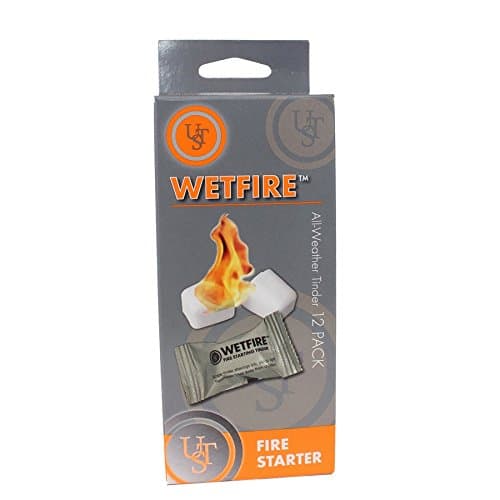
Cubes burning up to 5 minutes at over 1,300 F, at 0.16 oz each, that float and burn longer when wet.
UST publishes a burn time of up to 5 minutes per cube, a burn temperature of over 1,300 F, a cube weight of 0.16 oz at 0.75 by 0.75 by 0.5 in, individually sealed packaging with up to a 5-year shelf life, and cubes that float and burn longer when wet or moist.
Five minutes is the figure that matters. Most tinder gives you seconds, which is not long enough to get marginal kindling going. Five minutes of 1,300 F under damp pencil-thick sticks will dry them and light them, which is the entire problem this solves.
The drawback
It is a consumable. Each cube is one fire, and a pack of twelve is twelve attempts, which makes it expensive compared with tinder you can gather or make at home.
You need two things, not one. A ferro rod such as the Light My Fire FireSteel 2.0 Scout makes sparks at a published 5,400 F for about 3,000 strikes and works wet and cold. A tinder such as UST WetFire burns up to 5 minutes per cube so damp kindling has time to catch.
QWhy do my campfires keep going out?
Almost always at the gap between tinder and kindling. The tinder burns for ten seconds and the damp sticks above it never catch. Use tinder that burns for minutes rather than seconds, and build the whole fire before you light anything.
QIs a ferro rod better than a lighter?
It is a better backup, not a better primary. A disposable lighter starts most campfires with no skill. It also fails when cold, wet, at altitude or empty, with no warning. A ferro rod fails only when it runs out, which takes years. Carry both, in different places.
QCan I make my own firestarter?
Yes, and it works as well as a bought one. Cotton balls worked through with petroleum jelly burn for four to five minutes and cost almost nothing. Dryer lint in a cardboard egg carton cup with melted wax does the same. Store either in a small screw-top jar.
How we picked
Everyone else in this category will tell you they tested twenty of these. We have not tested any of them, and we would rather say so than pretend. There is no gear closet here and no test lab.
What we did instead: pulled the published specifications from each manufacturer's own spec sheet or manual, named the standard behind every rating so you can check what it actually promises, did the arithmetic that turns a spec into a decision, and pulled today's real retail price rather than quoting one from memory. Every pick states a drawback, because a list where nothing is wrong with anything is an advert.
The limits of that method, stated plainly: published specs do not capture zipper quality, seam durability, or how a tent behaves at 2am in a storm. Where that matters, we say so on the pick. The full method is here.