A 13 to 14 in hatchet is a one-handed tool for splitting kindling and driving stakes. A 19 to 24 in axe is a two-handed tool that can process firewood. The head weight matters far less than the handle length, because the handle is the lever that generates the energy. Buying a hatchet and expecting it to fell anything is the most common mistake in the category.
For almost all campground camping, the honest answer is that you need the hatchet and not the axe. Firewood is usually sold split at the camp store, and what you actually do with a cutting tool is reduce those splits to kindling. A 14 in hatchet does that in a confined space, packs in a bin, and is far safer to use badly.
The case for the longer axe is dispersed camping and gathering deadfall, where you are processing whole rounds rather than pre-split wood. If that is not your camping, the money is better spent on a saw — the comparison is in how to choose a camp saw or axe.
Compared on published numbers
Tool
Length
Total weight
Cutting edge
Handle
Sheath
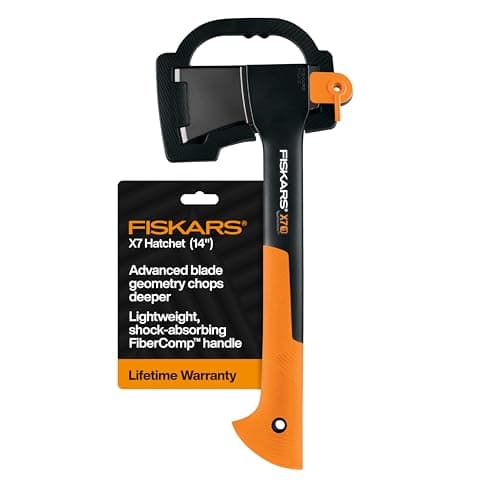
Fiskars X7
14 in
not published
2.5 in
hollow FiberComp composite
included
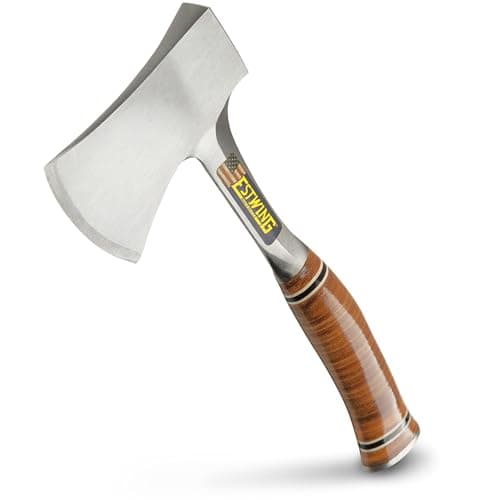
Estwing Sportsman E24A
13.5 in
1.8 lb
3.25 in
forged steel, stacked leather grip
ballistic nylon
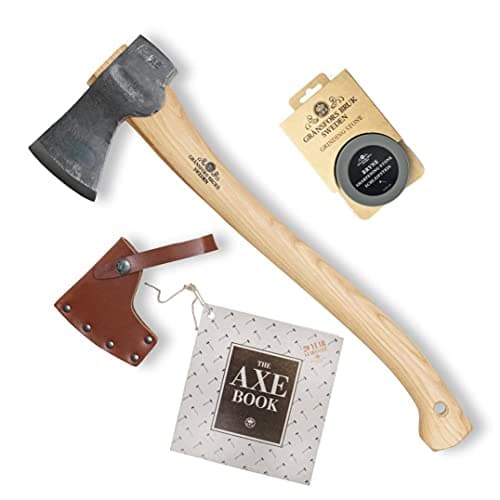
Gransfors Bruk Small Forest Axe
19 in
2 lb
3.25 in face
hickory
vegetable-tanned leather
Figures as published by each manufacturer.
The three handle materials, and how each fails
Composite. Cannot loosen, absorbs shock well, survives an overstrike better than wood. Not repairable and not replaceable; when it goes, the tool goes.
One-piece steel. Cannot fail at the joint because there is no joint. Transmits the most shock to your hands, and it is the heaviest for the cutting power.
Hickory. Best feel, best shock absorption, and the only one you can replace when it breaks. It also dries out, loosens and is the one an overstrike snaps.
Overstriking — missing the target and hitting the log with the handle just behind the head — is what breaks handles, and it is a technique problem rather than a product problem. A chopping block at the right height prevents most of it.
Check the fire rules before you plan around cut wood
Many campgrounds prohibit gathering or cutting wood entirely, and most state and national forests restrict it to dead and downed material, often with a size limit. Transporting firewood across county or state lines is also restricted in much of the country because of insect quarantines. The rule almost everywhere is to buy firewood where you burn it. The rest of the fire-management picture is in campfire safety basics.
Using a hatchet without hurting yourself
The dangerous position is the one everyone starts in: kneeling or crouching with the wood on the ground, swinging down. A miss goes into your leg. Put the wood on a chopping block at knee height or higher so a miss goes into the block or the ground well away from you.
For kindling specifically, the safer method is not to swing at all. Set the edge on the end grain of the split, then lift both the hatchet and the wood together and bring them down on the block as a unit. The wood splits, the edge never travels through open air, and children can watch from a sensible distance without anyone tensing up.
Sharpening, which is where axes are actually lost
A dull axe is more dangerous than a sharp one, because it glances instead of biting. Of the tools here, only the Gransfors arrives with a genuinely usable factory edge; the hatchets arrive serviceable rather than sharp.
The maintenance is a file for reprofiling and a puck stone for honing, and the technique transfers directly from how to sharpen a knife at camp. An axe puck stone is a few dollars and is the only maintenance most camp hatchets ever need.
Which to buy
Buy the Fiskars X7 if you want one tool for campground kindling and you would rather not think about it. Buy the Estwing E24A if you want something indestructible and you can live with the shock. Buy the Gransfors Small Forest Axe if you are processing real wood and will maintain an edge.
And consider buying a saw instead of any of them. For most camp tasks a folding saw is safer, lighter and faster — the case is made in best camping saws.
The picks in full
1. Best overall
Fiskars X7 Hatchet, 14 in.
Fiskars
A 14 in hatchet with a forged carbon steel head insert-molded into a hollow composite handle, hardened to HRC 50-56, with a sheath.
Fiskars publishes a 14 in overall length, a 2.5 in cutting edge, a forged carbon steel head insert-molded into the handle, a hardness of HRC 50-56, a hollow FiberComp shock-absorbing handle and an included sheath.
Insert-molding is the reason this design has taken over the category. The head cannot work loose from the handle, which is the failure that ends most wooden-handled hatchets, and the hollow handle puts the weight forward where it does the cutting. For splitting wrist-thick wood into kindling it is hard to argue with.
Fiskars sells two other small axes at almost exactly this length, the X13 and the X14, and the model numbers make them look like a size ladder when they are not. Fiskars X7 vs X13 vs X14 compares the three on grind, on the striking end only one of them has, and on the figures Fiskars declines to publish for the two newer models.
The drawback
The composite handle cannot be replaced. When the head finally loosens or the handle cracks, the tool is finished, where a wooden handle would be a twenty-minute repair.
Published specs
Overall length
14 in
Cutting edge
2.5 in
Head
forged carbon steel, insert-molded into the handle
Head and handle forged from a single piece of 1055 carbon steel, 13.5 in long, 1.8 lb, with a stacked leather grip.
Estwing publishes a 13.5 in overall length, a 1.8 lb total weight, a 1.3 lb head, a 3.25 in cutting edge, a head and handle forged from one piece of 1055 carbon steel, a hand-sanded and lacquered stacked leather grip, a ballistic nylon sheath and manufacture in Rockford, Illinois.
There is nothing to come loose because there are no joints. The leather washers do some shock absorption and not as much as a hollow composite handle, but this is a tool that will outlast everything else in your kit and can be left in a truck bed for a decade.
The drawback
One-piece steel transmits shock straight into your hand and elbow. After an hour of splitting you will feel it, which is exactly what the composite handles were invented to fix.
Published specs
Overall length
13.5 in
Total weight
1.8 lb
Head weight
1.3 lb
Cutting edge
3.25 in
Construction
head and handle forged from one piece of 1055 carbon steel
Grip
stacked genuine leather, hand sanded and lacquered
A hand-forged head on a 19 in hickory handle at 2 lb total, with a vegetable-tanned leather sheath.
Gransfors Bruk publishes a 19 in hickory handle, a total weight of 0.9 kg / 2 lb, a head weight of about 1.5 lb, a 3.25 in face, a hand-forged head stamped with the smith's initials and a vegetable-tanned leather sheath.
The extra five inches of handle over a hatchet roughly doubles the energy at the edge, which is the difference between splitting kindling and actually processing rounds. It also arrives properly sharp, which almost nothing else in this category does.
The drawback
Nineteen inches is a two-handed tool that needs space to swing, and it costs several times what the hatchets do. A hickory handle also needs looking after and can be broken by an overstrike.
Usually not. Campground firewood is sold pre-split, so the actual job is reducing splits to kindling, which a 14 in hatchet does. A folding saw handles most of the rest more safely. A full axe is for dispersed camping where you process whole rounds.
QWhat size camp axe should I buy?
A 13 to 14 in hatchet is a one-handed kindling and stake tool. A 19 to 24 in axe is a two-handed tool that can process firewood. Handle length matters more than head weight, because the handle is the lever that generates the energy.
QIs a composite or wooden axe handle better?
Composite cannot work loose and survives overstrikes, but is not repairable. Hickory feels best, absorbs shock best and can be replaced when it breaks, but it dries out and loosens. One-piece steel never fails at the joint and transmits the most shock to your hands.
QWhat is the safest way to split kindling?
Do not swing. Set the edge on the end grain of the split, then lift the hatchet and the wood together and bring them down on the chopping block as a unit. The edge never travels through open air, and a miss cannot reach your leg.
How we picked
Everyone else in this category will tell you they tested twenty of these. We have not tested any of them, and we would rather say so than pretend. There is no gear closet here and no test lab.
What we did instead: pulled the published specifications from each manufacturer's own spec sheet or manual, named the standard behind every rating so you can check what it actually promises, did the arithmetic that turns a spec into a decision, and pulled today's real retail price rather than quoting one from memory. Every pick states a drawback, because a list where nothing is wrong with anything is an advert.
The limits of that method, stated plainly: published specs do not capture zipper quality, seam durability, or how a tent behaves at 2am in a storm. Where that matters, we say so on the pick. The full method is here.