The Best Camping Knives, Sized for What a Camper Actually Cuts
A camping knife opens packaging, cuts cord, slices food and shaves kindling. Every one of those jobs argues for a small, sharp blade rather than a large one.
Over a camping weekend a knife opens packaging, cuts cord, slices food, shaves kindling and occasionally trims a broken guy line. It does not baton firewood, skin game or split logs, whatever the product photography shows. That list argues for a 3 to 4 in blade. Longer blades are harder to control on food, heavier, and more conspicuous at a family campground for no gain.
Knife
Blade
Weight
Steel
Lock
Best at
Morakniv Companion
4.1 in, 2.0 mm thick
3.9 oz with sheath
Sandvik 12C27 stainless
Fixed blade
Everything at a campsite
Opinel No.08
3.35 in
1.6 oz
XC90 carbon or 12C27 stainless
Virobloc collar
Pocket carry and food
Victorinox Huntsman
91 mm frame, 15 functions
about 97.5 g
Victorinox stainless
Non-locking
Scissors, saw and small tasks
All figures as published by the manufacturers.
Fixed, folding or Swiss Army?
Fixed blade. Nothing to fold, nothing to fail, easy to clean, and the whole blade is available. It needs a sheath, and it looks like more knife than it is.
Folder. Pocketable and light. The hinge collects grit and water, so it needs drying and occasional cleaning, and the lock is a part that can wear.
Swiss Army knife. Fifteen adequate tools instead of one good one. The scissors, saw and openers earn their place; the main blade is the weakest part of it.
Most campers end up with a fixed blade in the kitchen box and a folder or a SAK in a pocket, which is a sensible arrangement rather than an indulgence — they are used for different things at different moments.
Carbon or stainless, decided by how you treat it
Carbon steel takes a keener edge and is easier to sharpen; it also rusts, quickly, if it is put away damp or used on acidic food. Stainless holds up to the treatment a camp knife actually gets. For camping, and particularly for anywhere coastal — see the beach camping guide — stainless is the low-maintenance answer, and Morakniv publishes Sandvik 12C27 for exactly this use.
What makes a good camp knife handle
Grip when wet is the specification that matters and the one least often published. Morakniv publishes a high-friction rubber handle; Opinel publishes beech wood, which is warm in the hand and slick when wet.
Look for a handle that fills your hand without hot spots, and some form of guard or finger stop so a wet hand cannot slide forward onto the blade. That is the single most common way people cut themselves with a camp knife, and it happens with a knife that is doing exactly what it should.
The legal part
Knife carry is regulated differently by state, by county and by land manager, and rules can cover blade length, locking mechanisms and fixed versus folding. A knife that is unremarkable at one campground can be a problem at another, and national parks frequently have their own rules.
Check the rules for where you are going. We do not publish legal advice, and this is one of the few gear categories where the answer genuinely depends on where you are standing.
What we did not do
We have not used, cut with or sharpened any of these. There is no standardized test for knife edge retention or toughness comparable to ISO 23537 for sleeping bags, so this page compares blade length, thickness, steel type, weight and lock mechanism — what the makers publish and what genuinely differs. Every figure carries a link to its source. See how we research, and best multi-tools for camping for the pliers-first alternative.
The picks in full
1. Best all-round camping knife
Morakniv Companion (Stainless)
Morakniv
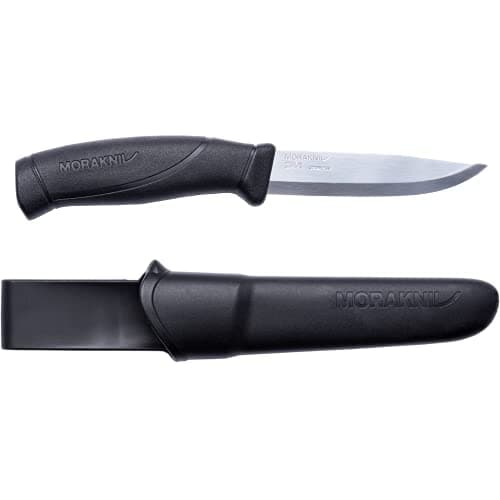
A 4.1 in Sandvik 12C27 stainless blade at 3.9 oz with its sheath, on a high-friction rubber handle, with nothing to fold or fail.
Morakniv publishes a 4.1 in (104 mm) blade length, a 2.0 mm blade thickness (3.2 mm on the Heavy Duty version), Sandvik 12C27 stainless steel, a 3.9 oz (110 g) weight with the sheath, a high-friction rubber handle, and an ambidextrous polymer sheath with a belt clip.
Four inches is close to the ideal length for camp work. Long enough to slice through a cabbage or shave a feather stick, short enough to control precisely on a cutting board, and nowhere near the size where a knife becomes unwieldy and intimidating.
The 12C27 stainless is the right choice for camping specifically. Carbon steel takes a keener edge and rusts if left wet, which at a campsite means every time somebody washes it and puts it away damp. Stainless is more forgiving of exactly the treatment a camp knife gets, and the sharpening difference is small — see how to sharpen a knife at camp.
The drawback
A fixed blade needs a sheath and reads as more knife than it is, which is a consideration at a busy family campground.
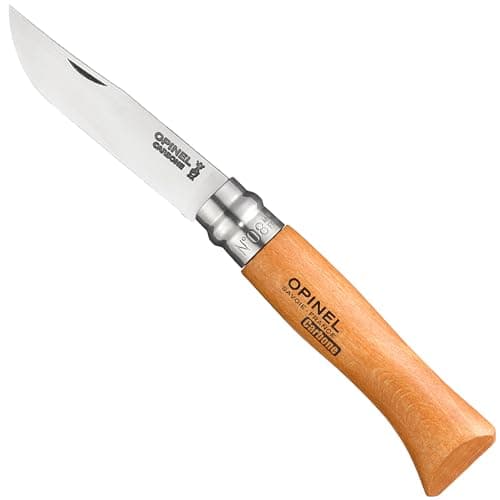
A 3.35 in blade at 1.6 oz on a beech handle, locking with the Virobloc collar, at 7.5 in open.
Opinel publishes a 3.35 in (8.5 cm) blade, a 7.5 in (19.5 cm) open length, a 1.6 oz weight, XC90 carbon steel or Sandvik 12C27 stainless depending on the version, a Virobloc rotating collar lock patented in 1955, a beech wood handle, and manufacture in Savoie, France. The whole knife is five parts.
One point six ounces is the number that makes this a knife you carry rather than a knife you pack. It is a superb food knife — the thin blade and long, flat grind slice cleanly in a way a thicker survival blade does not — and the Virobloc collar locks the blade both open and closed, so it cannot open in a pocket.
Take the stainless version for camping unless you have a specific preference. The carbon version takes a better edge and will show a patina and then rust after one damp weekend, which is a lot of maintenance for a knife whose main job is cutting cheese.
The drawback
A wooden handle swells when wet and can stiffen the pivot, and a hinge collects grit that needs drying and cleaning.
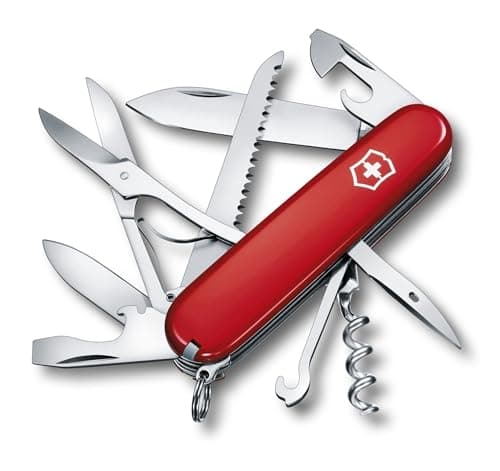
15 functions in a 91 mm frame at about 97.5 g, including two blades, scissors, a wood saw, a corkscrew and an awl.
Victorinox publishes 15 functions in a 91 mm (3.5 in) closed length at about 97.5 g (3.4 oz) and roughly 20 mm thick, including a large and small blade, corkscrew, reamer/punch/sewing awl, scissors, wood saw, multipurpose hook, key ring, tweezers, toothpick, can opener, bottle opener, 6 mm and 3 mm screwdrivers and a wire stripper.
The scissors are the reason people who own one keep it in a pocket. Cutting tape, trimming a bandage, opening a packet cleanly and cutting cord are all easier with scissors than with a blade, and this is the smallest object that carries a usable pair.
The wood saw is the other underrated function: it cuts a wrist-thick branch far faster than you would expect from something that folds into a pocket knife. Neither replaces a dedicated tool — the point is that all fifteen are in your pocket, and the dedicated versions are in the car. Where the saw stops being enough is in how to choose a camp saw or axe.
The drawback
Every function is a compromise version of a dedicated tool, and the main blade is short and does not lock.
Published specs
Functions
15
Length
91 mm / 3.5 in closed
Weight
about 97.5 g / 3.4 oz
Thickness
about 20 mm
Includes
large and small blade, wood saw, scissors, corkscrew, awl
Also
can and bottle openers, screwdrivers, wire stripper, tweezers, toothpick
A 3 to 4 in blade. That covers opening packaging, cutting cord, food prep and shaving kindling, which is what campers actually do. Morakniv publishes 4.1 in for the Companion and Opinel publishes 3.35 in for the No.08; longer blades are harder to control on food.
QShould a camping knife be carbon steel or stainless?
Stainless, for most campers. Carbon takes a keener edge and is easier to sharpen, but it rusts quickly if put away damp or used on acidic food - which is exactly what happens at a campsite. Sandvik 12C27 stainless is the standard camp choice.
QIs a fixed blade or a folding knife better for camping?
A fixed blade is easier to clean, has nothing to fail and gives you the whole blade; it needs a sheath. A folder is lighter and pocketable but the hinge collects grit and water. Many campers keep a fixed blade in the kitchen box and a folder in a pocket.
QIs a Swiss Army knife enough for camping?
For small tasks, often. The scissors and wood saw on a Huntsman genuinely earn their place, and 15 functions at 97.5 g in a pocket is hard to beat. The main blade is the weakest part, so it is a complement to a proper camp knife rather than a replacement.
How we picked
Everyone else in this category will tell you they tested twenty of these. We have not tested any of them, and we would rather say so than pretend. There is no gear closet here and no test lab.
What we did instead: pulled the published specifications from each manufacturer's own spec sheet or manual, named the standard behind every rating so you can check what it actually promises, did the arithmetic that turns a spec into a decision, and pulled today's real retail price rather than quoting one from memory. Every pick states a drawback, because a list where nothing is wrong with anything is an advert.
The limits of that method, stated plainly: published specs do not capture zipper quality, seam durability, or how a tent behaves at 2am in a storm. Where that matters, we say so on the pick. The full method is here.