Trail & Tarp earns a commission from qualifying purchases made through links on this page, at no extra cost to you. Full disclosure.
The rules come before the tool
The short answer
In much of North America you must not move firewood between areas, because it spreads invasive insects and disease — the standing advice is to buy it where you burn it or gather it on site where that is permitted. Many campgrounds also prohibit cutting standing trees, living or dead, entirely. Those two rules decide what your fire looks like far more than any tool you buy.
The practical consequence at most developed campgrounds is that you arrive with bought firewood that is already split and cut to length. In that case you need neither a saw nor an axe, and the only cutting tool involved is a knife for kindling — see best camping knives.
Where gathering dead and downed wood is permitted, a saw becomes genuinely useful. Where you are burning bought wood in long pieces, a saw is useful. An axe is useful in a narrower case than most people expect: splitting rounds that are already too thick to burn.
Saw versus axe, on the things that matter
Folding saw
Bow saw
Hatchet
Cuts across the grain
Fast and controlled
Fastest for thick wood
Slow and inefficient
Splits along the grain
No
No
Yes; this is what it is for
Weight
6-12 oz
1.5-3 lb
1.5-3 lb
Packed size
Pocket to forearm
Awkward, often a frame
Awkward and heavy
Safety
Blade is enclosed when folded; low energy
Enclosed, stable
Highest injury risk of any camp tool
Noise
Quiet
Quiet
Loud, in a campground at 8am
Skill needed
Almost none
Almost none
Real technique, and a chopping block
Our comparison of the three categories. The only row where the axe wins is splitting.
Read that table honestly and the conclusion is unavoidable for most campers: a folding saw does the job you actually have, at a fraction of the weight, with a fraction of the risk. An axe is specialist equipment for splitting, and splitting is something most campers never do because bought firewood arrives split.
Choosing a folding saw
Three things to look at. Blade length, which sets the maximum diameter you can comfortably cut — a 7 to 8 in blade handles wrist-thick branches, and 10 to 12 in handles arm-thick. Tooth pattern, where an aggressive raker or triple-cut pattern cuts green wood far faster than a fine-toothed pattern. And the lock, which must hold the blade open and closed positively, because a saw that folds on your hand is the one way this tool hurts you.
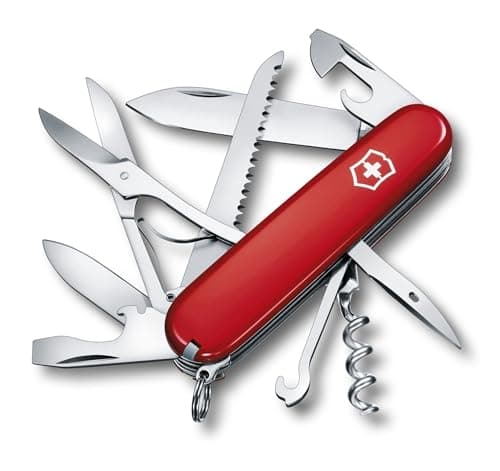
A folding camp saw in that range covers a campsite. The wood saw on a Victorinox Huntsman is more capable than it looks for occasional use and cuts a wrist-thick branch surprisingly quickly, which for many people is enough that a dedicated saw never gets bought.
If you do buy an axe, buy a chopping block habit with it
Never split wood held in your hand, on the ground, or against a foot. Use a solid round as a chopping block, keep everyone else well outside the swing radius including behind you, and stop when you are tired — almost all axe injuries happen on the last few swings of a session. A hatchet is the highest-risk tool at a campsite by a wide margin, and it is the only one on this site we would suggest most people simply do not buy.
What actually makes a fire start
Not big wood. Fires fail at the kindling stage, and the answer is small dry material rather than a bigger tool: pencil-thin dead twigs, split slivers from a dry log, birch bark, or a fire starter you brought.
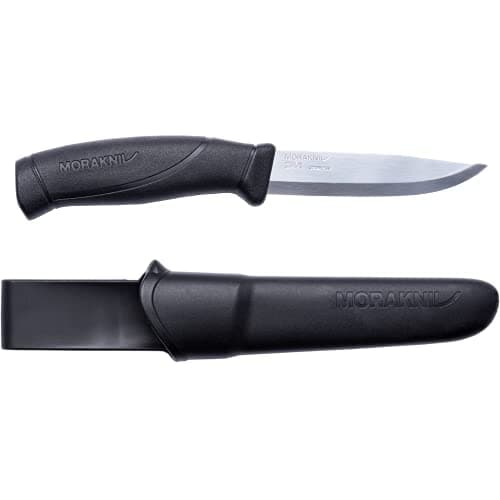
A knife makes better kindling than an axe. Shaving feather sticks from the dry inside of a split piece is a knife job, and it is the single most useful fire skill because it works when everything outdoors is damp. A Morakniv Companion at 4.1 in and 2.0 mm thick is well suited to it; carry a waterproof fire starter as well and the whole question of processing wood mostly disappears.
Transport and storage
Both tools travel with a blade guard or folded, in a rigid box rather than loose in a duffel. A saw blade against a sleeping bag will find it, and an unsheathed hatchet in a bag is a genuine hazard when somebody reaches in.
Dry both after use and put a light film of oil on steel that is not stainless; saw blades rust quickly and a rusty blade binds in the cut. The rest of the seasonal routine is in how to store camping gear in the off-season.
The honest recommendation
Most campers should own no saw and no axe. Buy firewood at or near the site, bring a knife for kindling and a fire starter, and be done. If you camp somewhere gathering is permitted and you want a fire regularly, buy a folding saw with a locking blade. Buy an axe only if you have a specific splitting need, somewhere to do it safely, and have been shown how.
And check the current fire status before every trip, because bans change week to week and a tool is no use in a season when fires are prohibited entirely — the practice and the rules are in campfire safety basics.
The gear this page points to
Morakniv Companion (Stainless)
Morakniv
4.1 in of Sandvik 12C27 at 2.0 mm. Feather sticks from the dry inside of a split log are a knife job, and the most useful fire skill there is.
Almost certainly not. Bought firewood arrives already split, and an axe is a splitting tool. A folding saw cuts across the grain faster, weighs a fraction as much and is far safer, and a knife makes better kindling than either.
QCan you bring your own firewood camping?
Generally you should not move it between areas, because it spreads invasive insects and disease. The standing advice is to buy firewood where you burn it or gather dead and downed wood on site where that is permitted. Many campgrounds also prohibit cutting standing trees.
QWhat size folding saw is best for camping?
A 7 to 8 in blade handles wrist-thick branches and a 10 to 12 in blade handles arm-thick wood. Look for an aggressive tooth pattern for green wood and a lock that holds the blade positively both open and closed.
QWhat is the safest way to split firewood at a campsite?
Use a solid round as a chopping block, never hold wood in your hand or split against a foot, keep everyone outside the swing radius including behind you, and stop when tired - most axe injuries happen on the last swings of a session.
Sources
Every figure on this page comes from a published source. We have not tested this gear, so the numbers are the manufacturer's or the standard body's, not ours. How we research.