A folding saw is lighter than a hatchet, cuts more wood per minute, and cannot bounce off a log into your knee. The category barely gets discussed and it should.
A saw removes wood by cutting fibers; an axe removes it by splitting them apart. Across a log, cutting takes far less energy than splitting, which is why a 190 g folding saw will get through a branch faster than a 1.8 lb hatchet and leave you less tired. A saw is also far safer: the blade is captive in the cut rather than swinging free.
The axe wins at exactly one thing, and it is worth naming because it is the reason to own both: splitting a round lengthwise, along the grain, to get at dry wood inside or make kindling. A saw is very poor at that. So the honest kit is a saw for cutting to length and a hatchet for splitting, and if you only take one, take the saw.
TPI sets what the saw is good at, and the relationship is simple: fewer, larger teeth cut green wood faster and leave a rougher finish; more, smaller teeth cut slower, cleaner, and handle dry or seasoned wood better without grabbing.
Teeth per inch
Cuts best
Trade
5 to 7 TPI
green wood, larger diameters, fast rough cuts
chatters on small dry branches
8 to 10 TPI
general camp use, dry and green
the usual compromise, and the right default
12 TPI and up
dry, seasoned or frozen wood, fine work
slow through anything thick
Our working guide to what the published TPI figure means in use.
Note that almost all modern camp saws cut on the pull stroke rather than the push. That is what lets the blade be thin: a blade in tension does not buckle, so it can be far lighter than a push saw of the same length. Let it do that — forcing the push stroke is how people bend blades.
Hardened teeth cannot be sharpened
Every saw here uses induction- or impulse-hardened teeth, which is why they stay sharp for years. It is also why none of them can be sharpened with a file: the hardened layer is harder than the file. When a blade finally dulls or you bend one, you buy a replacement blade rather than maintaining the one you have. Both Silky and Bahco sell them, and a spare blade is the sensible thing to keep with a saw you rely on.
Cutting technique that stops blades binding
Binding is what makes a saw feel bad, and it is almost never the saw. A log supported at both ends closes on the blade as you cut down through it; a log supported at one end opens away from the blade and then breaks early, tearing the last fibers.
The fix is to work out which way the wood will move before you start. On a supported-both-ends log, cut from underneath, or cut down a third and finish from below. On an overhanging branch, make a small undercut first so the bark does not strip when it goes. Neither takes any longer and both make a cheap saw feel like an expensive one.
What else to carry
Gloves, because the most common camp-saw injury is not a cut from the blade but a hand slipping onto the teeth while the other hand steadies the wood. Options are in best gloves for camping.
Buy the Bahco Laplander if you want a saw that weighs nothing and costs nothing and will be in the pack every trip. Buy the Silky GomBoy 240 if you cut enough wood that speed is worth an extra 95 grams. Buy the Corona RazorTOOTH if you are car camping and working on rounds rather than branches.
Before you check local rules on gathering wood at all, read dispersed camping for beginners — in most campgrounds cutting standing or downed wood is prohibited outright.
The picks in full
1. Best overall
Silky GomBoy 240 Folding Saw
Silky
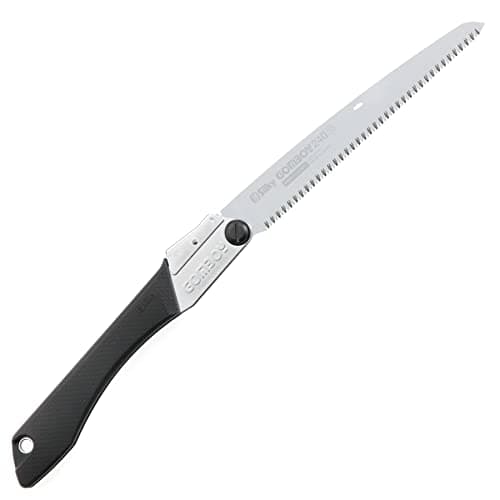
A 240 mm taper-ground blade with induction-hardened teeth at 285 g, folding to 270 mm.
Silky publishes a 240 mm / 9.45 in blade length, 10 teeth per 30 mm (about 8.5 per inch) in the medium-tooth version, a weight of 285 g / 0.63 lb, a folded length of 270 mm / 10.63 in, and a chrome-plated taper-ground blade with electrical induction-hardened teeth.
Taper grinding is the specification that matters and almost nobody explains. The blade is thicker at the teeth than at the spine, so the cut is wider than the steel behind it and the saw does not bind. That is why a Silky cuts so much faster than its size suggests.
The drawback
285 g is the heaviest here and the blade is aggressive enough to do real damage to a finger. The teeth are hardened, so when the blade eventually dulls you replace it rather than sharpen it.
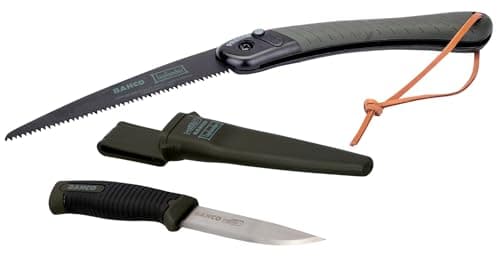
A 7.5 in blade at 7 TPI in a 190 g body, with an anti-rust epoxy coating and a rubber-coated handle.
Bahco publishes a 19 cm / 7.5 in blade, 7 TPI with hardened teeth, a 190 g / 6.67 oz weight, a 23 cm folded length, a 40 cm open length, an anti-rust epoxy blade coating and a high-density plastic handle with a rubber coating.
The epoxy coating is the reason this one survives being forgotten in a damp pack. It is the saw most people should start with: light enough that carrying it is not a decision, cheap enough that losing it is not a disaster.
The drawback
Seven teeth per inch is a coarse, general-purpose cut that leaves a rough finish, and the blade is short enough that anything over about 4 in diameter becomes tedious.
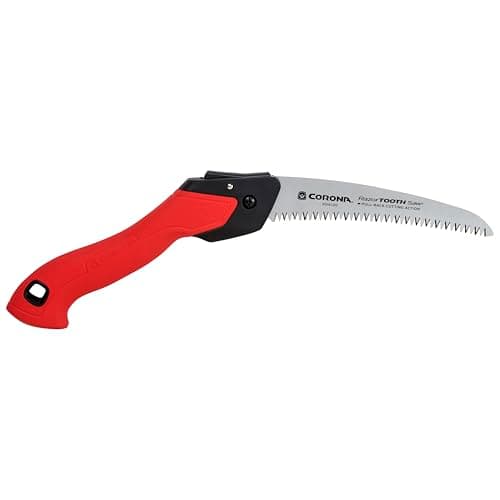
A 10 in curved impulse-hardened blade with three-sided razor teeth, rated by Corona for branches up to 5 to 6 in.
Corona publishes a 10 in curved blade, up to 6 teeth per inch with three-sided razor teeth, impulse-hardened chrome-plated steel, a rating for branches up to 5 to 6 in in diameter, and a co-molded ergonomic handle. Corona does not publish a weight figure on the product page.
The curve is the point. A curved blade keeps more teeth engaged through the stroke on a round log, which is where a straight blade starts skating. For camp firewood rather than kindling, this cuts faster than either of the others.
The drawback
Corona does not publish a weight for it, and a 10 in curved blade with a co-molded handle is a bulky object that belongs in a car rather than a backpack.
A saw, for almost everything. Cutting across the grain takes far less energy than splitting, so a 190 g folding saw gets through a branch faster than a 1.8 lb hatchet. An axe wins only at splitting rounds lengthwise for kindling.
QWhat TPI should a camping saw have?
Around 8 to 10 teeth per inch is the right default for mixed camp use. Five to 7 TPI cuts green wood and larger diameters faster but chatters on small dry branches; 12 TPI and up suits dry, seasoned or frozen wood and is slow through anything thick.
QCan you sharpen a folding camp saw?
Not the ones here. Induction- and impulse-hardened teeth stay sharp for years and are harder than a file, so they cannot be sharpened. When a blade dulls or bends you fit a replacement blade, which Silky and Bahco both sell.
QWhy does my camp saw keep binding?
Because of how the wood is supported, not the saw. A log held at both ends closes on the blade as you cut down. Cut from underneath instead, or cut a third of the way down and finish from below. On an overhanging branch, undercut first so the bark does not strip.
How we picked
Everyone else in this category will tell you they tested twenty of these. We have not tested any of them, and we would rather say so than pretend. There is no gear closet here and no test lab.
What we did instead: pulled the published specifications from each manufacturer's own spec sheet or manual, named the standard behind every rating so you can check what it actually promises, did the arithmetic that turns a spec into a decision, and pulled today's real retail price rather than quoting one from memory. Every pick states a drawback, because a list where nothing is wrong with anything is an advert.
The limits of that method, stated plainly: published specs do not capture zipper quality, seam durability, or how a tent behaves at 2am in a storm. Where that matters, we say so on the pick. The full method is here.