Fiskars X7 vs X13 vs X14: Three Small Axes, and Why Length Is Not the Difference
All three are 13 or 14 inches, which is why people assume they are the same axe in three colors. They are not. Fiskars grinds them differently, markets them for three different jobs, and only one of them has a face you are meant to hit things with.
Buy the X7 if you are buying one axe: it is the only one of the three with a published edge length and hardness, and it is ground for the seasoned firewood most campers actually cut. Buy the X13 if you care about carrying it, or if you want one tool that also drives tent stakes — it is the only one with a striking end. Buy the X14 only if you are cutting green, resinous wood, which is what its thin wide blade is ground for. The length is nearly identical across all three and is not the difference.
This comparison exists because the model numbers suggest a size ladder and they are not one. X7, X13 and X14 sound like three steps up in length. They are 14, 13 and 14 inches.
What Fiskars publishes, and what it does not
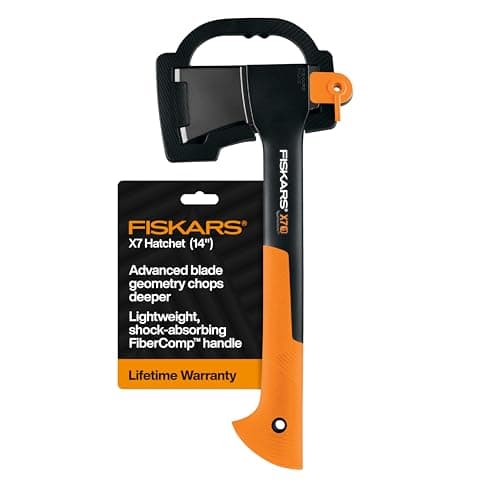
X7 Small Hatchet
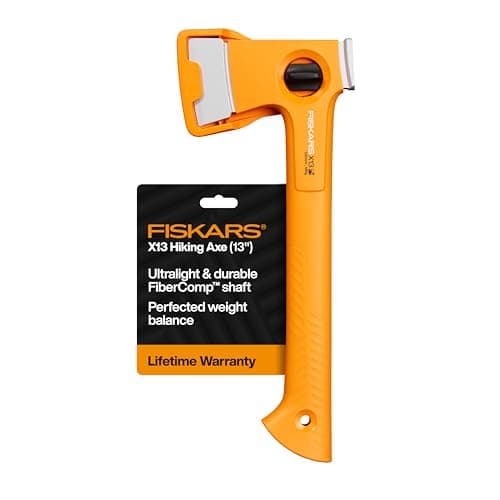
X13 Ultralight Hiking
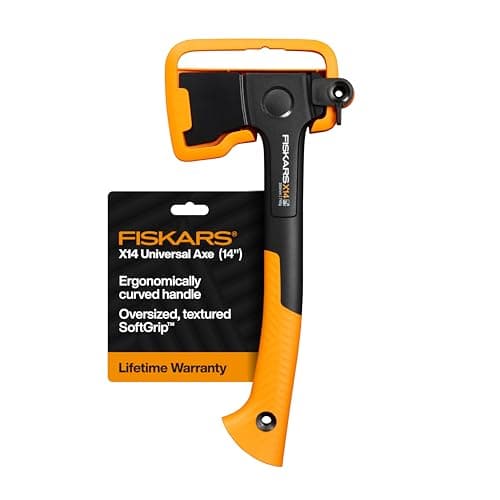
X14 Universal
Overall length
14 in
13 in
14 in
Cutting edge
2.5 in
not published
not published
Hardness
HRC 50-56
not published
not published
Weight
not published
15% lighter than other compact X-series, no figure
not published
Blade grind
deeper cuts
proprietary grind
thin and wide
Intended wood
small to medium kindling
kindling and bushcraft
fresh resinous, spruce and pine
Striking end
no
YES, for tent stakes
no
Handle
hollow FiberComp
FiberComp, high-vis orange
curved FiberComp, SoftGrip
Sheath
included
included, belt loop and lock
included
Figures as published by Fiskars on 2026-10-25. The X7 figures come from Fiskars' own product page; the X13 and X14 from their current listings, which publish markedly less.
That table is the most useful thing on this page, and the blanks are the point. Fiskars publishes no weight for any of the three. It publishes a cutting-edge length and a hardness for the X7 and for neither of the others. So the two newer models cannot be compared against each other, against the X7, or against any competitor on the two specifications that actually describe an axe head.
We are not going to fill those cells. An axe is a simple enough object that the absence is conspicuous rather than excusable, and a number we invented would be worse than a blank.
Same length, different grind
With the handles within an inch of each other, the blade geometry is doing all the differentiating, and Fiskars describes it plainly if you read the listings side by side.
The X7 cuts deeper. A stouter wedge drives further into hard, dry, seasoned wood and splits it apart. That is the firewood case.
The X14 is thin and wide. That slices cleanly through soft, wet, sappy growth instead of compressing it. That is the limbing case, and Fiskars names spruce and pine specifically.
The X13 is the compromise, made lighter. Fiskars describes it for kindling and bushcraft and puts the emphasis on weight and carryability rather than on what it cuts best.
If that sounds like a small distinction, it is the same distinction as a splitting maul against a felling axe, scaled down. Geometry decides whether a blade wedges or slices, and the right one for your wood matters more than fifteen percent of a weight nobody published.
The striking end is the only feature here you cannot replicate
The X13 is the one axe of the three with a face Fiskars intends you to strike with, and that is worth more at a campsite than it sounds: it replaces the mallet you would otherwise carry for driving stakes into hard ground. On the X7 and X14 there is no such face, and hammering with the poll of an axe that is not designed for it is how you deform a head or split a handle at the eye. If you were going to buy a mallet anyway, the X13 is cheaper than the pair.
Does any of this belong in a backpack?
Fiskars markets the X13 for hiking and backpacking, and that is the brand talking rather than us. The position on this site has not changed: most campers should carry a saw or nothing at all. A folding saw cuts faster, cuts safer, weighs less and makes far less noise, and the firewood rules in much of North America mean you are buying wood at the gate rather than cutting it anyway.
Where the X13 earns a place in a pack is the narrower case: you already know you want an axe, you are going somewhere gathering is permitted, and you want the lightest competent one with a stake striker on the back. That is a real buyer. It is just a much smaller group than the marketing implies.
When you actually want a longer handle
All three of these are one-handed tools, and a 13 or 14 in handle caps how much force you can put behind the head regardless of grind. Fiskars sells the X11 at 17 in and the X15 at 24 in for exactly that reason, and the step up in leverage is far larger than anything separating the three axes on this page.
If you are splitting rounds rather than making kindling, none of these is the tool, and the handle-length argument is worked through properly in best camp axes and hatchets. The honest summary is that a hatchet makes kindling from split wood, and nothing more.
Which to buy
Buy the X7 unless one of the other two solves a problem you actually have. It is the only one you can compare on paper, it is ground for seasoned firewood, and it carries a lifetime warranty.
Buy the X13 if weight matters or if you want the stake striker, and accept that you are buying on a relative weight claim rather than a number. Buy the X14 if you are genuinely cutting green spruce and pine, and skip it otherwise — a thin wide edge in a knot is how edges roll.
And before any of them, check what you are allowed to do. Many campgrounds prohibit cutting standing trees entirely and most of North America restricts moving firewood between areas, which is covered in how to choose a camp saw or axe. Keeping the edge usable afterwards is in how to sharpen a knife at camp.
The picks in full
1. The X7
Fiskars X7 Hatchet, 14 in.
Fiskars
14 in with a 2.5 in cutting edge at HRC 50-56, ground for deeper cuts into small and medium kindling, with a lifetime warranty.
Fiskars publishes a 14 in overall length, a 2.5 in cutting edge, a forged carbon steel head insert-molded into the handle, a hardness of HRC 50-56, a hollow shock-absorbing FiberComp handle, an included sheath and a lifetime warranty. The listing describes it as chopping small to medium kindling with deeper cuts.
The X7 is the only one of the three for which Fiskars publishes an edge length and a hardness figure, and that is reason enough to make it the default. You can compare it to other brands on paper; the X13 and X14 you cannot.
It is also the model this site already recommends as the best camp axe overall, for the reasons set out in best camp axes and hatchets — which is the page to read if you have not yet decided that an axe is the tool you need at all.
The drawback
No striking face, so it is the wrong tool for tent stakes, and the deeper-cutting grind is the one most likely to bury itself in green wood and stick.
Published specs
Overall length
14 in
Cutting edge
2.5 in
Head
forged carbon steel, insert-molded into the handle
13 in, published as 15% lighter than the other compact X-series axes, in high-visibility orange, with a striking end meant for tent stakes.
Fiskars publishes a 13 in length, a design 15% lighter than other compact X-series axes, a double-hardened forged steel head insert-molded into the handle, a proprietary blade grind with a low-friction anti-rust coating, a high-visibility orange FiberComp handle, a striking end for driving tent stakes, a sheath with a belt loop and a locking mechanism, and an intended use of hiking, backpacking and camping.
Two of those are genuinely useful and one is marketing. The striking end is the real feature: it is the only one of the three with a face Fiskars intends you to hit things with, which turns the axe into the mallet you would otherwise be buying separately for stakes in hard ground. High-visibility orange is the other, and it is not a gimmick on a tool you put down in leaf litter.
The 15% is the marketing. Fifteen percent lighter than what, exactly? Fiskars does not publish a weight for this axe or for the models it is being compared against, so the claim cannot be checked or converted into ounces. Treat it as “the lightest of the three” and nothing more precise.
The drawback
Fiskars publishes no absolute weight for it, only that 15% claim against an unnamed baseline, and no cutting-edge length or hardness at all. The shortest handle here is also the least leverage.
Published specs
Overall length
13 in
Maker's weight claim
15% lighter than other compact X-series axes; no absolute weight is published
Head
double-hardened forged steel, insert-molded into the handle
Blade
proprietary grind, low-friction anti-rust coating
Handle
FiberComp, high-visibility orange
Striking end
yes, for driving tent stakes
Sheath
included, with a belt loop and a locking mechanism
Intended use
hiking, backpacking and camping, per Fiskars
Note
no cutting-edge length and no hardness figure are published for this model
14 in with a thin, wide blade Fiskars grinds for clean cuts in fresh spruce and pine, on a curved SoftGrip handle, usually the cheapest of the three.
Fiskars publishes a 14 in length, a thin wide blade edge ground for clean cuts in fresh resinous wood such as spruce and pine, a balance weighted for limbing, a double-hardened forged steel head insert-molded into the handle, a low-friction coating, a curved shock-absorbing FiberComp handle with a textured SoftGrip zone and overstrike protection, and an included sheath.
“Fresh resinous wood” is the phrase that tells you what this axe is for, and it is the opposite of what most campers do. Green spruce and pine are sappy and soft, and a thin wide edge slices them cleanly instead of wedging. Seasoned firewood is hard and dry, and wants the deeper, stouter grind of the X7.
So the X14 is the right answer if you are limbing branches on your own land or clearing fresh growth. It is the wrong answer if the job is splitting the bundle of seasoned firewood you bought at the campground gate — which, under the firewood rules, is what the job usually is.
The drawback
Fiskars publishes no weight, edge length or hardness for it either. A thin wide edge is also the one most likely to roll or chip if you drive it into a knot or hit a stone.
QWhat is the difference between the Fiskars X7 and X14?
Blade grind, not size - both are 14 inches. Fiskars grinds the X7 for deeper cuts into small and medium kindling, which suits dry seasoned firewood, and grinds the X14 thin and wide for clean cuts in fresh resinous wood like spruce and pine, which suits limbing green growth. Neither has a striking end.
QIs the Fiskars X13 lighter than the X7?
Fiskars says it is 15% lighter than other compact X-series axes, but publishes no absolute weight for the X13, the X7 or the X14. So the X13 is the lightest of the three, and that is as precise as the published data allows anyone to be.
QWhich Fiskars axe can drive tent stakes?
Only the X13. It is the one model of the three with a striking end that Fiskars intends for driving tent stakes. The X7 and X14 have no striking face, and hammering with the poll of an axe not designed for it risks deforming the head or splitting the handle at the eye.
QWhich Fiskars axe is best for camping?
The X7 for most people. It is the only one of the three with a published cutting-edge length and hardness figure, so it can be compared against other brands, and its deeper-cutting grind matches the seasoned firewood most campers buy at the campground gate.
QDo you need an axe for camping at all?
Usually not. A folding saw is faster, safer, lighter and quieter for the same jobs, and firewood rules across much of North America mean you buy wood where you burn it rather than cutting it. An axe earns its place mainly for splitting bought wood into kindling.
QWhat about the Fiskars X11 and X15?
They are longer tools for a different job: the X11 is 17 inches and the X15 is 24 inches, and the extra handle is leverage for splitting rounds rather than making kindling. The three axes on this page are all one-handed 13 to 14 inch tools, which caps the force behind the head whatever the grind.
How we picked
Everyone else in this category will tell you they tested twenty of these. We have not tested any of them, and we would rather say so than pretend. There is no gear closet here and no test lab.
What we did instead: pulled the published specifications from each manufacturer's own spec sheet or manual, named the standard behind every rating so you can check what it actually promises, did the arithmetic that turns a spec into a decision, and pulled today's real retail price rather than quoting one from memory. Every pick states a drawback, because a list where nothing is wrong with anything is an advert.
The limits of that method, stated plainly: published specs do not capture zipper quality, seam durability, or how a tent behaves at 2am in a storm. Where that matters, we say so on the pick. The full method is here.