The Best Tent Stakes for Sand and Hard Ground, and Why the Ones in the Box Fail
Stakes are the cheapest part of a tent and the part that fails first. They also fail in two opposite ways, and the stake that fixes one makes the other worse.
Soft ground fails by pull-out: there is nothing for a narrow stake to grip, so it slides out under load. Hard ground fails by refusal: the stake will not go in, and you bend it trying. Surface area fixes the first, material strength fixes the second, and no single stake does both well.
This is why the pegs in the box disappoint on both. A thin pressed-aluminum pin has neither the surface area for sand nor the stiffness for gravel, and it is the cheapest component of a tent for exactly that reason. Replacing them is the least expensive meaningful upgrade in camping, and the one most likely to save a pitch in wind — how to pitch a tent in wind.
What to look for
Ground
What fails
What fixes it
Shape to buy
Loose sand, dunes, beach
pull-out under load
surface area
broad plate, or a deadman
Snow
pull-out, then melt-out
surface area plus burial
broad plate, buried sideways
Normal soil, grass, roots
rotation and walking out
cross-section shape
Y-beam
Baked clay, gravel, compacted pads
the stake bends before it enters
material strength
steel pin, milled point
Rocky ground with buried stone
bending, or no penetration at all
strength plus a mallet
steel, and move if it stops
Matching the failure mode to the stake, rather than buying one type for everything.
Length matters alongside shape. A longer stake reaches soil that has not been disturbed or dried out, which is why the sand stake here is 9.5 in and the steel one is 10 in against the Groundhog's 7.5. In loose or baked ground, depth is holding power.
Compared on published numbers
Stake
Length
Weight per stake
Material
Best ground
Kit
MSR Groundhog
7.5 in / 19 cm
13.95 g / about 0.49 oz
7000-series aluminum
normal soil, grass, roots
6
MSR Blizzard
9.5 in / 24 cm
27 g / 0.95 oz
7000-series aluminum
sand and snow
4
Eurmax galvanized steel
10 in
not published
galvanized steel
hard, compacted, rocky
10, with ropes
Figures as published by MSR and Eurmax. Eurmax does not publish a weight per stake, so we have left it blank.
Note the weight spread between the two MSR stakes: the sand stake is nearly double the Groundhog for one third more length. That extra mass is the broad profile, and it is the specification doing the work.
The deadman anchor beats every stake in sand
In genuinely loose sand or deep snow, stop trying to drive anything downward. Dig a trench, lay the stake horizontally across it with the guyline tied to its middle, bury it and pack the material down hard on top. You are now pulling against the weight of everything above it rather than against friction on a thin shaft, and it holds dramatically better. A stuff sack filled with sand, or a buried log, works on exactly the same principle if you have no stakes at all — which is the trick worth knowing on a beach camping trip.
Angle and technique, which are free
Two habits get more holding power out of any stake than upgrading it does.
Angle the stake away from the tent, roughly 45 degrees to the ground, with the guyline pulling against the buried length rather than levering the head up. Driving a stake straight down is the single most common pitching error.
Use every guyout point, not just the corners. Load spread across eight points is load no single stake has to carry — and the shape argument for why that matters is in tent poles and stakes explained.
On hard ground, carry something to drive with. A rubber or steel mallet with a stake puller is the difference between staking a gravel pad and giving up on it, and the puller end saves both your fingers and the stakes at the end of the trip. Never use a rock: it mushrooms the head and bends the shaft.
What the specifications do not tell you
Nobody publishes a holding-force figure, because it would depend entirely on the soil. There is no standard test, so any “holds up to X pounds” claim you see is a marketing number rather than a measurement. Length, cross-section and material are the honest proxies, which is why those are the columns in the table above.
Eurmax does not publish a weight per stake for the 10-pack, and we are not going to weigh a photograph. Assume steel is several times the mass of aluminum and plan accordingly: a set of ten is a car-camping item, full stop.
What to buy with them
Spare guyline, because the cord supplied with most tents is thin and hard to see. Fifty feet of guyline costs very little and lets you use the guyout points your tent already has. Reflective cord is worth the small premium purely for not tripping over it after dark — campsite lighting covers the other half of that problem.
Which to buy
Buy the MSR Groundhogs if you buy one set. They are the right answer at the campgrounds most people actually use, and they are light enough to carry.
Add the Blizzards only if you camp on sand or snow, where nothing narrow works. Add the steel pegs if your sites are compacted gravel pads, baked clay, or if you are also staking a canopy or a tarp, where higher loads and zero weight penalty both point at steel.
The honest setup for a household that camps in varied places is a set of Groundhogs in the tent bag permanently, plus four steel pegs and a mallet living in the car for the sites that need them. The tents those stakes are holding down are in best car camping tents and best tents for windy conditions.
The picks in full
1. Best overall
MSR Groundhog Tent Stakes
MSR
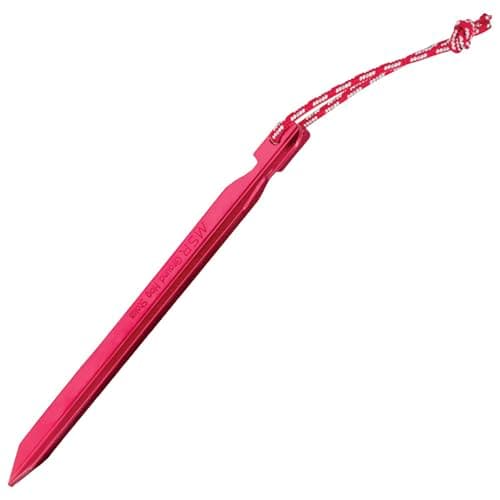
A 7.5 in Y-beam in 7000-series aluminum at 13.95 g per stake, with a reflective pull loop.
MSR publishes a 7.5 in / 19 cm length, a 13.95 g (about 0.49 oz) weight per stake, 7000-series aluminum construction, a Y-beam design and a reflective pull loop, sold in kits of six.
The Y-beam is the reason this is the default. Three fins meeting at a spine give the stake far more surface bearing against the soil than a round pin of the same weight, so it resists being pulled sideways by a guyline rather than levering out. A round pin rotates and walks; a Y-beam does not.
The reflective loop sounds like a gimmick and is the thing you appreciate at 6am when you are trying to find eight stakes in wet grass before driving home.
The drawback
The Y-beam is the wrong shape for both extremes. In loose sand it pulls straight out, and in truly rocky ground the aluminum will bend before it goes in.
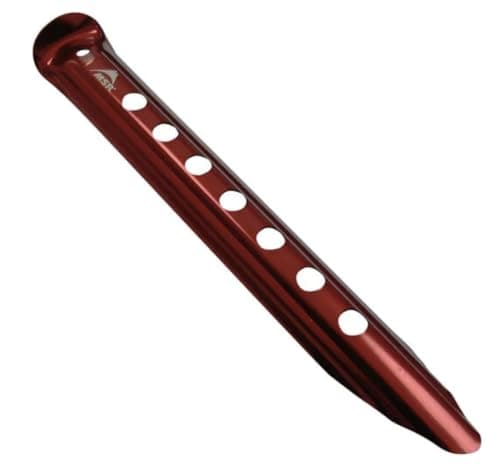
A broad 9.5 in aluminum plate at 27 g per stake, usable upright or buried sideways as a deadman.
MSR publishes a 9.5 in / 24 cm length, a 27 g / 0.95 oz weight per stake, 7000-series aluminum, a broad profile, kits of four, and use either vertically or buried horizontally as a deadman anchor. It is specifically intended for sand and snow.
Surface area is the whole idea. Loose material has no structure to grip a narrow stake, so holding power comes from how much of it you are pushing against. A wide plate does that; a pin does not, which is why standard stakes slide out of a beach under almost no load.
The deadman use is the part most people miss. Buried horizontally with the guyline tied to its middle and the sand packed back on top, it holds far better than anything driven vertically into the same ground.
The drawback
Nearly twice the weight of a Groundhog and much bulkier, and in firm soil the broad profile is harder to drive than a narrow stake.
Published specs
Length
9.5 in / 24 cm
Weight per stake
27 g / 0.95 oz
Material
7000-series aluminum
Profile
broad, for soft ground
Use
vertical, or buried horizontally as a deadman anchor
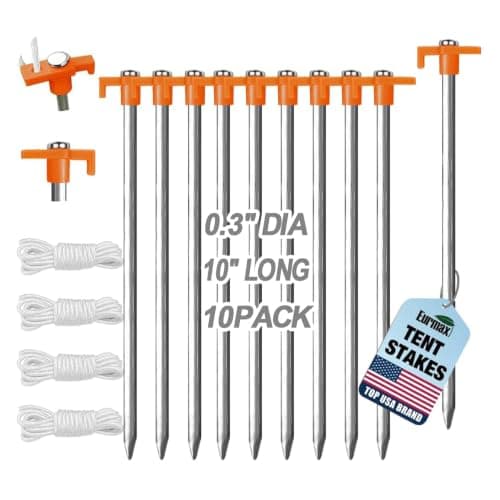
A 10 in galvanized steel peg with a milled point and a hook head, in a 10-pack with guylines.
Eurmax publishes a 10 in length, galvanized steel construction, milled points for hard soil, a hook head with a rope eyelet, and a 10-pack that includes four 10 ft ropes and a stopper. A weight per stake is not published.
Steel is the answer to hard ground for a simple reason: aluminum bends at the point where steel keeps going. On a compacted gravel campground pad, an aluminum stake folds against the first buried rock, while a steel pin either drives past it or tells you to move six inches left.
These also suit canopies and tarps, where the loads are higher and the weight penalty is irrelevant because the whole setup arrived in a car.
The drawback
Steel is heavy and these are not a backpacking item. The hook head also does not hold a guyline as securely as a proper loop, so cord can jump off in wind.
Broad-profile stakes, or any stake buried horizontally as a deadman. MSR's Blizzard publishes a 9.5 in length and a wide plate at 27 g per stake specifically for sand and snow. Narrow pins fail in loose material because holding power there comes from surface area, not friction on a thin shaft.
QWhat tent stakes work in hard rocky ground?
Steel, with a milled point. Aluminum bends against buried stone where steel drives past it or stops cleanly. Eurmax's galvanized steel pegs publish a 10 in length and a milled point for hard soil. Carry a mallet too, and move the stake if it stops dead rather than bending it.
QAre the stakes that come with a tent any good?
Rarely. Thin pressed-aluminum pins have neither the surface area for soft ground nor the stiffness for hard ground, and they are the cheapest component of the tent. Replacing them is the least expensive meaningful upgrade in camping.
QWhat angle should you drive a tent stake?
Roughly 45 degrees, leaning away from the tent, so the guyline pulls against the buried length rather than levering the head out. Driving straight down is the most common pitching mistake and costs more holding power than any stake upgrade returns.
QHow much holding power does a tent stake have?
Nobody can say honestly. There is no standard test and it depends entirely on the soil, so any specific pounds-of-force claim is marketing rather than measurement. Length, cross-section shape and material are the honest things to compare.
How we picked
Everyone else in this category will tell you they tested twenty of these. We have not tested any of them, and we would rather say so than pretend. There is no gear closet here and no test lab.
What we did instead: pulled the published specifications from each manufacturer's own spec sheet or manual, named the standard behind every rating so you can check what it actually promises, did the arithmetic that turns a spec into a decision, and pulled today's real retail price rather than quoting one from memory. Every pick states a drawback, because a list where nothing is wrong with anything is an advert.
The limits of that method, stated plainly: published specs do not capture zipper quality, seam durability, or how a tent behaves at 2am in a storm. Where that matters, we say so on the pick. The full method is here.