The Best Heated Vests for Winter Camping, and the Battery Math Nobody Mentions
A heated vest is a battery you wear. Treat it as insulation and it will disappoint you; treat it as a few hours of standing-still warmth you can switch on at the coldest part of the evening, and it is the best thing in a winter camp kit.
Trail & Tarp earns a commission from qualifying purchases made through links on this page, at no extra cost to you. Full disclosure.
Quick picks
#
Product
Best for
Price
1
Best overall
ORORO Men's Heated Puffer Vest
Four carbon-fiber heating zones, a 35.4 Wh UL-certified battery good for up to 10 hours on low, inside a water- and wind-resistant insulated nylon shell.
A vest that is still warm with the heat off, worn as the outer layer at a cold campsite
A heated vest earns its place in the hours you are standing still in the cold — cooking, sitting at the fire, watching children, setting up in the dark. It is the wrong tool for hiking, where your own body produces more heat than any battery, and it is not a substitute for insulation, because the battery runs out and the garment does not stop being your outer layer.
That is the whole frame. The failure case for heated apparel is somebody buying it to replace a winter jacket and discovering that three hours on high is three hours. The success case is somebody who already has their layers sorted and wants to beat the specific misery of being stationary at 25 F while dinner cooks.
Compared on published numbers
Vest
Zones
Battery
Runtime
Shell
Wash
ORORO Heated Puffer Vest
4, carbon fiber
35.4 Wh, UL, 800+ cycles
up to 10 h on low
insulated nylon, water- and wind-resistant
50+ cycles
Venustas Women's Heated Vest
6, incl. shoulders
36 Wh
10 h low / 6 h medium / 3 h high
quilted, water-resistant, mylar liner
machine washable
ORORO Heated Fleece Vest
4
35.4 Wh, UL
up to 8 h
fleece, no wind or water claim
50+ cycles
ORORO MINI 5K battery
n/a
4,800 mAh, 800 cycles
doubles whatever vest it feeds
n/a
n/a
Figures as published by each maker on 2026-10-17. Only Venustas publishes a runtime for every heat setting; the ORORO figures are its low-setting maximum.
Two findings fall straight out of that table. The two vests with near-identical batteries (35.4 Wh and 36 Wh) differ by two hours on low purely because of what their shells do with the heat. And every maker's headline runtime is its lowest setting — the number that matters for a cold evening is Venustas's three hours on high, which is the only one published.
The watt-hour figure is the one spec worth reading
Battery capacity in watt-hours is the only number on a heated garment that is directly comparable across brands, because it is energy rather than marketing. A 35.4 Wh pack holds 35.4 watt-hours whatever the garment around it claims. If a vest publishes only milliamp-hours with no voltage, you cannot convert it and cannot compare it — which is itself a reason to be cautious.
Watt-hours are also what let you plan around a camp power supply. All four products here sit between 35 and 36 Wh, so a modest power bank recharges a vest battery more than once, and a power station will do it many times over. The same unit of measurement runs through power banks vs power stations.
Heated is not the same as insulated, and the difference shows up at 2am
Heating elements need power. Insulation needs nothing. A down or synthetic jacket keeps working while you sleep, in a storm, on day three, with a dead phone and a dead car battery. A heated vest is an active device with a runtime, and a winter kit built around one is a kit with a single point of failure. Buy the insulated jacket first and the heated vest second, never the other way around. For sleeping warmth, battery heat is not part of the answer at all — how to build a camping sleep system explains what is.
Sizing, and why this is a bad blind gift
Every vest on this page is sold per size and color, and a heated garment has to fit closely for the heating panels to sit against you — a vest two sizes too big holds the elements away from your back, which is exactly where you wanted them. There is no “runs generous, order down” shortcut available here because none of these makers publishes a fit standard.
If you are buying for somebody else this December, buy the battery, buy a hand warmer, or buy something from camping gifts under $50 instead, and let them pick their own size. A returned heated vest is a worse gift than a smaller thing that fits.
Washing it without destroying it
Both ORORO vests are rated for 50-plus machine wash cycles and the Venustas is described as washer-safe. In all three cases the instruction is the same and non-negotiable: take the battery out first. Beyond that, treat them like any technical layer — cool wash, no fabric softener, no dry cleaning. The procedure for the rest of your shells is in how to wash and reproof a rain jacket.
What to buy
Buy the ORORO Heated Puffer Vest if the vest is going to be your outer layer at camp and you want it to still be useful at hour eleven. Buy the Venustas Women's Heated Vest for the widest heat coverage and the only honestly published high-setting runtime. Buy the ORORO Heated Fleece Vest if you already own a good shell and want the heat underneath it.
Whichever you pick, buy the spare battery with it or plan to charge in the car. A heated vest with one pack is a three-hour product on the setting you will actually use.
The picks in full
1. Best overall
ORORO Men's Heated Puffer Vest
ORORO
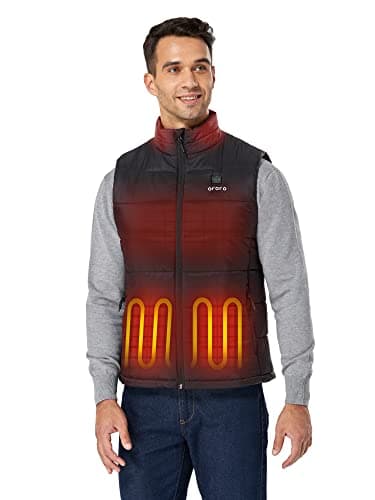
Four carbon-fiber heating zones, a 35.4 Wh UL-certified battery good for up to 10 hours on low, inside a water- and wind-resistant insulated nylon shell.
ORORO publishes four carbon-fiber heating zones at the collar, mid-back and both hand pockets, three one-button heat settings, a 7.38 V 4,800 mAh (35.4 Wh) UL-certified battery rated to 800-plus charge cycles, up to 10 hours of runtime on low, a USB port on the battery that charges a phone, a water- and wind-resistant nylon shell with light insulation, and a heating system rated for 50-plus machine wash cycles with the battery removed.
The insulation is the reason this is the pick. Every heated garment eventually runs the battery down, and what you are left standing in at that moment is the difference between a good one and a gadget. A flat fleece vest is a flat fleece vest; a flat puffer vest is still a puffer vest. For camping specifically, where the battery will not last the whole trip, that matters more than the heating spec.
Wind resistance is the other camping-relevant difference. A heating element warms the air next to your skin, and wind removes exactly that air. A shell that stops the wind is what lets the heat stay where you paid to put it.
The drawback
It is the most expensive vest here and the insulation that makes it good with the heat off also makes it bulky under a shell. Sold per size and color, so it is a poor blind gift.
Published specs
Heating zones
4 carbon fiber: collar, mid-back, both pockets
Settings
3, one-button
Battery
7.38 V, 4,800 mAh (35.4 Wh), UL certified, 800+ cycles
Runtime
up to 10 h on low
Shell
nylon, water- and wind-resistant, light insulation
Extra
USB port on the battery charges a phone
Care
rated for 50+ machine wash cycles; remove battery first
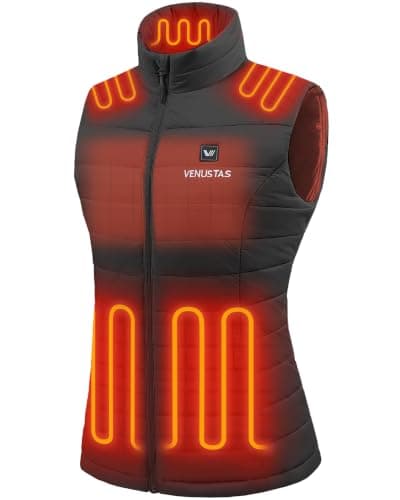
Six heating zones including shoulders, a 36 Wh battery published at 10 hours on low, 6 on medium and 3 on high, and a 2.5-hour recharge.
Venustas publishes six heating zones — collar, back, both shoulders and underneath both hand pockets — three settings, a 36 Wh battery, runtimes of 10 hours on low, 6 on medium and 3 on high, a 2.5-hour recharge, a water-resistant quilted shell with a silver mylar liner, and a USB port for charging a phone. The box contains the vest, battery and a carry bag; the charger is not included.
Six zones versus four is a real difference in feel rather than a spec-sheet one. Shoulder panels put heat where a pack strap or a chair back takes it away, and spreading the same wattage over more area means a lower surface temperature for the same comfort.
Publishing all three runtimes is also worth crediting. Everyone quotes the low-setting figure in the headline; Venustas is the only maker here that prints what you get on high, and three hours is the honest number to plan an evening around.
The drawback
Venustas publishes 3 hours on high, which is the setting you will want when it is actually cold. The charger is not in the box, which is a genuine irritation on a product that needs charging.
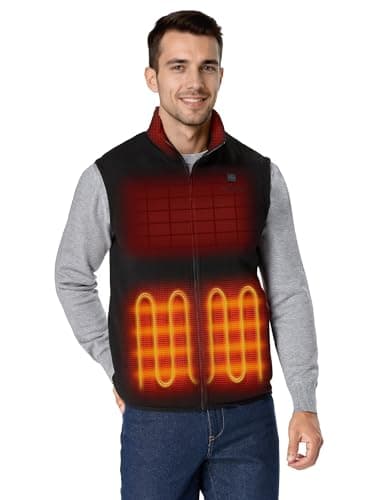
Four heating zones on the same 35.4 Wh UL battery, up to 8 hours, in a soft fleece with nothing to make it bulky.
ORORO publishes four heating zones at the neck, back and both pockets, the same 7.38 V 4,800 mAh (35.4 Wh) UL-certified battery, up to 8 hours of runtime, a fleece construction with no wind or water resistance claimed, and 50-plus machine wash cycles with the battery out.
Same battery, less runtime, and the reason is instructive: insulation does not create heat, it slows the loss of it. The fleece loses heat faster than the puffer, so the same 35.4 Wh buys two fewer hours. That one comparison is the clearest demonstration on this page that a heated garment is a heat-retention product first and an electrical one second.
Where it wins is layering. If you already own a good insulated jacket or a hard shell, a slim heated fleece slides underneath it and makes that jacket into a winter jacket. Buying the puffer version instead means owning two bulky outer layers.
The drawback
No wind or water resistance is claimed, so it needs a shell over it outdoors, and with the heat off it is just a fleece vest. Eight hours against the puffer's ten, from the same battery, because there is less insulation holding the heat in.
Published specs
Heating zones
4: neck, back and both pockets
Battery
7.38 V, 4,800 mAh (35.4 Wh), UL certified
Runtime
up to 8 h
Shell
fleece; no wind or water resistance claimed
Care
rated for 50+ machine wash cycles; remove battery first
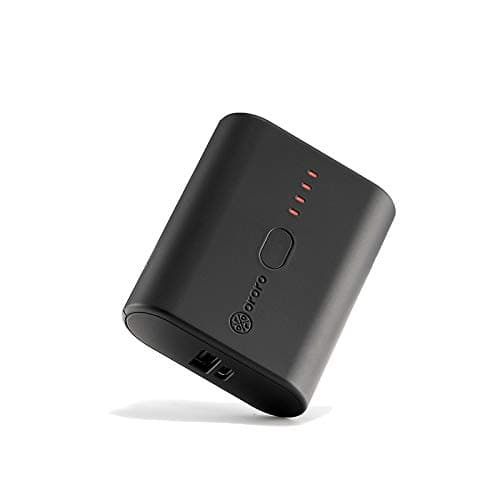
A 4,800 mAh ORORO-compatible battery, 40% smaller than the standard pack, rated to 800 recharges, with a USB-A output.
ORORO publishes 4,800 mAh, a 4-hour recharge with a 5 V 3 A charger, a body 40% smaller than its standard battery, a USB-A output that charges a phone while you wear it, 800 rated recharge cycles, and UL and CE certification. The charger and cord are not in the box.
We are naming a battery as a pick because the limiting factor on every vest here is the battery, not the garment. A second pack is the difference between heat on Friday evening and heat on Friday and Saturday evening, and it is cheaper than the vest.
The alternative is charging in the car or off a power station, which works and is what most people will do. What size power station do I need has the watt-hour arithmetic: a 35.4 Wh vest battery is a rounding error against a camp power station, so a station you already own makes the spare pack optional.
The drawback
It is a battery at a serious price, the charger and cord are not included, and it only fits ORORO apparel — a Venustas vest needs a Venustas pack.
For the stationary hours, yes. Cooking, sitting at a fire and setting up in the dark are when you lose heat fastest and generate the least, and that is exactly the window a 3-to-10 hour battery covers. They are not worth it for hiking, where your own output exceeds anything a battery provides, and they do not replace insulation.
QHow long does a heated vest battery last?
On published figures, 8 to 10 hours on the lowest setting. Venustas is the only maker here that publishes the full set: 10 hours on low, 6 on medium and 3 on high from its 36 Wh pack. Plan a cold evening around the high-setting figure, not the headline one.
QCan you charge a heated vest battery while camping?
Yes. The vest batteries here are 35 to 36 watt-hours, so a mid-size power bank will refill one more than once and a camp power station will do it many times. The vehicle's USB socket also works. A spare battery is the alternative, and it is cheaper than a second vest.
QCan you wash a heated vest?
Yes, with the battery removed. ORORO rates both vests here for 50-plus machine wash cycles and Venustas describes its vest as washer-safe. Cool wash, no fabric softener, no dry cleaning, and let it air dry.
QHeated vest or insulated jacket for winter camping?
Insulated jacket first, every time. It works with no power, in any weather, for the whole trip. A heated vest is a worthwhile addition for the stationary hours once your passive layers are sorted, and a poor foundation on its own because it has a runtime.
How we picked
Everyone else in this category will tell you they tested twenty of these. We have not tested any of them, and we would rather say so than pretend. There is no gear closet here and no test lab.
What we did instead: pulled the published specifications from each manufacturer's own spec sheet or manual, named the standard behind every rating so you can check what it actually promises, did the arithmetic that turns a spec into a decision, and pulled today's real retail price rather than quoting one from memory. Every pick states a drawback, because a list where nothing is wrong with anything is an advert.
The limits of that method, stated plainly: published specs do not capture zipper quality, seam durability, or how a tent behaves at 2am in a storm. Where that matters, we say so on the pick. The full method is here.