The Best Coolers for a Week-Long Trip, Where Ice Retention Actually Matters
For a weekend, any cooler works. Past about four days the differences between them stop being theoretical, and how you pack matters as much as what you bought.
On a weekend, a cheap cooler with enough ice works fine. Past about four days, wall thickness, lid sealing and how you pack start deciding whether your food is safe. The single biggest gain is not a better cooler — it is running two of them.
Every time a lid opens, cold air falls out and warm air replaces it. On a long trip the drinks cooler gets opened thirty times a day and the food cooler needs to stay shut. One box cannot do both jobs, and separating them buys more retention than upgrading brands does.
What to look for
Specification
What to want on a long trip
Why
Construction
rotomolded, or thick-walled with a gasket
wall thickness is most of the retention difference
Published ice capacity
stated in pounds
lets you plan the 2:1 ratio honestly
Lid seal
a gasket and latches, not a resting lid
air exchange is how cold escapes
Drain
a plug you can open without tipping it
you will drain meltwater repeatedly
Certification
IGBC, if bears are a possibility
some areas require a certified container
Weight empty
as low as you can accept
it is the part you carry before any food goes in
What matters when the trip is long enough for the differences to show.
Note what is not on that list: any manufacturer's days-of-ice claim. There is no standard test, the protocols differ by brand, and the numbers are not comparable — which is the point of how long does ice last in a cooler.
The two-cooler system
Cooler
Contents
Rule
Food cooler
meat, dairy, anything that spoils
opens twice a day, at meal times only
Drinks cooler
drinks, snacks, anything grabbed
opens as often as anyone likes
Optional third
day bag, a soft cooler for the beach or trail
leaves the site without the big boxes
Splitting by opening frequency, not by size.
This costs less than upgrading one cooler two tiers and works better. A cheap second box for drinks protects the expensive one, and the soft cooler role is covered in best soft coolers for camping.
Packing is worth more days than the brand is
Pre-chill the empty cooler overnight with a sacrificial bag of ice. Use roughly two parts ice to one part contents by volume — YETI's own 28-can figure at 2:1 is them saying the same thing. Prefer block ice, which melts far slower than cubes, and fill every air gap, because air is what warms. Then keep it in shade, leave the meltwater in until you need the space, and open it as rarely as you can. Doing all of that with a mid-price cooler beats a premium one packed carelessly. The routine is in how to keep food cold camping.
Sizing for a week
Work backward from the ice. If half the volume is ice, a 45-quart-class cooler holds about 22 quarts of food, which YETI expresses as 28 cans. For two people over a week that is workable with a resupply; for a family it is not.
For four people over seven days, plan on a 65 to 70 quart food cooler plus a separate drinks box, and expect the loaded weight to need wheels or two people. If that sounds like too much, the honest alternative is a 12V fridge, which needs no ice at all and is compared against coolers in cooler vs 12V fridge for camping.
Which to buy
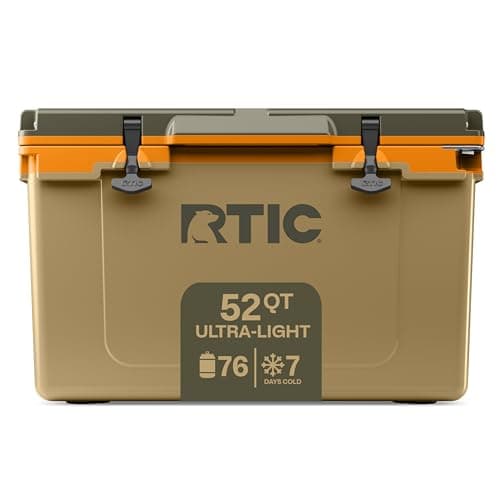
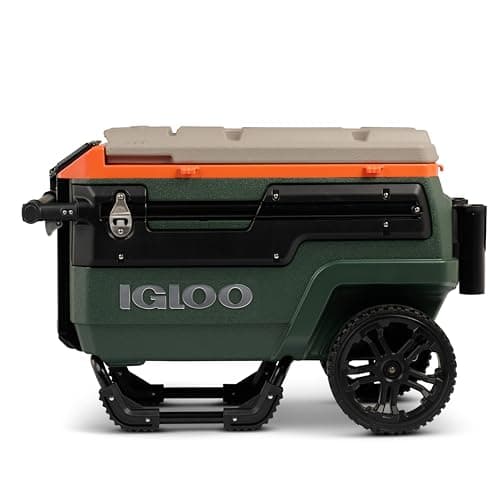
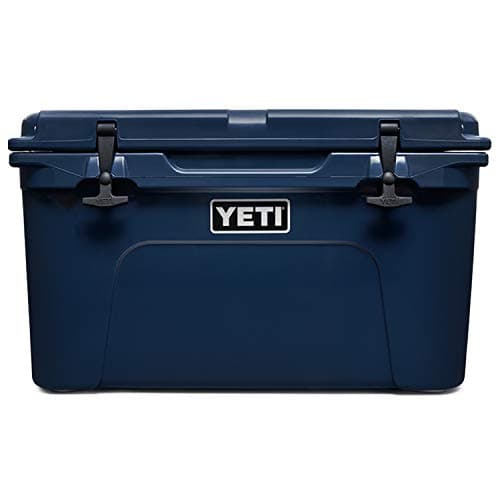
Buy the YETI Tundra 45 if the trip is long, hot and unsupported, or if you need a bear-certified container. Buy the RTIC 52 if you want the same construction argument for less. Buy the Igloo Trailmate if the cooler has to move more than a few yards loaded.
And whichever you buy, buy a cheap second cooler for drinks. It is the highest-value purchase on this page — see best budget coolers.
The picks in full
1. Best overall for long trips
YETI Tundra 45
YETI
37 lb of ice capacity in a rotomolded body, IGBC bear certified, at 24.6 lb empty.
YETI publishes a 54-can capacity or 37 lb of ice, 28 cans when packed at a 2:1 ice ratio, exterior dimensions of 25.6 by 15.9 by 15.5 in, a 24.6 lb empty weight, and rotomolded construction that is IGBC bear certified.
The 2:1 figure is the useful one and YETI publishes it plainly: at the ice ratio a long trip actually requires, a 45-quart-class cooler holds 28 cans of food and drink. Plan around that number, not the 54.
The drawback
Only 54 cans of interior for a 25.6 by 15.9 in footprint, and 24.6 lb before you load it. Thick walls cost you space and back.
A 52 QT rotomolded-class box in RTIC's Ultra-Light line.
RTIC publishes the 52 QT in its Ultra-Light cooler line. The reason it sits here is the same construction argument that justifies the YETI — thick insulated walls, a gasketed lid and heavy latches — at a price closer to the middle of the market.
The brand-level comparison, including where RTIC genuinely differs from YETI, is in YETI vs RTIC coolers.
The drawback
RTIC does not publish an ice-retention figure in days on the page we read, so the comparison with YETI rests on construction rather than a stated number.
70 quarts on all-terrain wheels, so a week of food does not need two people.
A week of food for a family at a 2:1 ice ratio is a genuinely heavy object — a loaded 70-quart cooler can approach 100 lb. At that point the question stops being insulation and starts being whether you can get it from the car to the site at all.
QWhat size cooler do I need for a week of camping?
Plan on half the volume being ice. A 45-quart-class cooler leaves roughly 22 quarts for food, which YETI states as 28 cans at a 2:1 ratio. That suits two people for a week with a resupply; a family of four needs a 65 to 70 quart food cooler plus a separate drinks box.
QDo I need an expensive cooler for a long trip?
Past about four days the construction differences stop being theoretical, so a thick-walled gasketed cooler earns its price. But running two coolers, one for food and one for drinks, buys more retention than upgrading a single box, because it stops the food cooler being opened all day.
QHow much ice do I need for a week-long camping trip?
Roughly two parts ice to one part contents by volume, topped up as it melts. Block ice lasts considerably longer than cubes, and filling air gaps matters because air is what warms the contents. Pre-chill the empty cooler overnight before you load it.
QIs a 12V fridge better than a cooler for a week?
If you have the power for it, yes, because it needs no ice and holds a set temperature. The trade is cost, weight and a continuous draw on your battery. For a week-long trip with a vehicle and a power station, it removes the ice problem entirely.
How we picked
Everyone else in this category will tell you they tested twenty of these. We have not tested any of them, and we would rather say so than pretend. There is no gear closet here and no test lab.
What we did instead: pulled the published specifications from each manufacturer's own spec sheet or manual, named the standard behind every rating so you can check what it actually promises, did the arithmetic that turns a spec into a decision, and pulled today's real retail price rather than quoting one from memory. Every pick states a drawback, because a list where nothing is wrong with anything is an advert.
The limits of that method, stated plainly: published specs do not capture zipper quality, seam durability, or how a tent behaves at 2am in a storm. Where that matters, we say so on the pick. The full method is here.