The Best Ice Packs for Coolers, and the Spec Nobody Tells You to Read
Ice packs are sold on size and bought on faith. The number that actually decides how they behave is the temperature they freeze at, and most brands never print it.
Water ice freezes and melts at 32 F. A gel pack that also freezes near 32 F is doing the same job as ice with less mess and less cooling capacity. A pack engineered to freeze at 18 F, or 5 F, starts colder and has to absorb more heat before it reaches the temperature ice starts at — which is where the longer hold comes from. Most brands never print that number. The ones that do are telling you something.
This is the single most useful thing to understand in the category, and it explains why two ice packs of identical size perform completely differently. It also explains the catch: a sub-freezing pack needs a freezer cold enough to charge it. A home freezer set around 0 F will fully freeze an 18 F pack and may struggle with a 5 F one.
What to look for
Specification
What to want
Why
Freeze point
published, and below 32 F
the only figure that separates a real cold source from a gel brick
Mass
as much as you can fit
cooling capacity scales with mass; a thin pack cannot hold much
Shape
flat for soft coolers, blocks for hard
wasted air around a bad shape is what warms the contents
Shell
hard for durability, film for packing
hard shells survive; film packs conform around food
Refill or sealed
refillable ships dry and cheap
sealed is simpler, refillable is lighter to buy
Leak record
a welded or screw cap you can inspect
a split pack in a cooler ruins the food it was protecting
What to read on an ice pack listing, in rough order of importance.
Compared on published numbers
Pack
Freeze point
Size
Weight
Shell
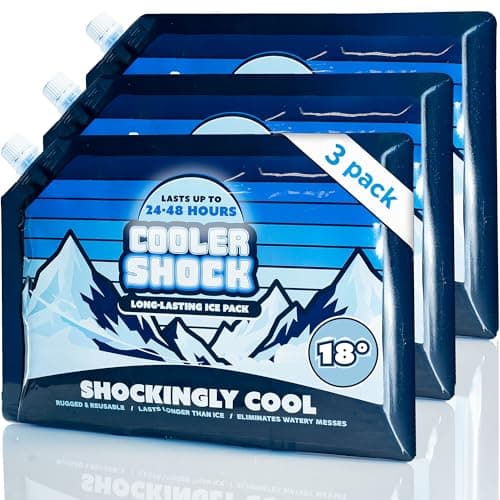
Cooler Shock, large
18 F
10 x 14 in
1.80 lb dry, about 5 lb filled
film, screw cap, fill yourself
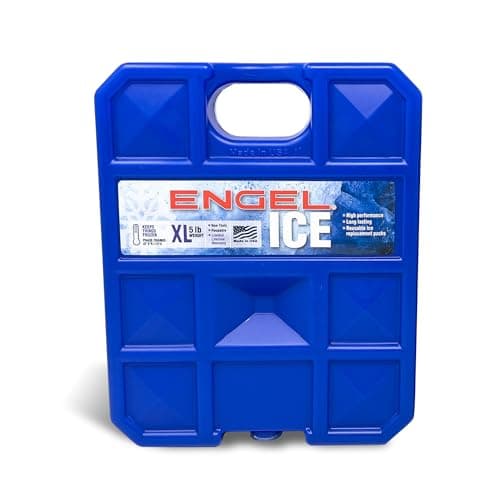
Engel 5F, large
5 F / -15 C
9.5 x 7.5 x 1.25 in
2.5 lb (5 lb in XL)
hard, UV-stabilized
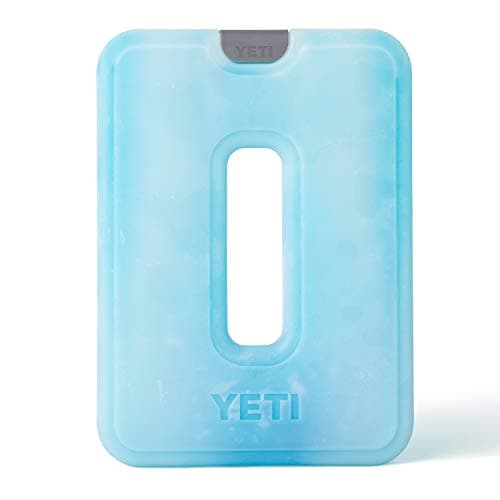
YETI ICE Sheet, large
not published
10 x 7.3 x 0.9 in
not published
hard, flat sheet
Figures as published by each manufacturer or its listing. Blank cells are figures the maker does not publish.
Note how much the YETI row cannot tell you. That is not an accident of our research; the brand simply does not publish a freeze point or a weight for the Sheet, and we are not going to invent either. It is a real product and a good shape, sold on less information than its competitors offer.
Ice packs versus actual ice
Ice packs are not a straight upgrade. They win and lose in specific ways, and the honest setup for most trips uses both.
Ice packs
Block ice
Cubed ice
Cold source below 32 F
yes, if the freeze point says so
no
no
Meltwater
none
some
a lot
Fills gaps around food
poorly
poorly
very well
Drinking water as it melts
no
yes
yes
Reusable
yes, indefinitely
no
no
Cost per trip
near zero after purchase
low
low
Needs planning
yes, 24 h in a freezer
yes, if you freeze your own
no
Our summary of where each cold source wins.
The practical answer: packs on the bottom and against the walls as the structural cold source, then cubed ice poured over the top to fill the air gaps. Air is what warms a cooler, and cubes are the only thing that fills the spaces between packages — the full method is in how to keep food cold camping.
Never put dry ice in a sealed cooler
Dry ice is the obvious-seeming answer to “colder than ice” and it is the one to be careful with. It sublimates into carbon dioxide gas, and in a gasketed cooler with heavy latches that pressure has nowhere to go. Use it only in a cooler that can vent, never in a sealed vehicle cabin, and handle it with gloves because it will burn skin on contact. A 5 F freezer pack gets you a genuine sub-freezing cold source with none of that, which is most of the reason the category exists.
How many you need
Think in mass, not in count. The working target is roughly a 2:1 ratio of cold source to contents by volume, which is the same arithmetic behind YETI's published “28 cans with 2:1 ice” figure for a 45-quart cooler.
For a 45 to 50 quart cooler over a weekend, that is about four large packs plus a bag of cubes for the gaps. For a week, packs alone will not do it and you are into the planning covered in best coolers for a week-long trip. Two coolers still beat one, because every lid opening costs cold — the reasoning is in how long does ice last in a cooler.
The freezer is the limiting factor
Two practical constraints people discover the night before a trip. First, time: a large pack needs a full 24 hours to freeze solid, and a half-frozen pack is a bag of cold water with a small ice core. Second, temperature: your freezer has to be colder than the pack's rated point to charge it properly.
Lay packs flat with space around them rather than stacking them, so air can circulate. And pre-chill the cooler itself the night before with a sacrificial bag of cubes — a warm cooler spends the first hours of a trip stealing cold from whatever you put in it, which is the single most common reason a well-packed box underperforms.
What the specifications do not tell you
Nobody publishes a hold-time figure you can compare. “Stays frozen for 48 hours” depends on the cooler, the ambient temperature, the load and how often the lid opens, and there is no standard test behind any of it — the same problem as cooler ice claims. Freeze point and mass are the honest proxies.
Durability is also unpublished. Film packs like Cooler Shock are lighter and conform to the load; hard shells like Engel's survive being stood on. Neither maker states a lifespan, and we have not tested one, so the shell material is the only guide we can honestly offer.
What to buy with them
A cheap cooler thermometer is the accessory that turns all of this from guesswork into something you can check. Food safety is a temperature question, not a feeling, and knowing whether your cooler is holding below 40 F is worth more than upgrading anything else on this page.
If you are still choosing the box the packs go in, start at best coolers for camping, or cooler vs 12V fridge if you would rather skip the ice problem altogether. A wide-mouth bottle filled two-thirds and frozen is the cheapest ice pack in camping, and it becomes drinking water as it melts.
Which to buy
Buy Cooler Shock if you want the most cooling for the money and do not mind filling them yourself. An 18 F freeze point and about 5 lb of mass per pack is the best combination here for ordinary weekend camping.
Buy the Engel 5 F packs if you need to keep something frozen rather than merely cold, and your freezer is genuinely cold enough to charge them.
Buy the YETI ICE Sheet if the cooler is soft-sided or the space is tight and a thick block would waste more volume than it cools — accepting that you are buying on shape rather than on a published freeze point.
The picks in full
1. Best overall
Cooler Shock Reusable Ice Packs, Large
Cooler Shock
Freezes at 18 F and ships dry at 1.80 lb, so you fill it with water at home and it weighs about 5 lb frozen.
Cooler Shock publishes an 18 F frozen temperature, a large size of 10 by 14 in at a 1.80 lb dry weight, a filled weight of about 5 lb each, and a maker's claim that one pack replaces up to 7 lb of ice. Small (6.5 by 7.5 in, 0.70 lb) and medium (10 by 9 in, 1.20 lb) sizes are also published.
Eighteen degrees is the whole product. Water ice sits at 32 F and holds there while it melts; a pack that freezes fourteen degrees colder has to absorb heat all the way up to 32 F before it even starts behaving like ice. That extra range is where the longer hold comes from.
Shipping dry is the other clever part: you pay to ship plastic and powder rather than water, and the pack becomes 5 lb only once you fill it at home.
The drawback
You have to fill them yourself and get the water level right, and a badly closed screw cap leaks in the freezer. They also need a full 24 hours in a home freezer to freeze solid.
Published specs
Freeze point
18 F once frozen
Size (large)
10 x 14 in
Dry weight (large)
1.80 lb
Filled weight
about 5 lb each
Maker claim
replaces up to 7 lb of ice
Use
fill with water, screw the cap, freeze
Other sizes
small 6.5 x 7.5 in (0.70 lb), medium 10 x 9 in (1.20 lb)
A published 5 F / -15 C freeze point in a hard UV-stabilized shell, in 2.5 lb and 5 lb sizes.
Engel publishes a 5 F / -15 C freeze point, a large pack at 9.5 by 7.5 by 1.25 in and 2.5 lb, an extra-large at 11 by 8.75 by 2 in and 5 lb, a rugged UV-stabilized non-toxic shell, a leak-proof ultrasonic spin-welded cap, dishwasher-safe construction, and US manufacture.
This is the pack to buy if the job is keeping something frozen rather than cold. Meat for the second half of a trip, or a fish you want to bring home, needs a source below 32 F, and water ice by definition cannot provide one.
Engel publishes several freeze points across its range — a 32 F pack and a 28.4 F pack as well as this one — which is unusually transparent for the category and makes the trade explicit rather than hidden.
The drawback
A hard shell wastes space around its edges in a packed cooler, and 5 F needs a freezer that actually reaches it — many home freezers sit closer to 0 to 10 F and some will not fully charge it.
A flat sheet at 10 by 7.3 by 0.9 in, nearly 50 percent slimmer than a standard YETI ICE block.
YETI publishes dimensions of 10 W by 7.3 D by 0.9 H in (25.4 by 18.4 by 2.3 cm), a profile nearly 50 percent slimmer than standard YETI ICE, and a flat shape intended to freeze faster and to fit the brand's soft coolers.
Thinness is a real design argument in a soft cooler, where a chunky block eats the interior you were trying to fill. Against the side wall of a soft cooler a sheet gives you cooling without losing a third of the volume.
We are marking the missing figures plainly rather than guessing them. Without a published freeze point, treat it as a conventional around-32 F pack until YETI says otherwise.
The drawback
YETI does not publish a freeze point or a weight for the Sheet on the listings we read, so you cannot compare it on the one specification that matters most here.
For some jobs. A pack with a published freeze point below 32 F is a colder source than water ice and leaves no meltwater, but it cannot fill the air gaps between packages and you cannot drink it. The best setup is packs against the walls and base as the structural cold, with cubed ice poured over to fill the gaps.
QWhat temperature do ice packs freeze at?
It varies enormously, and that is the specification to compare. Cooler Shock publishes 18 F and Engel publishes 5 F for its coldest freezer packs, while many gel packs freeze near 32 F and so perform much like ordinary ice. Plenty of brands, including YETI on the Ice Sheet, do not publish a figure at all.
QHow many ice packs do I need for a cooler?
Think in mass rather than count, aiming for roughly two parts cold source to one part contents by volume. For a 45 to 50 quart cooler over a weekend that is about four large packs plus a bag of cubes for the gaps. For a week, packs alone will not carry it.
QHow long do ice packs take to freeze?
A large pack needs a full 24 hours to freeze solid, and a partly frozen pack is mostly cold water with a small core. Lay them flat with space around them rather than stacking, and note that a pack rated to 5 F needs a freezer that actually reaches that temperature to charge fully.
QCan you use dry ice in a cooler instead?
Carefully, and never in a sealed one. Dry ice sublimates into carbon dioxide gas, and a gasketed cooler with heavy latches gives that pressure nowhere to go. It also burns skin on contact and should never be used in a closed vehicle cabin. A 5 F freezer pack gives you a sub-freezing source with none of those risks.
How we picked
Everyone else in this category will tell you they tested twenty of these. We have not tested any of them, and we would rather say so than pretend. There is no gear closet here and no test lab.
What we did instead: pulled the published specifications from each manufacturer's own spec sheet or manual, named the standard behind every rating so you can check what it actually promises, did the arithmetic that turns a spec into a decision, and pulled today's real retail price rather than quoting one from memory. Every pick states a drawback, because a list where nothing is wrong with anything is an advert.
The limits of that method, stated plainly: published specs do not capture zipper quality, seam durability, or how a tent behaves at 2am in a storm. Where that matters, we say so on the pick. The full method is here.